
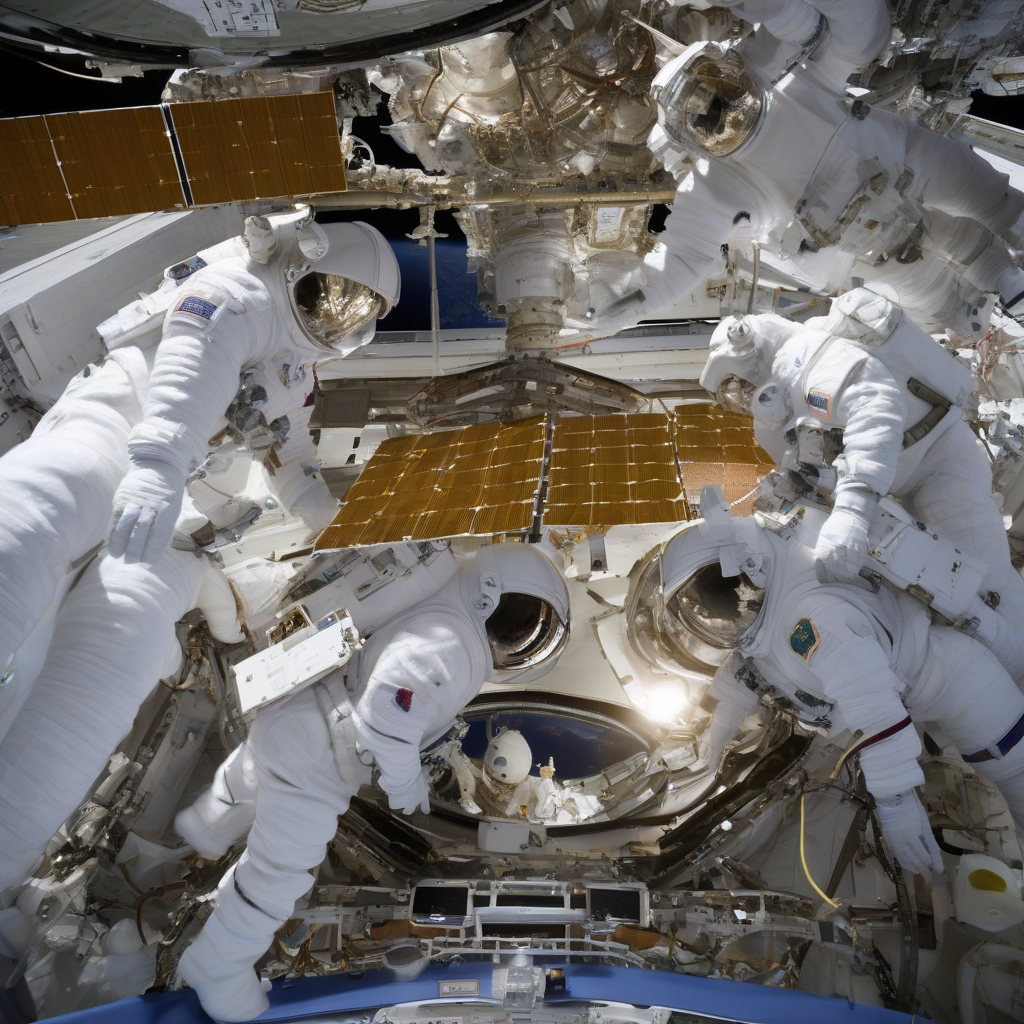

On Thursday, Aug. 6, 2026, NASA astronauts Jessica Meir and Anil Menon completed a 6.5-hour spacewalk to finalize the mounting hardware for the International Space Station's (ISS) ongoing solar array augmentation. According to Space.com, the mission focused on assembling a modification kit required for the future installation of an ISS Roll-Out Solar Array (iROSA) on the station's 3B power channel.
During the extravehicular activity (EVA), the pair worked on the station's far right, or starboard (S6) truss segment. To ensure structural stability during the assembly process, Menon operated from an articulating portable foot restraint (APFR) mounted to a worksite interface (WIFEX). The astronauts secured triangular brackets onto the 3B mast canister and routed electrical cabling intended to integrate the future iROSA into the existing power channel. The installation was concluded by applying multi-layer insulation to the struts as a protective measure against micrometeoroid debris.
Since the initiation of the iROSA project in 2021, six of the assemblies have been successfully deployed. The current effort aims to modernize the station's power generation, as the original eight solar arrays have surpassed their 15-year design life and exhibit diminished performance. Following the completion of the 3B power channel hardware, only two iROSA units remain for future delivery.
Solar Array Upgrade Data
| Specification | Detail |
|---|---|
| Spacewalk Duration | 6.5 hours |
| Date of Operation | Aug. 6, 2026 |
| Target Power Channel | 3B (Starboard/S6) |
| Power Increase Projection | 20% to 30% |
| Remaining iROSA Units | 2 |
Why It Matters
The ongoing power augmentation of the ISS is vital for sustaining long-term orbital research. By increasing the station's electricity supply by 20% to 30%, NASA is extending the operational life of the laboratory while preparing for intensive technology demonstrations. This transition from legacy arrays to high-efficiency roll-out solar technology sets a operational baseline for future commercial space stations and deep-space habitation modules. As energy demands rise with newer payloads and artificial intelligence-driven research instruments, the ability to retrofit existing infrastructure in high-radiation, microgravity environments will define the commercial viability of low Earth orbit operations.
Reader Discussion & Insights