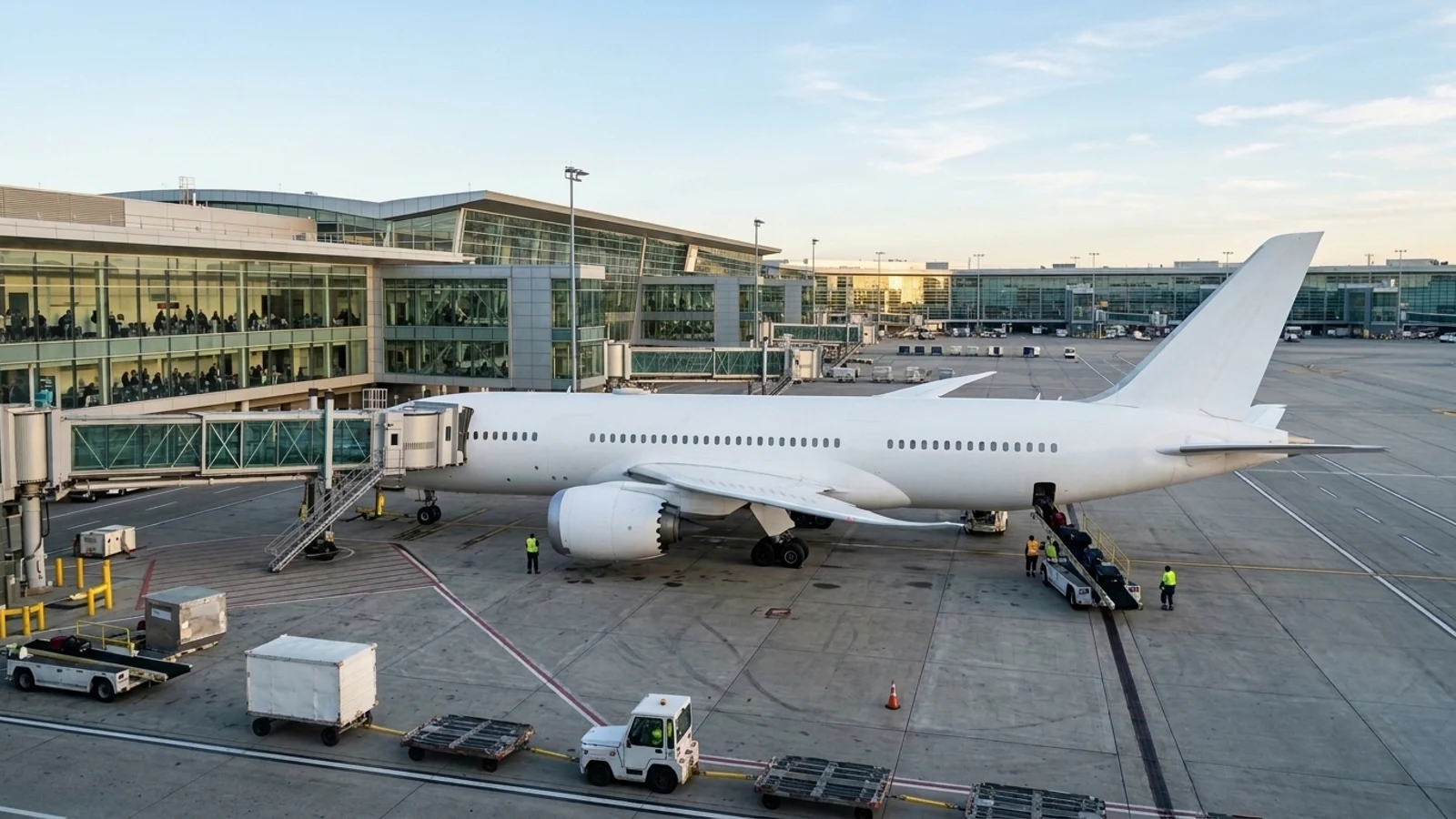
Emirates provides unique travel options through its use of fifth-freedom traffic rights, which enable the carrier to transport passengers and cargo between two countries outside of the United Arab Emirates. According to Simple Flying Aviation Discovery, these operations allow the airline to connect its home hub in Dubai to a secondary country and then extend the flight to a third destination. This legal framework permits Emirates to sell standalone tickets on these intermediate legs, effectively creating a global network that does not always require a stop in the Middle East. Source
Current US Fifth-Freedom Route Operations
Currently, Emirates operates three distinct fifth-freedom routes that incorporate a stop within the United States. These include connections between New York (JFK) and Milan Malpensa (MXP), Newark Liberty (EWR) and Athens (ATH), as well as Miami (MIA) and Bogotá (BOG). These services are facilitated by the airline's widebody fleet, specifically utilizing variants of the Airbus A380 and Boeing 777. While two of these routes serve as extensions to European destinations, the third utilizes South Florida as a strategic point for regional connectivity. Source
The operational structure of these flights varies based on geographic demand and specific aircraft capabilities. The routes between the New York metropolitan area and Southern Europe, designated as EK205/206 for the JFK–MXP leg and EK209/210 for the EWR–ATH leg, are designed to capture both local transatlantic demand and through-traffic destined for Dubai. These flights allow Emirates to maintain fleet efficiency by ensuring that widebody aircraft are not sitting idle on the ground during their transatlantic turnaround periods. Source
In contrast, the Miami–Bogotá service (EK213/EK214) functions differently, operating as an onward tag from the Dubai–Miami service. This sector spans approximately 1,513 miles. Simple Flying Aviation Discovery notes that the high altitude of Bogotá's El Dorado International Airport, situated at 8,360 feet above sea level, presents operational challenges. The thin air and hot-and-high conditions necessitate a stop in Miami, which allows the airline to manage takeoff payload limitations while still providing a viable service on a Boeing 777. Source
The stability and growth of these routes have been subject to various operational shifts. The Newark–Athens service was introduced in March 2017, joining the long-standing New York–Milan route. The Miami–Bogotá service began in 2024, although it has faced intermittent schedule adjustments, including those prompted by regional airspace disruptions in early 2026. The airline successfully resumed the Bogotá tag in May 2026, highlighting how these specific routes are integrated into a broader, fluid global schedule. Source
Regulatory Environment and Competitive Landscape
These routes operate in a competitive environment, often drawing scrutiny from domestic US legacy carriers. American Airlines, Delta Air Lines, and United Airlines have historically challenged the expansion of Gulf carrier operations in the United States. Through organizations like the Partnership for Open & Fair Skies, these US carriers have raised concerns regarding state support and competitive fairness. Emirates, however, maintains that its operations are strictly commercial, supported by dividend payouts and a focus on point-to-point passenger demand. Source
Because of these ongoing tensions and the complexity of bilateral treaty negotiations, Emirates has prioritized the optimization of its existing three routes rather than aggressively pursuing new US city pairs. The airline's leadership has noted that while further expansion is technically possible, the political sensitivities in Washington necessitate a cautious approach. Consequently, travelers can expect the current trio of routes to remain the core focus of the airline's fifth-freedom activities within the US market for the foreseeable future. Source
For passengers interested in these flights, the booking experience often mirrors standard international travel. Emirates Skywards and various partner programs allow for reward redemptions on these sectors. Redemptions for the JFK–Europe legs, for example, have been observed starting at 17,000 to 17,500 miles one-way for economy, 87,000 for business, and 102,000 for first class. While these rates are attractive, availability often fluctuates, and travelers should compare these against frequency-dense domestic options that might offer better flexibility. Source
Travelers should remain aware of certain limitations inherent in these fifth-freedom offerings. Unlike high-frequency domestic routes, these flights generally operate on a once-daily basis, leaving limited options for rebooking if a delay or cancellation occurs due to upstream issues in the Gulf or Europe. Additionally, the specific aircraft configuration, such as cabin layout or the presence of specific First Class suites, can change due to fleet rotations. A schedule published months in advance serves as a guide rather than a fixed guarantee. Source
The table below outlines the three active fifth-freedom routes currently serviced by Emirates connecting through the United States. Source
Looking ahead, the introduction of newer aircraft types, such as the Airbus A350-900, may eventually lead to further adjustments in how Emirates allocates its cabin products across the US network. While the airline continues to evaluate growth opportunities, the existing three links provide a consistent benchmark for the types of secondary connections the carrier is willing to support. Future changes will likely reflect the same balance of aircraft performance, ground-turn efficiency, and the political realities of the US aviation market. Source