
New York Metro Airport Delay Analysis
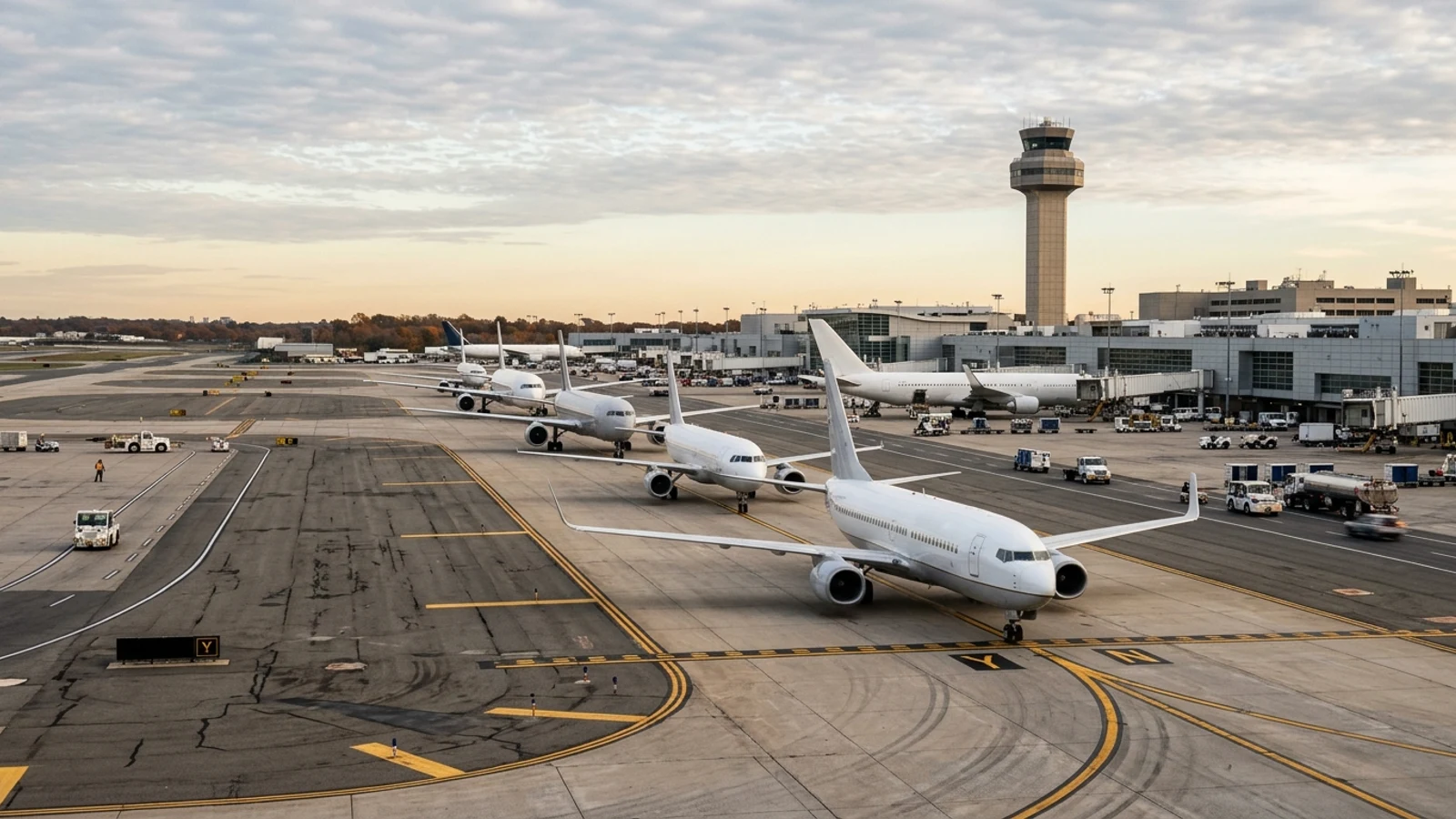
Travelers navigating the New York City airport network faced significant disruptions in September 2026, as federal data confirms that a large portion of the nation's longest tarmac delays occurred within this region. According to the US Department of Transportation’s Air Travel Consumer Report, released in November 2026, flights to and from New York metro airports accounted for a full quarter of all instances where aircraft remained on the tarmac for three or more hours. Source
New York Metro Airport Delay Analysis
The data highlights specific incidents at John F. Kennedy International Airport and Newark Liberty International Airport. Out of 16 total flights nationwide flagged for exceeding these tarmac duration thresholds, four were linked to these two major hubs. While the report records the frequency of these events, it does not explicitly state the primary causes behind the individual holdups or determine if airlines breached specific federal consumer protection regulations during these specific delays. Source
International service was notably impacted by extended wait times during the month. United Airlines Flight 123, traveling from London Heathrow to Newark on September 21, suffered a tarmac delay of four hours and 25 minutes after the aircraft was diverted to Stewart International Airport in the Hudson Valley. This reflects broader infrastructure and logistical challenges, as diversions to alternative airports often result in longer wait times for passengers who are restricted to the aircraft while on the ground. Source
American Airlines also experienced significant tarmac delays on international routes. On September 25, flight 2996, which was scheduled to fly from Mexico City to JFK, was diverted to Charlotte, North Carolina. The flight remained on the tarmac for four hours and 24 minutes. These incidents involving international arrivals highlight the challenges of managing aircraft that have already entered the airspace or require unplanned ground handling at secondary airports when primary hubs are congested or experiencing air traffic control constraints. Source
Operational Reliability and Performance
Domestic operations at New York airports were similarly affected by extended ground delays in September. JetBlue recorded two domestic flight incidents flagged in the federal report. The airline’s flight 119, departing from JFK for Atlanta, was diverted to Huntsville, Alabama, on September 11, spending three hours and 32 minutes on the tarmac. Additionally, JetBlue flight 955 to Washington Reagan National Airport experienced a delay of three hours and five minutes while remaining at the gate at JFK on September 1. Source
The performance metrics for New York airports reveal consistent challenges with punctuality. While LaGuardia Airport did not appear in the extended tarmac delay tables for the month, it ranked among the lowest for on-time performance among the country's 30 largest airports. Data shows 68.8% of flights arrived on time at LaGuardia, compared to 75% at JFK and 76.9% at Newark. Newark also maintained a strong departure punctuality, with 80.7% of its flights leaving on time during the same period. Source
Nationwide, airline reliability has shown signs of decline through the first nine months of 2026. Total cancellations reached 121,080, representing a 42% increase compared to the same period in 2025. JetBlue, in particular, reported 7,536 cancellations during this timeframe, which is more than triple the 2,473 cancellations recorded in the first nine months of 2025. These figures demonstrate the mounting pressure on the domestic aviation system and the impact of cascading delays on passenger schedules. Source
The federal government maintains strict requirements for passenger treatment during these extended delays. Airlines are mandated to provide passengers the opportunity to disembark after three hours for domestic flights and four hours for international flights. Furthermore, carriers must provide adequate provisions including snacks and drinking water within two hours, ensure lavatory functionality, and facilitate medical assistance if necessary. Exceptions are granted only under specific safety, security, or air traffic control directives. Source
The following table summarizes the key international tarmac delay events documented in the September 2026 federal reports: Source
| Airline | Route | Date | Delay Duration | Diversion Airport | :--- | :--- | :--- | :--- | :--- | | United | LHR to EWR | Sept 21 | 4h 25m | Stewart Int'l | | American | Mexico City to JFK | Sept 25 | 4h 24m | Charlotte, NC | | Avianca | Medellin to MIA | N/A | 5h 18m | N/A | Source
The Department of Transportation continues to monitor these incidents, having received 103 consumer complaints related to tarmac delays in September alone. This contributes to a total of 821 complaints filed in the first nine months of 2026. While infrastructure strain and controller shortages are cited as potential drivers for congestion, the airline industry remains under scrutiny to ensure compliance with tarmac delay protections, as evidenced by previous multi-million dollar fines imposed on carriers for past violations. Source
Despite these performance hurdles, US carriers maintain high safety standards. However, the contrast in reliability between domestic operations and other international benchmarks often remains a point of critique. Moving forward, the industry faces the challenge of managing capacity at major hubs like JFK and Newark, where slot scarcity and busy flight schedules often exacerbate the impact of minor irregularities, leading to the prolonged tarmac waits observed in recent government reports. Source

