
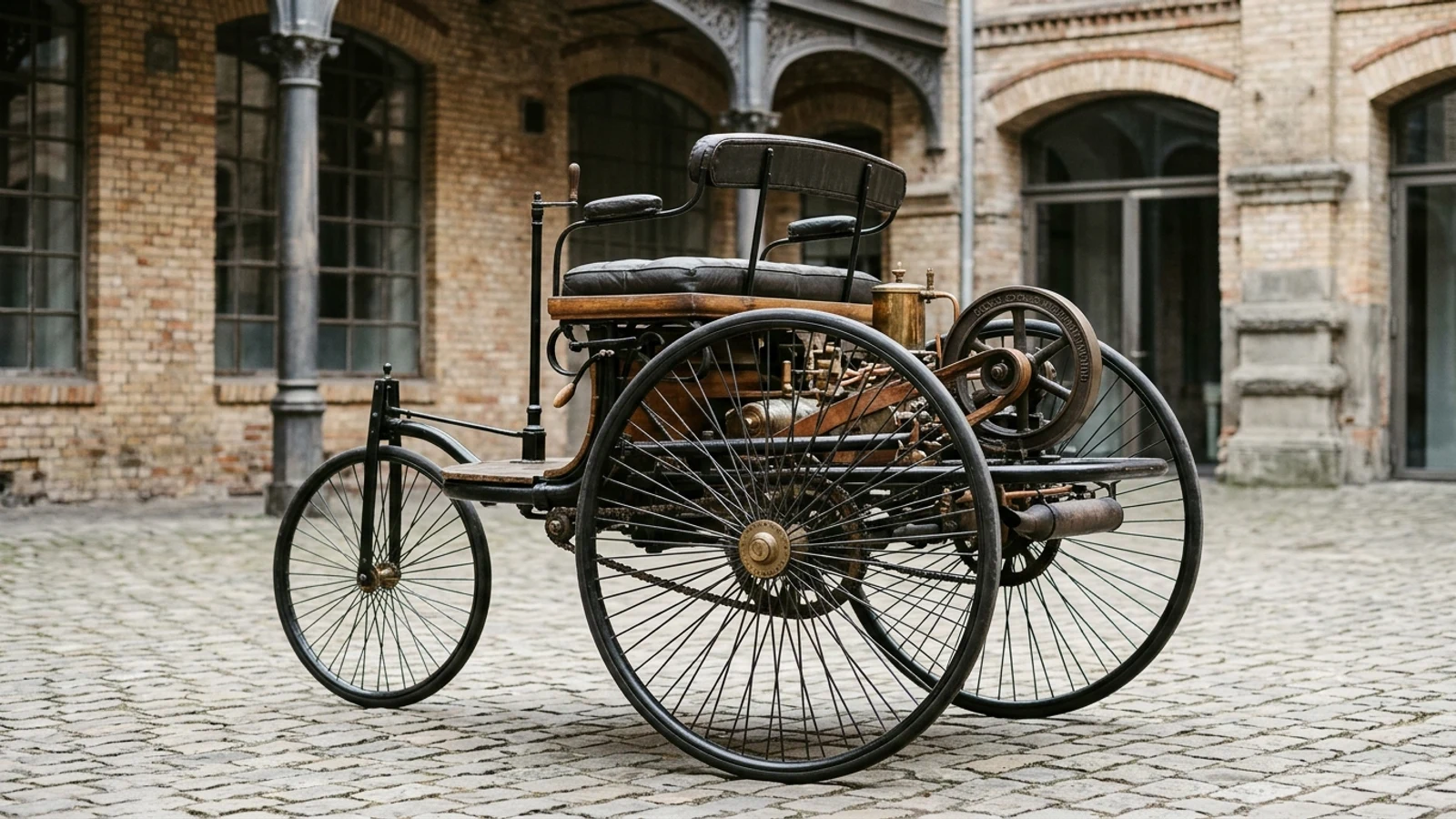
The 1886 Benz Patent Motorwagen stands as a seminal entry in the history of automotive engineering. As reported by Car and Driver, the vehicle is recognized as the first car designed to be a motor vehicle from inception rather than a modified horse-drawn carriage. Its development by Carl Benz involved an entirely new approach to transportation, avoiding the adaptation of existing carriage designs. This early automobile serves as a reference point for understanding the origins of modern vehicle functionality and design. Source
The design of the Patent Motorwagen prioritizes simplicity, featuring a three-wheel configuration to minimize weight. At the time of its creation, industry standards lacked components common in later decades, such as kingpins or uprights at the wheels. Consequently, the vehicle’s steering relied on a design that pivoted the entire axle. The operator steers the vehicle using a wood handle that resembles an awl, as the steering wheel had not yet been integrated into automotive design in 1886. Source
Mechanical elements of the vehicle remain exposed, lacking the protective casings found in modern engines. Components including the crankshaft, connecting rod, cam gear, and drive belt are visible during operation. Maintenance requirements are substantial by contemporary standards, with certain parts necessitating manual greasing before use. Lubrication for the cylinder and intake valve is managed through drip lubricators, which apply oil during operation, eventually resulting in oil residue on the road surface. Source
The starting procedure for the Patent Motorwagen is a multi-step process that reflects the technology of its era. An ignition system provides energy to a spark plug approximately eight inches in length. To initiate the engine, the operator must manually spin a horizontal flywheel. Fuel management is handled by an adjustable air-hexane mixture, which allows the operator to enrich the mixture for starting purposes. This early engine design lacked a throttle, maintaining an operating speed around 400 rpm. Source
Cooling the engine requires a water-based system, utilizing a 4.8-quart copper vessel positioned above the cylinder. Under normal operating conditions, this cooling capacity is limited, with water often boiling over after approximately one hour of use. This limitation necessitates frequent stops to allow the engine to cool down, a routine constraint for operation in 1886. The fuel system originally utilized naphtha, a common solvent available at apothecaries during that period. Source
Driving the Patent Motorwagen involves specific manual controls situated on a leather-trimmed bench. Acceleration is achieved by pushing a long lever on the left side of the vehicle, which engages an engine-driven leather strap to the axle. Stopping the vehicle is performed by pulling the same lever backward, which actuates a shoe that creates friction against the axle. The vehicle demonstrates a manufacturer-claimed top speed of 13 mph, reflecting the performance limitations of its 0.88 horsepower engine. Source
Historical evaluations of the Benz Patent Motorwagen highlight the disorientation and challenges inherent in operating early automotive technology. Because many modern safety and comfort features had not yet been invented, the driving experience is described as requiring significant attention. The lack of standard safety equipment like radiators or carburetor jets distinguishes the 1886 experience from modern driving. Operators encounter a vehicle where safety systems and predictable handling characteristics were not yet established. Source
Beyond the Patent Motorwagen, interest in antique vehicles remains active within the automotive community. As documented by Car and Driver, Senior features editor Elana Scherr maintains an interest in early automotive history, demonstrated by her ownership of a 1915 Dodge. Efforts to organize events for early vehicles in the United States, similar to the London-to-Brighton run, reflect a broader dedication to preserving and understanding the mechanical evolution of the automobile over the last 140 years. Source
While the Patent Motorwagen represents the beginning of the internal combustion era, recent magazine features also cover modern high-performance vehicles. Readers interested in contemporary automotive engineering may note mentions of recent vehicles with power ratings approaching 795 hp or 1000 hp. This contrast emphasizes the progress in power, cooling, and safety systems between the 1886 Patent Motorwagen and current production automobiles featured in contemporary media outlets such as Car and Driver. Source
Comparing the technological state of 1886 to contemporary requirements illustrates the rapid change in automotive design. Features such as radios and modern lighting were entirely absent, while the reliance on external mechanical parts like drive belts and manual oiling mechanisms defines the 1886 operation. The Benz Patent Motorwagen remains a critical reference for its role in establishing the automobile as a distinct class of vehicle rather than a horse-drawn carriage successor. Source
In addition to the Benz model, other early vehicles from the turn of the century, such as a 116-year-old Pullman, continue to see occasional use. Operators of such vehicles often integrate modern convenience technology, such as Waze, during transit. This intersection of early mechanical engineering and contemporary navigation reflects the continued engagement of owners with antique automotive history in modern settings. These vehicles serve as proof of the early development of private transit before modern speed limits and infrastructure. Source
Technical Specifications and Operational Data
The following table summarizes the key mechanical and operational specifications of the 1886 Benz Patent Motorwagen based on the reporting from Car and Driver. Source
| Feature | Specification |
|---|---|
| Power | 0.88 Horsepower |
| Displacement | 1.0-Liter |
| Operating Speed | 400 rpm |
| Top Speed | 13 mph (claimed) |
| Cooling System | 4.8-quart copper vessel |
| Wheels | 3-wheel configuration |

