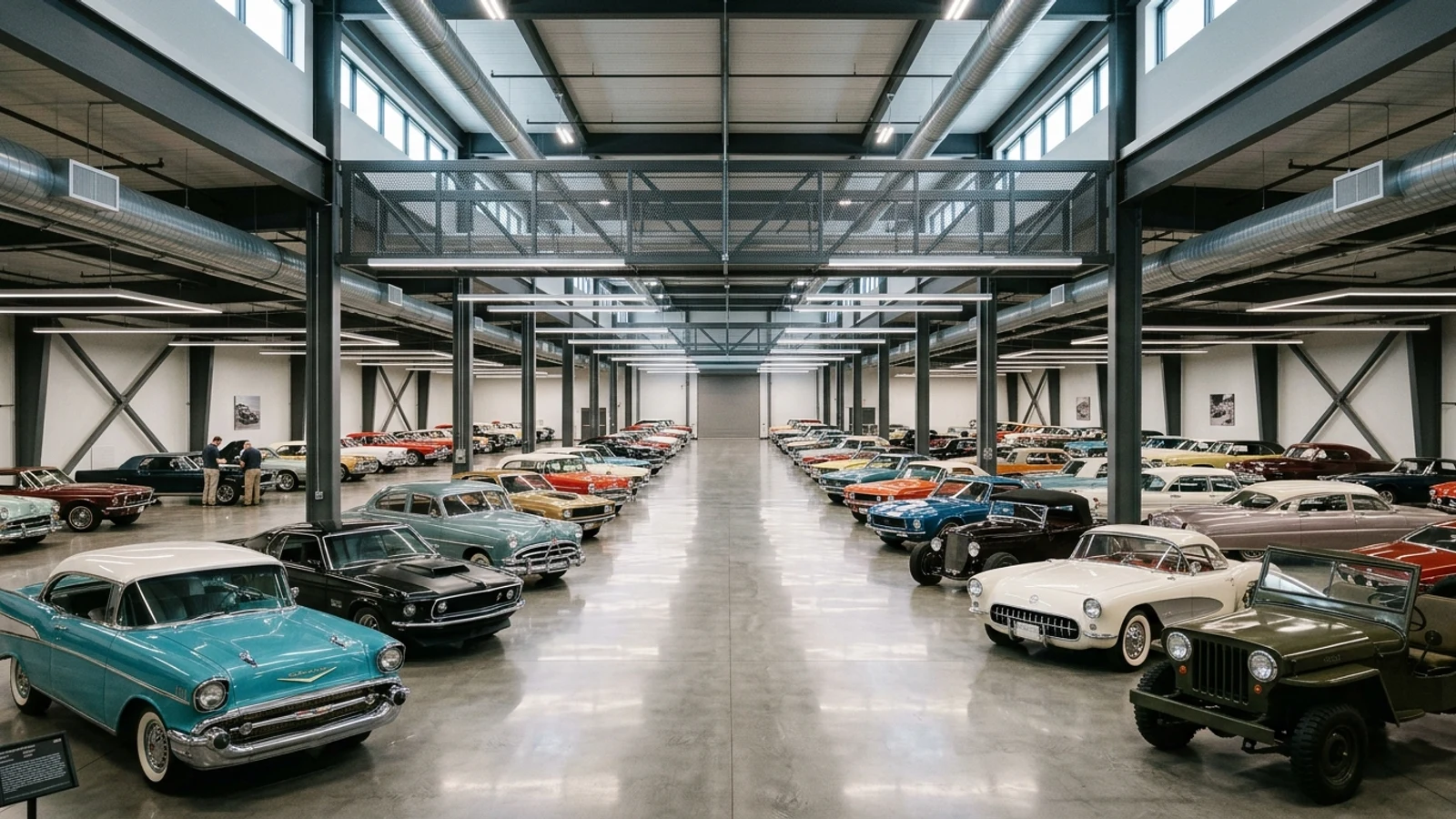
Ford has established a permanent home for its extensive Heritage Fleet, relocating a collection of historic vehicles to a dedicated facility in Romulus, Michigan. The company began curating this official collection in 2024, following a period where it lacked a centralized repository for its significant historical automobiles. This new center, referred to as the Ford Vault, occupies a building that previously served as an Amazon warehouse. The site currently houses a diverse array of vehicles ranging from early Model Ts and race cars to various one-off concept designs. Source
The collection is curated to showcase the evolution of the manufacturer and its impact on history. According to Ford corporate historian Ted Ryan, the objective is to allow visitors to understand the company's role in American history more deeply. The facility is currently organized into thematic categories that help illustrate the broader Ford story. Beyond standard production models, the vault holds numerous concept vehicles that served as design foundations for later mass-market cars, as well as specific utility vehicles like ambulances, fire trucks, and police cars. Source
Access to the facility is strictly limited at this time due to specific zoning laws, rendering it inaccessible to the general public. While the site is currently closed to outside visitors, Ford has permitted limited media access and employee-led events. Notably, an internal event for employees saw significant demand, with 3,200 tickets selling out within two hours. Ford has confirmed it is actively coordinating with Romulus city government officials to address zoning requirements and building codes to eventually convert the space into a public museum. Source
The collection includes rare vehicles that have remained in storage for decades, alongside units donated by private collectors and others obtained through short-term loan agreements. Notable exhibits include a right-hand-drive Model T from the United Kingdom finished in green, reflecting the diverse color options offered before the company standardized black paint for efficiency in 1914. Other unique items in the fleet serve to educate apprentices at Ford’s Experimental Vehicles Building on the intricacies of concept vehicle development. Source
A significant portion of the collection consists of concept vehicles that highlight experimental engineering. For example, the 2003 Model U concept utilized a supercharged 2.3-liter four-cylinder hydrogen-combustion engine paired with an electrified automatic transmission. This vehicle featured advanced technology for its time, including adaptive headlights, a head-up display, and automatic emergency braking, alongside exterior body panels constructed from soy-based materials. The vault also stores the Super Chief concept, which featured a Tri-Flex V-10 engine capable of combusting gasoline, E85, or hydrogen. Source
The facility preserves prototypes that offer a window into failed or alternative projects. The U260 next-generation Bronco prototype, designed by a team led by Moray Callum, remains in the collection as a testament to early attempts to revive the Bronco nameplate before its eventual production return in 2021. Another example is the L2K, a roadster concept built on a modified 1993 Mazda Miata chassis that once toured the auto show circuit. The L2K was originally proposed as a Mercury sports car before being re-badged. Source
Additional highlights include experimental compact models like the Reflex, a diesel-electric hybrid coupe. The Reflex boasted a 2+1 seating layout with interior materials derived from recycled athletic footwear. Performance-focused historical pieces also remain on display, such as the Cougar II concept from 1963, which utilized a fiberglass body and pop-up headlights to achieve an alleged top speed of 170 mph. The fleet is rounded out by vehicles such as the tiny first-generation Ka hatchback, representing the final unit produced with under 10 miles on its odometer. Source
While Ford intends to pursue public access, there is no established timeline or finalized roadmap for the transformation. Discussions have taken place between company representatives and the Henry Ford Museum to explore potential future operations, though these remain preliminary. The primary focus currently remains on establishing the necessary infrastructure and zoning compliance required for public admission. The company emphasizes that the long-term goal is to make these historic assets accessible to the public in a formal, museum-style setting. Source