
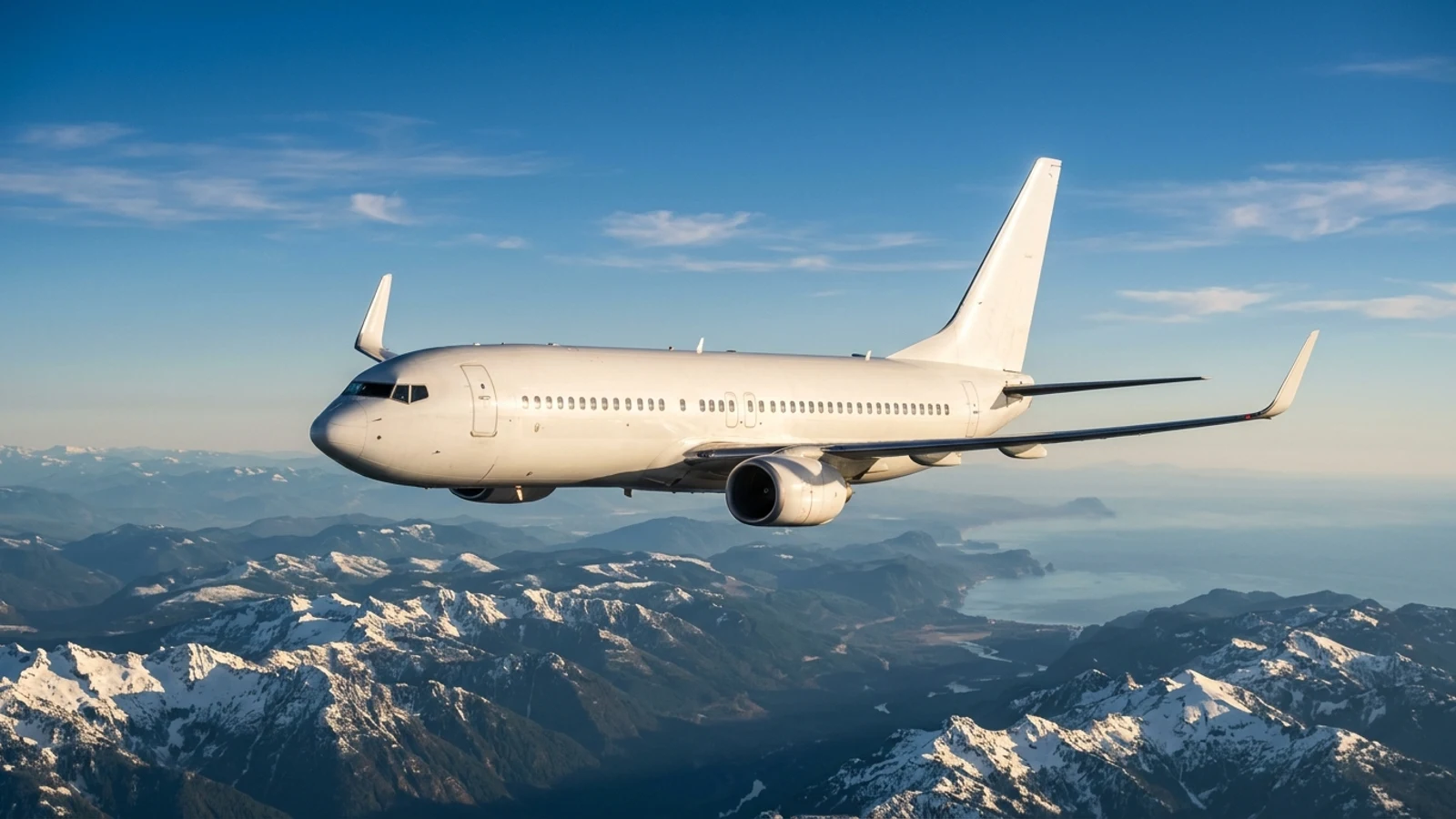
Southwest Airlines maintains one of the largest domestic narrowbody fleets in the United States, utilizing a vast network of Boeing 737 aircraft to connect various regions across the country. While the carrier is widely recognized for short-haul and medium-haul operations, it also operates several transcontinental routes that stretch nearly 2,700 miles. These specific nonstop services highlight the airline's evolving strategy, as it balances the use of 737 variants to connect major cities on both the East and West Coasts. Source
Data from 2026 indicates that the longest nonstop route operated by the airline connects Boston Logan International Airport (BOS) and San Francisco International Airport (SFO), covering an average distance of 2,704 miles. The second-longest route in the network links Rhode Island T.F. Green International Airport (PVD) to San Francisco, with an average distance of 2,691 miles. Rounding out the top three is the Boston to San Jose International Airport (SJC) connection, which averages 2,689 miles. Source
The airline's transcontinental network remains highly competitive, with several other city pairs also exceeding 2,500 miles. For instance, the Providence-San Jose route covers approximately 2,675 miles, and the Boston-San Diego International Airport (SAN) route spans 2,588 miles. Additionally, Baltimore/Washington International Thurgood Marshall Airport (BWI) serves as a key origin point for long-distance flights to both San Francisco and San Jose, covering 2,457 miles and 2,438 miles, respectively. Source
To support these long-distance journeys, Southwest relies on a standardized narrowbody fleet consisting of the Boeing 737-700, 737-800, and the 737 MAX 8. According to Cirium data, the 737 MAX 8 was the primary aircraft deployed on these routes in 2026. This specific variant operated 1,310 flights during the observed period, providing 229,250 available seats. The 737-800 followed with 813 flights and 142,275 seats, while the 737-700 operated 209 flights with 28,770 available seats. Source
The configuration of the airline's 737-800 and 737 MAX 8 fleets ensures consistent capacity, with both models capable of accommodating up to 175 passengers. By focusing on a common narrowbody fleet, Southwest reduces operational complexities regarding maintenance, training, and scheduling. This strategy enables the airline to match passenger demand effectively without requiring the use of larger widebody aircraft typically deployed by competitors for longer-distance travel across the continental United States. Source
Southwest's strategy in 2026 relies on a point-to-point network model, which provides direct connectivity between city pairs without the need for traditional hub transfers. The airline has also introduced red-eye flights to optimize fleet utilization, offering over 50 peak-day overnight services. Furthermore, the carrier is expanding its distribution by listing flight options on third-party platforms such as Google Flights and Expedia to reach a broader customer base and integrate them into its loyalty program. Source
In a separate operational context, Alaska Airlines recently encountered a ground collision at New York John F. Kennedy International Airport (JFK) involving a Boeing 737-800. On November 23, 2026, aircraft N548AS, scheduled for flight AS41 to San Francisco, collided with a catering vehicle during pushback. The collision caused damage to the ventral strake of the left-hand split scimitar winglet, which necessitated the cancellation of the flight and subsequent maintenance inspection of the 18.7-year-old aircraft. Source
Alaska Airlines confirmed that no injuries occurred during the JFK incident, and affected passengers were reaccommodated on a later flight. While the aircraft underwent maintenance, the carrier continues to operate its transcontinental schedule using its fleet of 59 Boeing 737-800s. Such ground incidents underscore the risks inherent in apron operations, even as airlines strive to maintain high-frequency service schedules between major coastal hubs like New York and the Bay Area. Source
Delta Air Lines also utilizes the 737-900ER on various domestic routes within North America, though its fleet management regarding ETOPS certification differs from competitors. While the 737-900ER lacks transoceanic range, Delta maintains ETOPS-180 certification on approximately 20 aircraft for specific overwater routes, such as those in the Caribbean. However, the airline has removed ETOPS equipment from most of its 737-900ER subfleet, as it now prioritizes the Airbus A321neo for longer Caribbean services. Source
Operational requirements for ETOPS certification, including the necessity for extra fuel reserves on routes with limited diversion options, have historically presented payload-range challenges for the 737-900ER on long routes like West Coast to Hawaii. Consequently, Delta migrated these services to the 757 and subsequently to the A321neo. In contrast, United Airlines continues to certify its entire 737 fleet for ETOPS to maximize operational flexibility, allowing it to substitute aircraft without disrupting schedules. Source
Operational Parameters and Route Data
The following table summarizes key routes and fleet configurations across the discussed operators for transcontinental and extended operations. Source
| Route | Distance | Primary Operator |
|---|---|---|
| BOS-SFO | 2,704 miles | Southwest |
| PVD-SFO | 2,691 miles | Southwest |
| BOS-SJC | 2,689 miles | Southwest |
| JFK-SFO | Daily | Alaska Airlines |

