
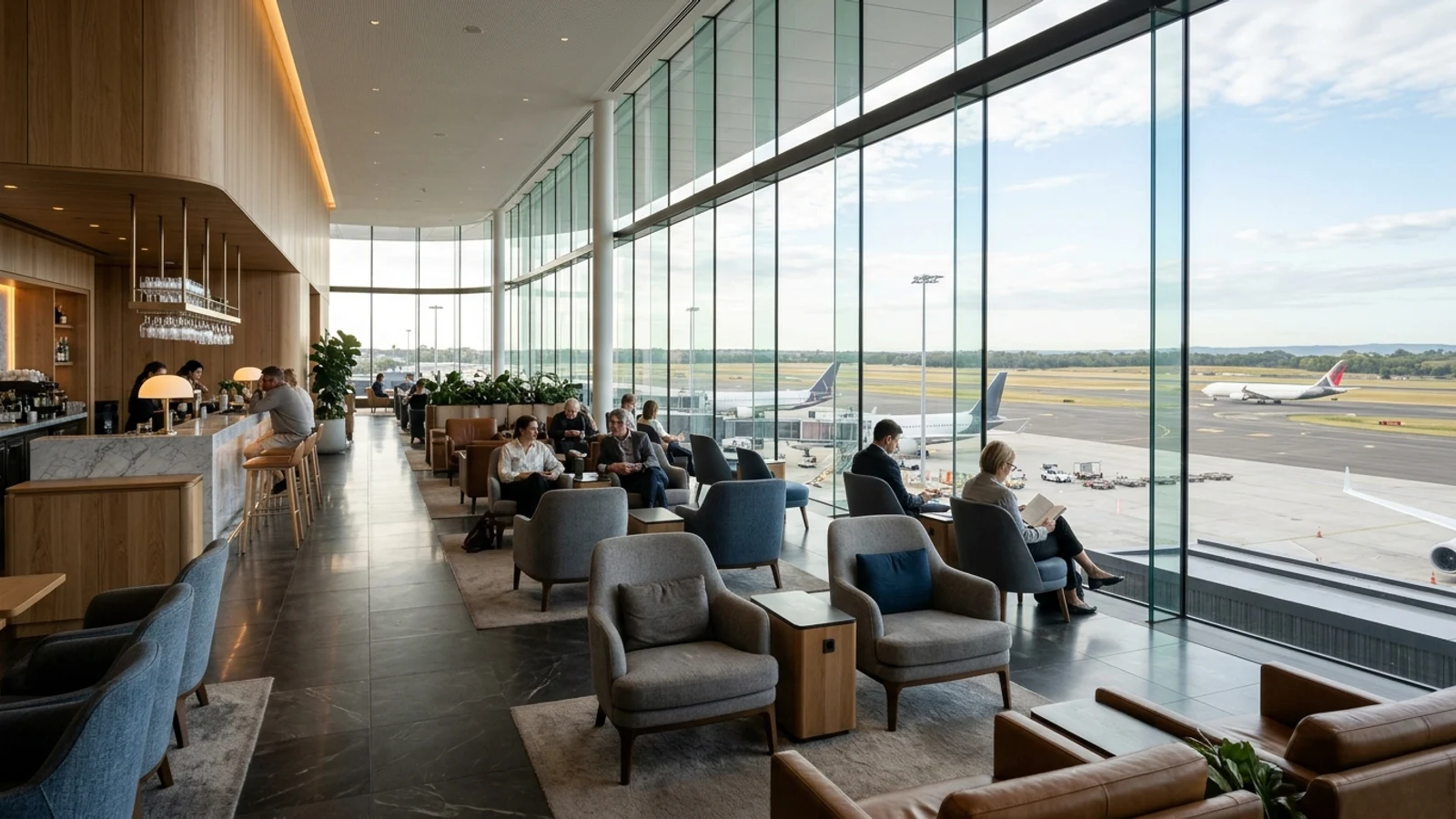
Western Sydney International Airport expanded its international passenger offering on 23 November 2026 with the opening of the Rayleigh Lounge. This premium facility is operated by dnata and provides a shared space for eligible travellers, distinguishing itself through a focus on passenger comfort as the airport builds its network. The launch of this lounge coincides with the introduction of new daily flight services by Singapore Airlines between Western Sydney and the Singapore Changi hub, marking a significant step in the airport's development. Source
The Rayleigh Lounge, located on the terminal's mezzanine level, is designed to serve as a respite for international passengers. The facility features large windows that offer panoramic views of the airfield and the Blue Mountains, aiming to provide a distinct regional atmosphere. Inside, the lounge includes a restaurant area, a bar, an open kitchen, and dedicated relaxation spaces. Three private shower rooms are available for guests, providing a practical amenity for those arriving from or preparing for long-haul international journeys. Source
Entry to the Rayleigh Lounge is not included for every passenger. Access is provided to eligible Singapore Airlines premium passengers, as well as members of the Priority Pass and DragonPass programmes. For travellers not covered by these arrangements, the airport has implemented a paid entry system. Passengers may purchase individual access for 69 Australian dollars. This structure allows economy-class travellers or those flying with other airlines to use the premium facilities, provided they meet the specific access criteria. Source
The lounge currently accommodates approximately 90 guests, though it is designed with the flexibility for future expansion to 130 seats. This scalability is part of the airport's broader strategy to manage passenger growth as international traffic increases. By offering a shared lounge facility rather than requiring individual airlines to construct proprietary spaces, the airport aims to keep passenger comfort central to its commercial operations while maintaining an efficient use of terminal space and infrastructure. Source
The new Singapore Airlines daily service represents a key component of the airport's international connectivity. The route is operated by an Airbus A350-900 aircraft with a total capacity of 303 seats, divided into 40 business-class seats and 263 economy-class seats. The schedule for this connection is fixed until 27 March 2027, with flight SQ201 departing Singapore at 11:30 local time and arriving in Western Sydney at 22:20. The return leg, SQ202, departs at 23:55, arriving in Singapore at 05:05 the following day. Source
The operational model at Western Sydney International differs from that of Sydney Kingsford Smith Airport. Notably, the new facility operates without a night-time aviation curfew, which provides airlines with significant scheduling flexibility. This was an essential factor for the Singapore Airlines route, as it accommodates a late-night departure for the return flight. For passengers, this means arrivals and departures may occur outside of the restricted hours typically found at older, curfew-regulated Australian major airports. Source
The airport, also known as Nancy-Bird Walton Airport, began handling commercial passenger traffic on 25 October 2026. While Sydney Kingsford Smith Airport retains advantages in proximity to the central city and established transit links, Western Sydney is positioning itself as a modern alternative. The government's investment programme for the region, totalling approximately 18 billion Australian dollars, has supported the development of both the airport and the surrounding infrastructure, including 360 local business contracts during the build phase. Source
In terms of future growth, the Australian government anticipates that the airport will eventually serve up to 10 million passengers annually. Currently, international airline partners including Singapore Airlines, Qatar Airways, Air New Zealand, and Vietjet have committed to the airport, supported by the Western Sydney International Take-Off Fund. As the airport matures, it intends to host additional international airlines, with the Rayleigh Lounge serving as a foundational element of its premium service infrastructure for all incoming carriers. Source
For passengers planning journeys, it is critical to distinguish between Sydney's two airports, as they are not interchangeable. Travellers should verify their specific airport designation on all booking documents. The new international gateway, located in Western Sydney, complements existing options rather than replacing them. As the regional visitor economy continues to evolve, the airport is focusing on the overall user experience, integrating local cultural elements and premium amenities like the Rayleigh Lounge into the travel lifecycle. Source
Operational Details and Service Parameters
The following table details the core operational characteristics of the initial international route connecting Western Sydney to the Singapore Changi hub as of 23 November 2026. Source
| Feature | Specification |
|---|---|
| Route | Singapore (SIN) - Western Sydney (WSI) |
| Aircraft Type | Airbus A350-900 |
| Total Capacity | 303 seats (40 Business / 263 Economy) |
| Schedule Period | 23 November 2026 – 27 March 2027 |
| Lounge Entry Fee | AUD 69 (if not included) |
| Lounge Capacity | 90 guests (initial) / 130 guests (planned) |
While the Rayleigh Lounge and the new Singapore Airlines route represent progress, the airport's long-term success depends on consistent service delivery and the growth of airline partnerships. The combination of no night-time curfew, modern infrastructure, and premium lounge services aims to attract both business and leisure travellers. Passengers should check for updates on lounge hours and service inclusions directly, as the facility and its operating policies continue to adapt to the requirements of airlines and their passengers. Source

