
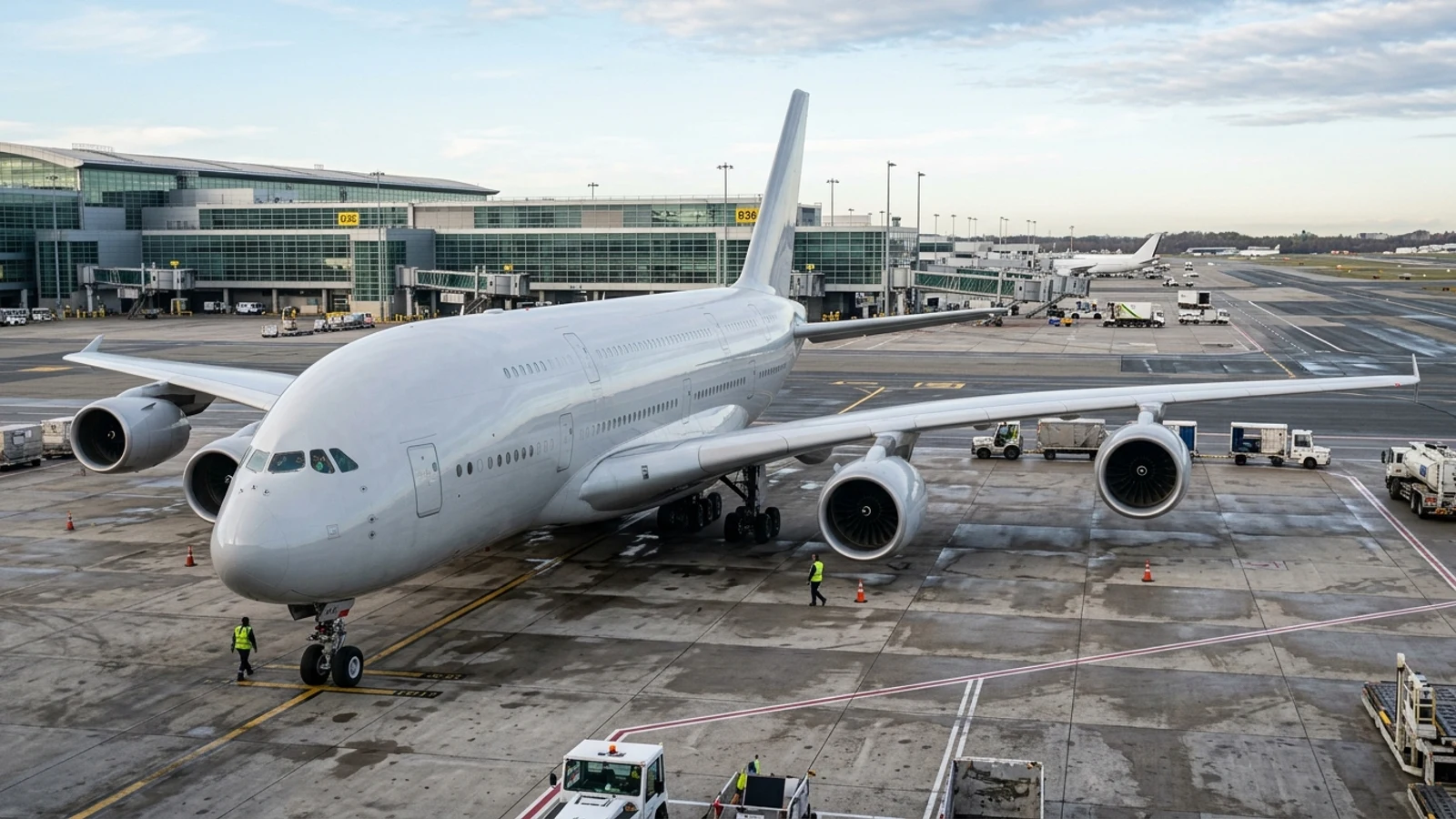
The status of the world's oldest Airbus A380-800 in commercial passenger service is frequently debated, with several aircraft claiming the title depending on whether the metric used is manufacturer serial number or delivery date. Emirates currently operates A6-EDF, which holds MSN 007 and was manufactured in 2006. This specific airframe was delivered to the airline in December 2009, although it spent time in storage during the global pandemic before returning to active service in April 2025. Source
While Emirates' A6-EDF is the oldest Superjumbo currently in commercial use, older airframes exist. The Airbus testbed F-WWOW (MSN 001) remains active, having first flown in 2005. Furthermore, Qantas operates VH-OQA and VH-OQB, which, despite having higher serial numbers (MSN 014 and 015), were delivered to the airline in 2008, predating the delivery of Emirates' oldest unit. Airbus is reportedly preparing to eventually replace the F-WWOW testbed with a former Malaysia Airlines A380, registered as 2-JAYN. Source
Between November 9 and November 16, 2026, the Emirates A6-EDF completed a variety of regional services rather than ultra-long-haul routes. Its schedule included round trips from Dubai to Mauritius, Manchester, London, Guangzhou, Cairo, and Bangkok. The longest of these flights was the eight-hour return journey from Guangzhou. Emirates has significantly adjusted its A380 fleet utilization, with only 84 of its 116 units currently in active service due to maintenance backlogs and cabin retrofit programs. Source
In addition to long-haul passenger jets, flight tracking analysis from November 2026 reveals a stark contrast between aircraft by flight frequency versus airborne hours. The world's busiest aircraft by flight count are predominantly regional turboprops or small jets, while those with the highest airborne hours are widebody international aircraft. The following table highlights the operational characteristics of high-frequency and high-duration aircraft as documented in the reporting. Source
| Aircraft Type | Operator | Weekly Flights | Primary Region |
|---|---|---|---|
| DHC-6 Twin Otter | Divi Divi Air | 75 | Dutch Caribbean |
| Boeing 717-200 | Hawaiian Airlines | 75 | Hawaii |
| ATR 72-500 | Norra (Finnair) | 74 | Finland |
| ATR 72-600 | Canaryfly | 74 | Canary Islands |
| ATR 72-600 | Air Nostrum | 73 | Balearic Islands |
By airborne hours, a different segment of the fleet dominates. An Air New Zealand Boeing 787-9 (ZK-NZD) logged approximately 134.2 hours over 14 flights in one week, averaging roughly 19 hours and ten minutes of flying time daily. SAS Airbus A350-900s also appear near the top of this list, spending similar amounts of time in the air, underscoring the intensity of long-haul widebody operations compared to the frequent short-duration legs typical of island-hopping turboprops. Source
The logistics network of Airbus itself provides further insight into heavy aircraft utilization. The Airbus Beluga XL, a freighter specifically designed to move oversized aircraft parts between production facilities, maintains a demanding schedule. F-GXLH, an A330-700 variant, recorded 15 flights between November 11 and November 17, 2026, totaling over 28 hours in the air and covering 10,193 miles, illustrating the backbone of the European manufacturing supply chain. Source
Operating primarily from its Toulouse operational center, the Beluga XL F-GXLH connects major production sites. During the observed week, the aircraft flew to locations including Hawarden in the UK, Hamburg in Germany, Bremen in Germany, and Saint-Nazaire in France. The aircraft logged three flights on multiple days, including November 11, 14, and 16, demonstrating that its schedule is dictated by production requirements rather than traditional commercial cargo hubs. Source
The operational patterns of these aircraft reflect distinct industry needs. The Beluga XL remains central to the European industrial network, with Toulouse serving as the most frequently visited airport, recording 12 takeoffs and landings for F-GXLH alone. Hamburg-Finkenwerder served as the second-busiest location for the freighter during the same week. This concentration of activity allows for the continuous flow of major structures between geographically separated facilities, avoiding delays in the wider production line. Source
Comparing these three distinct operational groups—aging long-haul passenger jets, high-frequency regional island-hoppers, and specialized industrial transports—highlights the diverse ways modern aviation assets are deployed. While the oldest A380s are being phased toward long-term retirement, the industry continues to rely on high-utilization strategies, whether in the form of nearly continuous widebody global flights or the rapid, short-haul rotations of the specialized Airbus logistics freighter fleet. Source

