
Severe Weather Impacts California Aviation
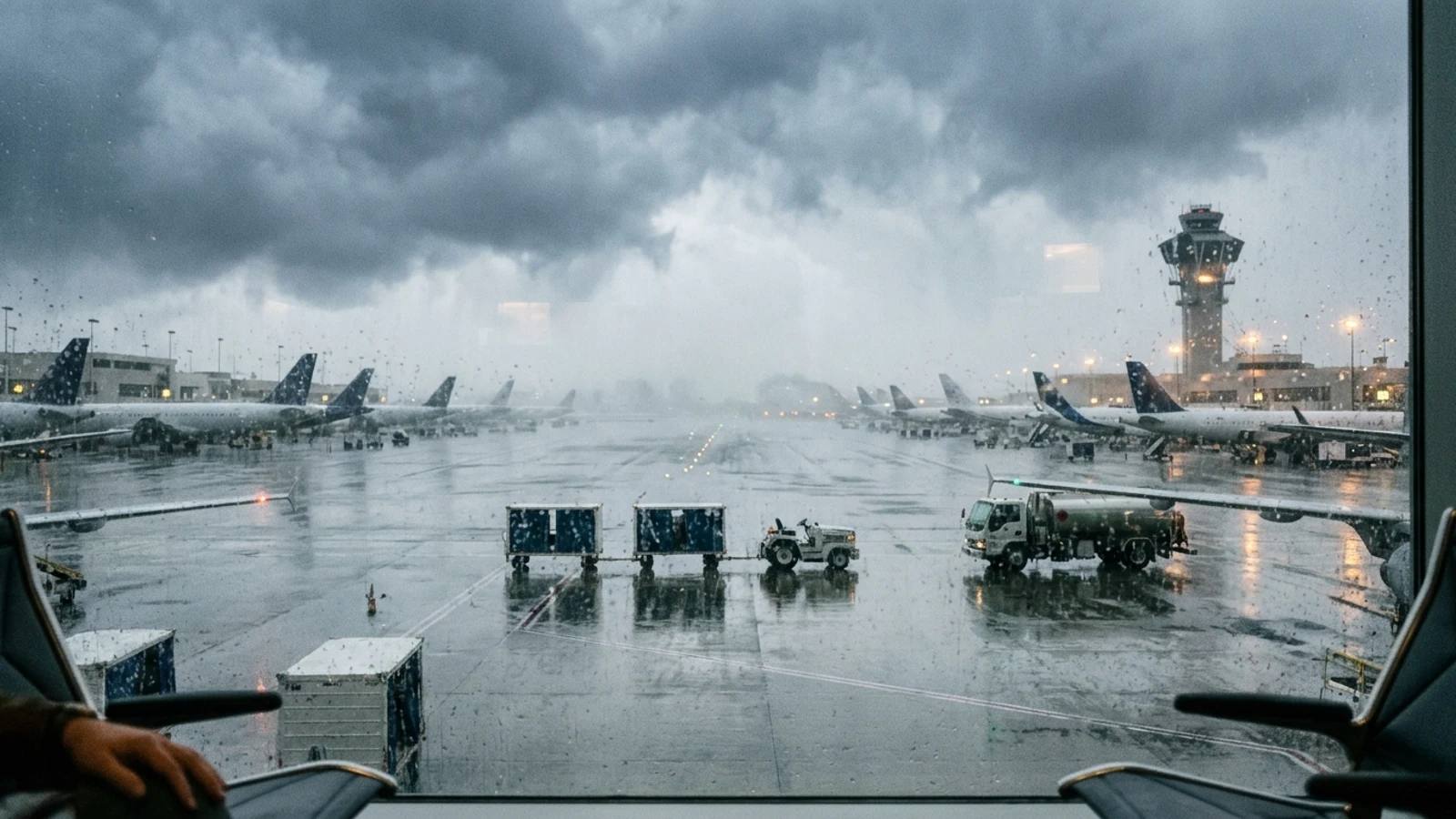
California airports experienced significant flight disruptions on Thursday, November 19, 2026, as powerful storms swept across the state. According to Travel And Tour World Aviation Discovery, Los Angeles International Airport (LAX) reported 56 delayed flights and one cancellation, while San Francisco International Airport (SFO) recorded 46 delayed flights and one cancellation. This combined morning snapshot of 102 delays and two cancellations occurred during the arrival of the season's first significant atmospheric river, which brought heavy rainfall and severe thunderstorms to the region. Source
The adverse weather conditions were characterized by heavy precipitation, thunderstorms, strong winds, and flash-flood threats. The National Weather Service issued warnings for parts of Los Angeles County, highlighting intense rainfall rates that, in some areas, exceeded one inch per hour. These environmental factors significantly complicated aviation operations by reducing visibility and affecting runway conditions. Furthermore, the strong winds presented additional challenges for aircraft during critical phases of flight, including approaches, departures, and ground handling procedures. Source
Operational safety remained the priority, forcing airlines and air traffic controllers to frequently reassess aircraft movements. Thunderstorms in the vicinity of LAX required the FAA’s Air Traffic Control System Command Center to issue advisories regarding arrival delays and airborne holding patterns, which reached up to 30 minutes in duration. While these figures provide a snapshot of the disruption, it is important to note that flight status changes throughout the day, and these totals do not reflect the full impact on the national airline network. Source
Nationwide Ground Stop Context and Recovery
The regional weather emergency follows a separate, larger aviation crisis that occurred on Friday, November 13, 2026. According to Yahoo and Patch, the Federal Aviation Administration issued a nationwide ground stop for all air traffic lasting approximately four hours. This unprecedented disruption was triggered by a technical failure at a remote facility while a contractor was replacing legacy copper wiring with fiber-optic lines. The resulting surge in connection attempts overwhelmed the air traffic control system's routers, leading to communication and radar feed failures. Source
The severity of the mid-November ground stop was significant, resulting in thousands of nationwide cancellations and delays. Data reported by FlightAware indicated that within 24 hours of the incident, over 600 flights were delayed and 293 were canceled at LAX alone. As the industry worked through the backlog, deeparrival.com noted that secondary airports, including Hollywood Burbank, John Wayne, and Ontario International, also experienced substantial delays as crews and aircraft were displaced from their original schedules. Source
Transportation Secretary Sean Duffy and FAA Administrator Bryan Bedford stated that the nationwide ground stop was a technical equipment failure, definitively ruling out cyberattacks or artificial intelligence malfunctions. The hardware involved, a faulty router, was sent to a laboratory for forensic review. Officials emphasized that while the ground stop was lifted on the evening of November 13, the restoration of normal airline operations required significant time for re-sequencing flights and repositioning flight crews to hubs across the country. Source
For passengers, the double impact of the November 13 nationwide ground stop and the November 19 atmospheric river created consecutive challenges. Travelers attempting to navigate these disruptions were advised by airports to rely on direct communications with their respective airlines rather than airport terminal information. Rebooking through mobile applications was identified as the most efficient way to manage disrupted itineraries, as airport ticket counters experienced severe congestion during the peak of the recovery periods. Source
The following table summarizes reported flight disruption metrics during the peak of the November ground stop recovery on Saturday, November 14, 2026, as captured by regional news and tracking services. Source
| Airport | Delayed Flights | Canceled Flights | Source
| :--- | :--- | :--- | Source
| LAX | 569 | 272 | Source
| John Wayne | 69 | 76 | Source
| Hollywood/Burbank | 59 | 29 | Source
| Long Beach | 17 | 9 | Source
The difference between the two events lies in their origin and scope. The November 13 event was a singular, systemic failure of air traffic control communications originating from a facility in Texas, while the November 19 disruptions were weather-driven, impacting regional capacity through standard safety protocols such as increased aircraft separation. Both events highlight the sensitivity of major gateways like LAX and SFO to disruptions that propagate quickly across domestic and international route networks. Source
Passengers traveling during these windows were warned of potential cascading impacts on connections. Missed flights, required overnight stays, and the loss of pre-booked ground transportation were common outcomes. Aviation officials urged travelers to maintain flexibility, keep personal documents in carry-on luggage, and monitor their flight status continuously. Even after the official reset of schedules, the recovery from the November 13 ground stop was noted to take until the end of that following weekend to achieve full stability. Source

