
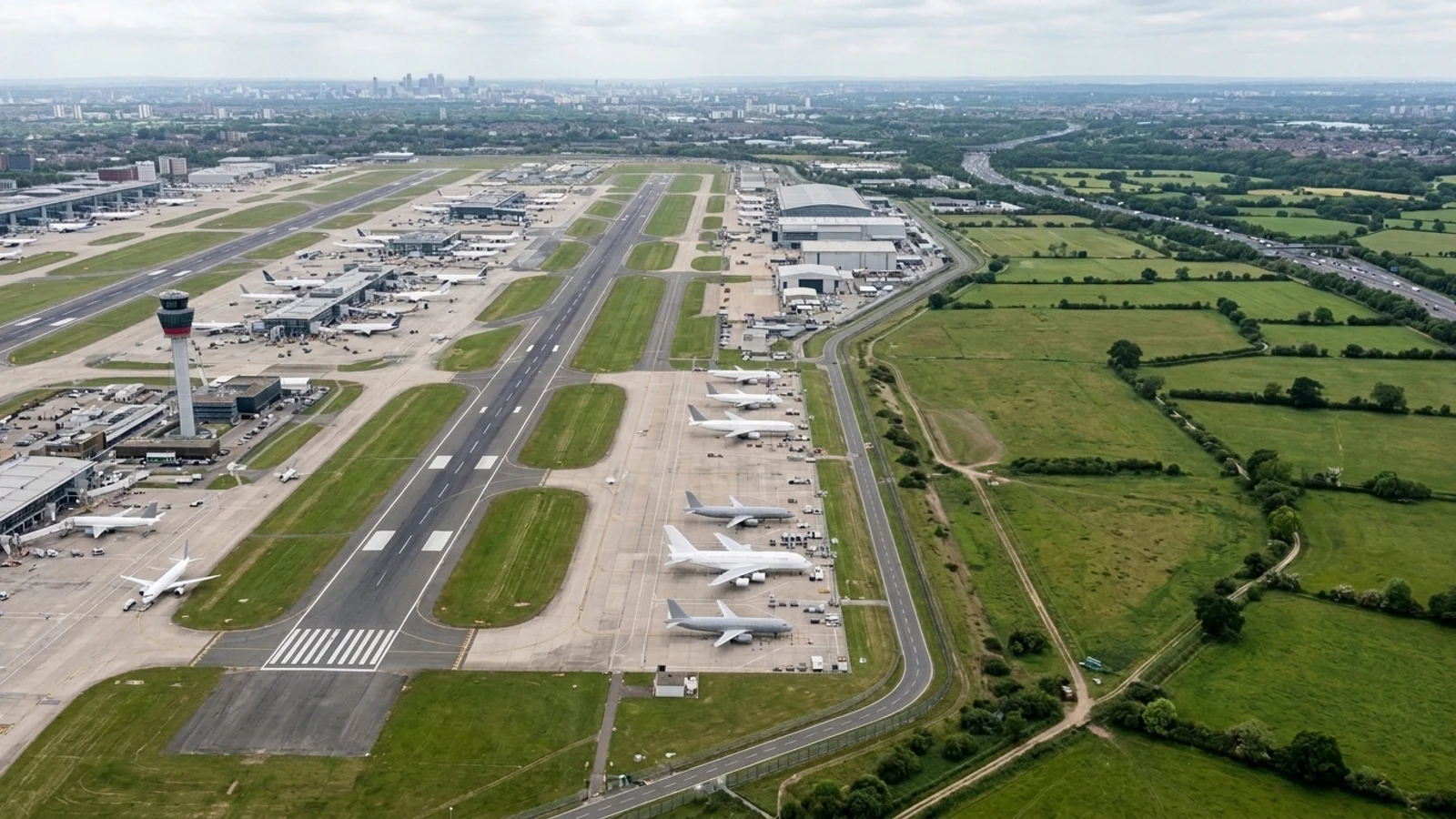
Parliamentary Oversight and Project Stagnation
The long-standing project to add a third runway at London Heathrow Airport faced a significant setback on November 26, 2026, following a formal review by the Transport Committee. British Members of Parliament delivered their official verdict on the draft Heathrow Expansion National Policy Statement after conducting an exhaustive five-week investigation. During this period, the committee engaged in rigorous evidence gathering to assess the validity of the expansion plans as proposed by the government, ultimately finding the official case to be insufficient for such a major project. Source
In its assessment, the committee explicitly addressed the government's attempts to categorize the expansion as a critical element for national economic growth. The report concluded that the administration failed to provide the necessary justification to support this classification. According to the committee, the case for labeling the Heathrow expansion as a critical infrastructure project for the UK has not been made, suggesting a fundamental disconnect between government planning documents and the actual expected benefits of the proposed third runway. Source
The committee's findings also highlighted a broader concern regarding the absence of a comprehensive national aviation strategy. MPs argued that the government should have established this overall framework before publishing the draft Heathrow Expansion National Policy Statement. Consequently, the committee urged ministers to pause all current plans and return to the planning phase to conduct more thorough work, ensuring that the full range of project benefits and associated costs are accurately defined before any further progression toward construction is considered. Source
Transport Committee Chair Ruth Cadbury formally advised that the plans for the third runway should be grounded while the government reassesses its position. The scale of the committee's review was extensive, incorporating 90 distinct pieces of written evidence. This process involved direct questioning of various key stakeholders, including community groups, academic experts, local authorities, and economists. Furthermore, the committee heard testimony from the aviation sector, the Climate Change Committee, the promoters of the runway schemes, and the Minister for Aviation. Source
Evaluation Criteria and Industry Concerns
The framework for evaluating the Heathrow expansion centers on four defined tests: national economic growth, climate impact, air quality standards, and noise pollution levels. Regarding the economic test, the committee scrutinized GDP modelling commissioned by the Department for Transport. The findings showed a marked decrease in projected benefits compared to earlier analyses. This discrepancy led the committee to describe the additional economic growth expected from the expanded airport as only relatively modest, failing to justify the project's massive scale. Source
While airline operators expressed support in principle for the expansion of London Heathrow, their feedback to the committee emphasized that affordability remains an overriding priority. Industry representatives raised concerns about the potential for increased operational charges resulting from the expensive construction of a third runway. The committee echoed these concerns, noting that any financial burden placed on airlines through these higher charges would likely be passed on to passengers, potentially impacting travel accessibility and costs for the broader public. Source
Environmental considerations also featured heavily in the committee's decision to stall the project. The Climate Change Committee provided evidence that was characterized by Chair Ruth Cadbury as a damning verdict on the environmental consequences of a third runway. The government has been advised that it cannot overlook these impacts if it intends to move forward. The committee specifically requested that the government strengthen its air quality and noise tests while developing concrete plans for improving public transport infrastructure at the airport. Source
To move beyond the current deadlock, the committee has urged the government to provide more robust analysis to fill the identified gaps in the National Policy Statement. This includes a more realistic bottoming out of the total costs for airlines and, subsequently, for passengers. Until the government completes a more transparent and comprehensive analysis that meets the committee's scrutiny, the path toward a third runway at London Heathrow remains blocked, forcing a retreat from the previously stated expansion timeline and project objectives. Source

