
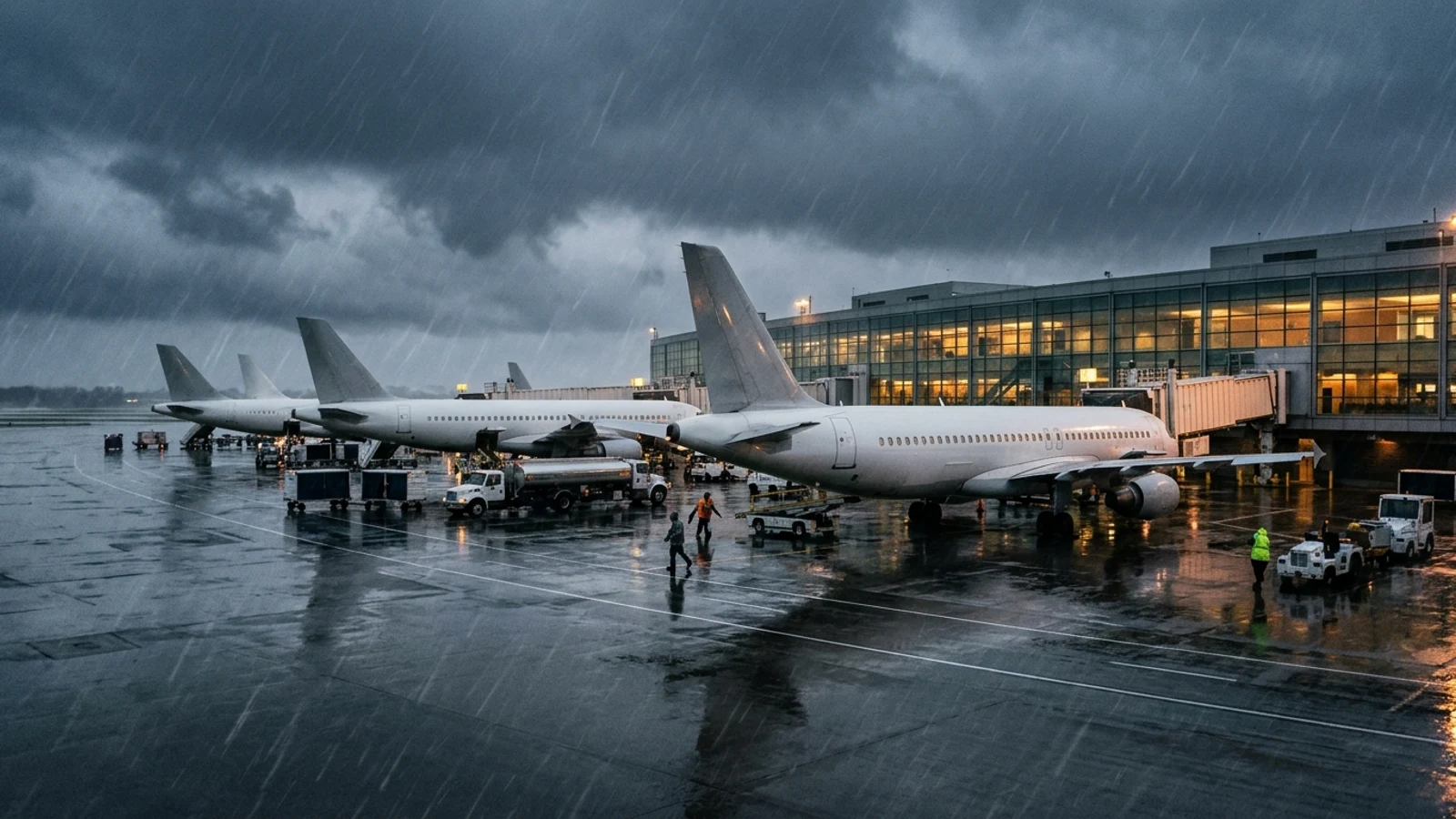
As of November 26, 2026, travelers across the United States are facing significant flight disruptions due to severe weather conditions affecting both the East and West coasts. FlightAware data indicates that 396 flights have been canceled, while 1,053 flights into, out of, or within the U.S. have experienced delays. These weather patterns, driven by dual low-pressure systems positioned off the northwest and northeast coasts, threaten to complicate transit for the more than 80 million Americans expected to travel during the holiday weekend. Source
The travel environment is further pressured by the volume of people moving for the holiday, which the Federal Aviation Administration (FAA) identifies as the busiest Thanksgiving travel weekend in 16 years. In the Miami-Fort Lauderdale region, heavy rainfall has submerged local streets, while flooding in Huntington Beach, California, has impacted homes and roadways. Coastal areas are experiencing extreme wave action, and officials in New York City and New Jersey have declared states of emergency to manage the impact of the storm. Source
Aviation disruptions are not limited to the current day. On Wednesday, November 25, 2026, flight-tracking services recorded over 6,800 delays and more than 60 cancellations. A significant operational event occurred at Miami International Airport (MIA) when a FedEx Express McDonnell Douglas MD-11 overshot a runway. This incident, involving a 34-year-old aircraft, necessitated a temporary FAA ground stop. Although the airport resumed operations Wednesday night, it did so with reduced capacity, and overnight delays were noted to exceed three hours. Source
Looking ahead, forecasts from AccuWeather and the FOX Forecast Center indicate that the Southeast and Northeast will remain sensitive areas for air traffic through Thanksgiving Day. Major hubs including Atlanta, Charlotte, Boston Logan, and several airports in the New York City metropolitan area, such as LaGuardia, JFK, and Newark, are identified as potentially high-risk for weather-related delays due to heavy rain, strong winds, and the possibility of coastal flooding or mixed precipitation as the systems move inland. Source
The potential for further disruption remains a concern for travelers. The Department of Transportation has maintained a specialized 'Tiger Team' comprising members from the FAA, Department of Defense, and other agencies to monitor the national aviation system. While federal officials seek to prevent nationwide ground stops similar to the four-hour event on November 13, they have acknowledged that while technological or human-error-based shutdowns may be mitigated, the unpredictable nature of severe regional weather remains a primary barrier to consistent flight schedules. Source
The American Automobile Association (AAA) projects that 81.5 million people will travel at least 50 miles from home for the Thanksgiving period. While nearly 90 percent of these travelers are expected to drive, the scale of road-based travel is also affected by the storms. Interstate 5 in the Pacific Northwest and mountain passes in the Rockies are expected to encounter significant snowfall and reduced visibility, while the St. Johns River watershed in Florida continues to experience elevated water levels from recent rainfall. Source
Operational Impact and Regional Outlook
Travelers should be aware that flight status can change rapidly. Information provided by official tracking services often reflects current observed delays rather than long-term forecasts. Travelers are advised to consult their specific airline carriers for real-time status updates, particularly when connecting through high-volume hubs in the Southeast and Northeast where atmospheric conditions are forecasted to intensify through November 27. Source
The following table summarizes the observed travel impacts reported across the holiday week, categorized by region and type of disruption. These figures reflect data captured by regional monitors and flight tracking services up to November 26, 2026. Source
| Region/Factor | Observed Impact | Status/Date |
|---|---|---|
| U.S. National | 396 Flight Cancellations | Nov 26, 2026 |
| U.S. National | 1,053 Flight Delays | Nov 26, 2026 |
| Miami (MIA) | Runway Overshoot/Ground Stop | Nov 25, 2026 |
| Boston (BOS) | 141 Delays / 6 Cancellations | Nov 22, 2026 (1 p.m.) |
| Nationwide | 81.5 Million Travelers | Thanksgiving Week |
Beyond flight traffic, weather conditions may also affect traditional outdoor events. In New York City, meteorologists are monitoring wind conditions for the 100th anniversary of the Macy's Thanksgiving Day Parade. Strict safety protocols dictate that balloons are prohibited from flying if sustained winds reach 23 miles per hour or if gusts exceed 34 miles per hour. These restrictions are in place to prevent the massive parade structures from acting as sails, posing a potential risk to spectators and handlers during the event. Source
Historical precedent for such disruptions is well-documented. In 1997, high winds pushed a parade balloon into a lamppost, resulting in injuries to four individuals. While the current forecast focuses on the broader impact of low-pressure systems traversing the country, the intersection of dense holiday travel and volatile atmospheric conditions requires constant monitoring by passengers and parade coordinators alike. Forecasters expect that travel headaches will begin to dissipate by Saturday, November 28, as the systems clear the eastern coast. Source
Managing Holiday Travel Logistics
The FAA and Department of Transportation note that despite the increased volume of travelers, their strategy focuses on maintaining system-wide integrity. While severe weather creates localized cancellations, the goal remains to ensure that any disruptions are contained and do not result in a total, nationwide cessation of air traffic. Travelers are encouraged to monitor weather alerts for their departure and destination cities to understand the potential for localized delays before arriving at the airport. Source

