
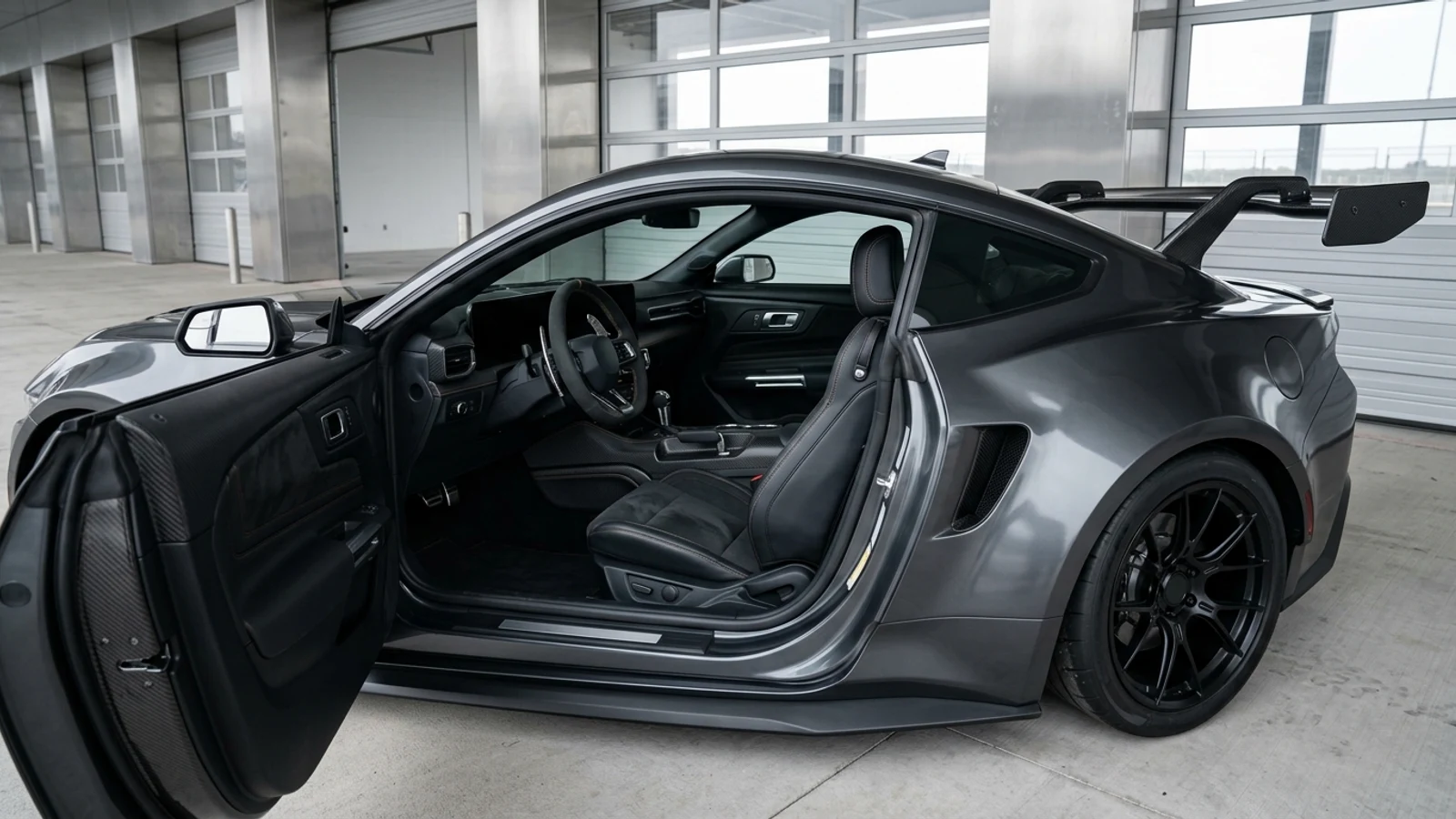
Ford has confirmed significant updates for the 2028 Mustang GTD model year, aimed at enhancing the vehicle's aesthetic and ergonomic profiles. A primary development is the introduction of a new 1901 special edition, designed to honor the historical Sweepstakes car that Henry Ford piloted to victory in 1901. This launch marks a 125-year celebration of that milestone. The new livery replaces the previously offered Spirit of America package, signifying a shift in the aesthetic strategy for this high-performance vehicle. Source
The 1901 special edition distinguishes itself with a Royal Red exterior finish complemented by contrasting black accents throughout the vehicle. To maintain a focus on performance-oriented styling, the front splitter, rear diffuser, rocker panels, and rear wing are constructed from exposed carbon fiber. Inside the cabin, the theme continues with mahogany red leather seats accented by race red stitching. These specific design elements define the 1901 package, which comes standard with the vehicle's Performance Package, focusing on weight reduction and aerodynamics. Source
Beyond the aesthetic changes, Ford has focused on tactile improvements for the driver's interface. The 2028 Mustang GTD features newly redesigned 3D-printed titanium paddle shifters alongside a revised shift ring. Furthermore, the interior luxury has been elevated with the application of full-grain leather across the instrument panel, door panels, and center console. These updates aim to refine the cockpit experience while maintaining the high-performance heritage associated with the Mustang badge in the current lineup. Source
In addition to the interior revisions, Ford has addressed previous supply chain constraints regarding optional components. For the 2028 model year, buyers will have access to magnesium wheels, which were originally slated for the car's launch but limited by availability issues. The exterior palette has also been refreshed, with the introduction of Incognito Green and Teal Tonic colors, which replace the previously available Sage Green and Blue Metallic options. Ford has additionally added new painted stripe selections to enhance customization for owners. Source
Under the hood, the powertrain remains unchanged for the 2028 model year. The vehicle continues to utilize a supercharged 5.2-liter V8 engine paired with a dry-sump oil system. According to specifications, the engine produces 815 horsepower and 664 pound-feet of torque. Power is delivered through a rear-mounted eight-speed dual-clutch transaxle. These mechanical figures maintain the vehicle's top speed, which is documented at 202 miles per hour. Stopping power is managed by Brembo ceramic brakes installed as standard equipment. Source
The logistical timeline for the 2028 model year has been clearly outlined by the manufacturer. Interested customers are scheduled to begin placing orders in December. Deliveries of the updated Mustang GTD are currently expected to commence during the second quarter of 2027. While details regarding the specific pricing structure for the 2028 model have not been finalized, Ford has stated that this information will be released closer to the vehicle's official on-sale date in the coming months. Source
Comparison of recent Ford Mustang performance models shows a wide range of engineering goals. The base 2027 Ford Mustang utilizes a 10-speed automatic transmission and a rear-wheel-drive platform, producing 315 horsepower and 350 lb.-ft. of torque. In contrast, the Mustang GTD is engineered for a distinct market segment requiring high-output track performance. These variations highlight the breadth of the Mustang lineup, ranging from accessible entry-level trims to specialized, limited-production variants built for high-speed track capability and luxury finish. Source
The competitive landscape for high-performance vehicles includes several manufacturers with distinct approaches to power and architecture. For example, the 2027 Chevrolet Corvette Z06 utilizes a naturally aspirated flat-plane crank engine producing 670 horsepower, catering to a mid-engine performance demographic. Similarly, the 2026 Porsche Cayenne Turbo Coupe Electric utilizes an all-electric powertrain to achieve 844 horsepower, demonstrating the industry's shift toward diverse propulsion systems. These vehicles offer alternative performance metrics compared to the supercharged V8 setup of the Ford Mustang GTD. Source
In the luxury performance SUV segment, the 2027 Mercedes-Benz GLC-Class Coupe offers a different focus. With an all-wheel-drive system and a 255 horsepower output, this model emphasizes daily drivability and refined interior utility rather than the track-focused performance found in the Mustang or Corvette variants. The curb weight of the GLC-Class Coupe, listed at 4321 lbs, contrasts with the lighter 3588 lbs base 2027 Mustang, illustrating the differences in engineering focus and market intent among current automotive offerings. Source
Documentation for the 2027 Mustang base model provides a foundation for understanding the standard features across the Ford portfolio. With a curb weight of 3588 lbs and a wheelbase of 107 inches, it occupies a specific footprint in the sports car category. The inclusion of the 10-speed automatic transmission reflects a balance between modern performance demands and daily driving utility. When reviewed against specialized models like the Mustang GTD, these figures clarify the gap between standard production vehicles and the GTD's track-oriented engineering. Source
The specifications of the 2027 Chevrolet Corvette Z06 further underscore the diversity of performance engineering. With a width of 79.7 inches and a height of 48.6 inches, the vehicle's physical dimensions are optimized for aerodynamics and track performance. The use of an 8-speed auto-shift manual transmission allows for high-RPM power delivery, peaking at 8400 RPM. This contrasts with the Ford Mustang GTD, which utilizes an 8-speed dual-clutch transaxle to manage the power generated by its supercharged 5.2-liter engine. Source

