
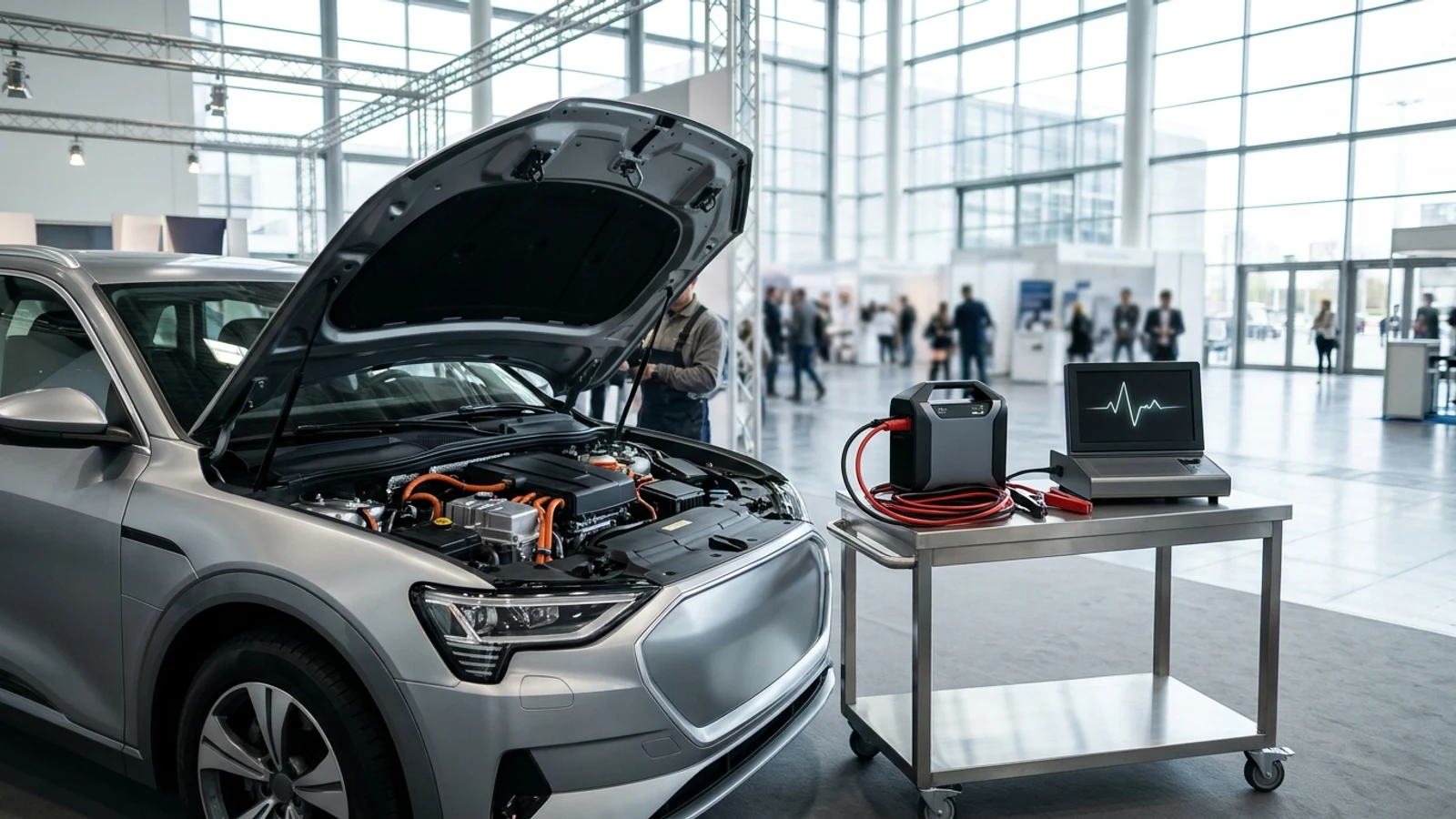
Leagend, an automotive technology company, announced plans to present its newest range of battery-care and vehicle-starting solutions at the Automechanika Shanghai 2026 trade show. The exhibition is scheduled to take place from December 2 to December 5, 2026, at the National Exhibition and Convention Center in Shanghai, China. The manufacturer intends to display its product line at Booth 6.2A64, emphasizing technical advancements in continuous battery monitoring and supercapacitor-based starting systems. Source
The company's showcase focuses on two primary technology categories designed for the automotive aftermarket. The first category involves ultra-low-power battery monitoring, while the second focuses on intelligent vehicle starting solutions built around supercapacitor technology. Leagend states that these products are intended for a variety of industry professionals, including distributors, importers, wholesalers, and service providers looking to improve visibility into battery conditions and expand their electronic product portfolios. Source
For continuous monitoring, the manufacturer is highlighting the BM7 Battery Monitor. This device is compatible with 6V, 12V, and 24V lead-acid and lithium batteries. It is designed for diverse applications, ranging from passenger vehicles and trucks to motorcycles, RVs, boats, and stationary energy storage systems. The unit operates via the Bluetooth-enabled leagend Smart App, which provides users with data on battery voltage, temperature, charge levels, and historical performance logs. Source
Technical specifications for the BM7 monitor include an onboard memory capability that stores up to 72 days of historical data, with measurements recorded every two minutes. The accompanying smart app supports unlimited data storage and allows users to track up to four distinct devices on a single interface. According to the manufacturer, the device uses ultra-low-power technology to ensure it does not create significant electrical loads on the batteries it monitors during extended periods of vehicle inactivity. Source
In addition to monitoring, Leagend is introducing its SuperCap Jump Starter series. Unlike traditional portable jump starters that rely on internal lithium batteries, these systems are designed for permanent, onboard installation. The units use supercapacitors to manage energy replenishment and provide supplemental cranking power. The series includes an intelligent self-learning mode that observes vehicle-specific voltage and cranking behavior to establish a baseline for automatic starting assistance when needed. Source
The SuperCap series is engineered to function across a broad temperature range from -40°C to 80°C. By sharing the electrical load during the engine-cranking process, the system aims to reduce stress on the primary vehicle battery, potentially extending its service life. The manufacturer notes that actual improvements in battery longevity are dependent on individual vehicle configurations, the current condition of the original battery, and specific operating environments encountered by the user. Source
SuperCap Jump Starter Series Specifications
Leagend will feature the JS300 as the primary representative model for the SuperCap line at the trade show. This model is designed for 12V sedans and SUVs with engine displacements between 2.0L and 3.5L. It is capable of delivering a peak starting current of 1,000A. The unit has an average standby current consumption of approximately 3mA and includes a 'Drive Mode' feature that allows the onboard supercapacitors to function as an energy buffer during vehicle operation. Source
The company has developed a range of variants within the SuperCap series to suit different market needs. These models are categorized by their intended engine size or system voltage requirements, allowing for selection based on the specific regional vehicle population. The JS200 is aimed at smaller passenger vehicles, the JS300 targets mid-range engines, the JS400 is for performance or larger-displacement engines, and the JS600 is designed specifically for 24V commercial vehicle systems, such as trucks and buses. Source
| Model | System Voltage | Engine/Application | Peak Current |
|---|---|---|---|
| JS200 | 12V | Small Displacement | Unspecified |
| JS300 | 12V | 2.0L – 3.5L | 1,000A |
| JS400 | 12V | Large/Performance | Unspecified |
| JS600 | 24V | Trucks and Buses | Unspecified |
Manufacturing and Technical Background
Leagend, established in 2005, reports that it serves more than 1,000 professional customers worldwide. The company maintains its own research and development division, which accounts for 40% of its total workforce. According to internal reporting, 30% of the firm's annual revenue is reinvested into technology and product development. This infrastructure supports their ability to offer varied electronics, including battery testers, chargers, OBD II diagnostics, and thermal imagers, in addition to the newly highlighted monitor and jump-start product lines. Source
For industry partners planning their 2027 inventories, the exhibition provides an opportunity to evaluate these technologies directly. The manufacturer encourages interested parties—including distributors and professional service technicians—to visit their booth to discuss potential private-label opportunities or OEM/ODM development. Those unable to attend may contact the company via email to request specific technical catalogs, wholesale pricing quotations, or to schedule further business consultations regarding the new product series. Source
The combination of the BM7 monitor's long-term data logging and the SuperCap Jump Starter's permanent installation reflects an attempt to address battery health throughout the entire vehicle lifecycle. By integrating monitoring and startup intelligence, Leagend aims to provide a more comprehensive, automated solution for modern vehicle electronic systems. The company emphasizes that these products can be integrated into existing aftermarket channels as either bundled sets or standalone product offerings based on specific regional demand. Source

