
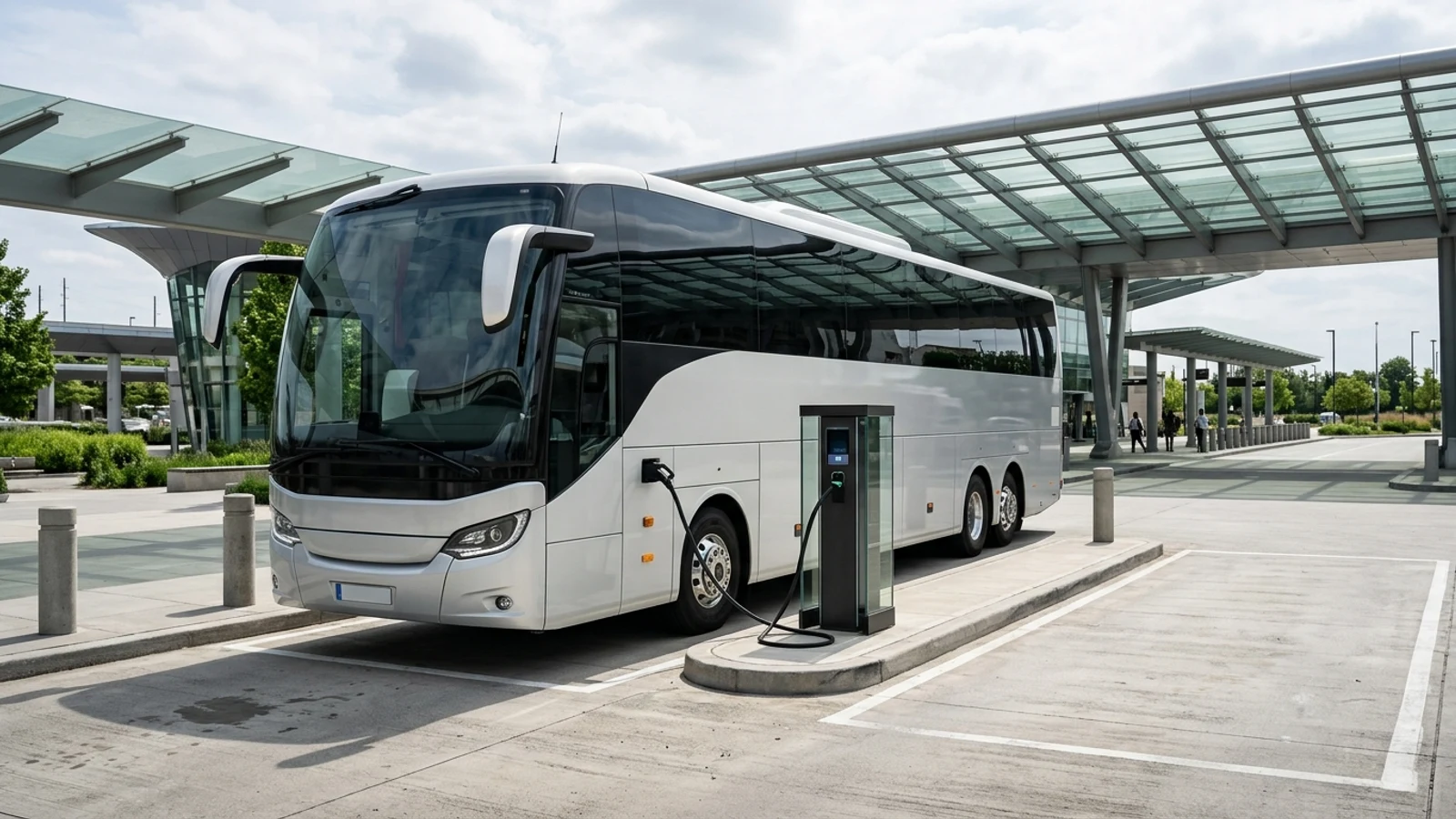
Prevost, the Quebec-based manufacturer owned by Volvo Group, has officially introduced its first battery-electric motorcoach, the H3-45 Electric, to the North American market. Unveiled on November 26, 2026, at the company's factory in Sainte-Claire, Quebec, the new model is designed to serve as a zero-emission alternative for operators. The coach builds upon the company's existing H-Series platform, maintaining the 45-foot three-axle configuration that has become a mainstay for highway travel across the continent. Source
Under the hood, the H3-45 Electric utilizes a propulsion system sourced entirely from Volvo Group. This includes a dual-motor electric drivetrain paired with an eight-speed automated manual transmission that incorporates an integrated hydraulic retarder. Rated at 450 kW, the powertrain is specifically engineered for highway applications where gear reduction helps maintain motor efficiency. Prevost reports an efficiency rating of 97% across the vehicle's working range, complemented by adjustable regenerative braking for descending grades. Source
The energy storage system consists of six liquid-cooled Volvo Cube 2 lithium-ion battery packs operating on a 600V architecture. While the total nominal capacity of the system is 540 kWh, the manufacturer specifies 459 kWh as the usable energy capacity. Prevost utilizes the remaining 15% of the total capacity as a buffer. The battery modules are IP6K9K-rated and use the same VCS2B coolant found in the diesel H3-45, with Volvo managing the program for battery refurbishment and recycling. Source
Regarding charging capabilities, the H3-45 Electric supports both the CCS1 and Megawatt Charging System (MCS) standards. According to Prevost, charging via a 350 kW CCS1 system allows a 20-80% state-of-charge increase in approximately 55 minutes. When using the MCS connection, this time is reduced to roughly 35 minutes. The charging port is strategically positioned to accommodate pull-through truck-stop stalls, and the manufacturer confirms that no adapters are required when using public charging networks. Source
The operational range of the coach is estimated by the manufacturer at up to 250 miles (400 kilometers). This figure assumes ideal conditions, as average energy consumption is anticipated at approximately 2.25 kWh per mile. Consequently, operators are advised to plan for closer to 200 miles of real-world range to maintain a functional energy reserve. The coach remains consistent with the diesel H3-45 in its passenger capacity, seating up to 52 individuals in a premium travel environment. Source
In addition to core performance metrics, the H3-45 Electric retains familiar features such as Cloud One Premium seating, an automatic tag-axle unload system, and a kneeling function for passenger accessibility. Driver safety is supported by the Prevost Driver Assist system and LED headlights, with 360-degree cameras and a winter package available as optional equipment. Operators should note that the available cold-weather heating system is diesel-fired, which may result in limited emissions during operation in freezing climates. Source
Prevost positions the H3-45 Electric as a drop-in replacement for diesel fleets, noting that the curb weight and overall dimensions are aligned with the traditional diesel model. This design philosophy aims to minimize the learning curve for maintenance technicians and operators, as the dashboard controls and chassis architecture remain largely unchanged. The company also offers a program to help customers analyze their existing diesel routes to estimate energy consumption and infrastructure requirements for the electric transition. Source
For fleet operators, the transition schedule includes pilot projects set to begin in early 2027, with full production deliveries currently anticipated by mid-August 2027. Market demand is expected to be strongest in regions with robust zero-emission incentives, such as California, where state-funded voucher programs like the Hybrid and Zero-Emission Truck and Bus Voucher Incentive Project can reduce acquisition costs for Class 8 vehicles by up to US$120,000. Prevost is also looking to British Columbia, Ontario, and Quebec for early adoption. Source
Technical Specifications
The table below summarizes the key technical specifications for the Prevost H3-45 Electric model as released by the manufacturer upon the vehicle's unveiling. These figures reflect the integration of the Volvo-sourced electric drivetrain and battery systems. Source
| Specification | Value |
|---|---|
| Nominal Battery Capacity | 540 kWh |
| Usable Battery Capacity | 459 kWh |
| Rated Motor Power | 450 kW |
| Max Range (Estimated) | 250 miles / 400 km |
| CCS1 (20-80%) Charge Time | 55 minutes |
| MCS (20-80%) Charge Time | 35 minutes |
| Max Passengers | 52 |
Market Strategy and Availability
Prevost emphasizes that the factory lines in Sainte-Claire are flexible, allowing for the concurrent production of both diesel and electric units. This modular manufacturing approach is intended to allow the company to pivot production volumes in response to shifting market demand. As of the unveiling, the company continues to lean on the established diesel H3-45, which meets current EPA and CARB standards, ensuring a dual-path offering for operators with varying operational requirements across North America. Source
While Prevost has successfully brought the H3-45 Electric to the market, several details remain unconfirmed regarding future service and support. Specifically, the manufacturer has not provided pricing information for the electric model at this stage. Furthermore, the status of the previously announced retrofit kit, intended to convert existing diesel coaches to electric powertrains, remains unclear as the company shifts its focus toward the production of new electric units. Operators are encouraged to consult directly with local Prevost representatives for specific site planning. Source

