
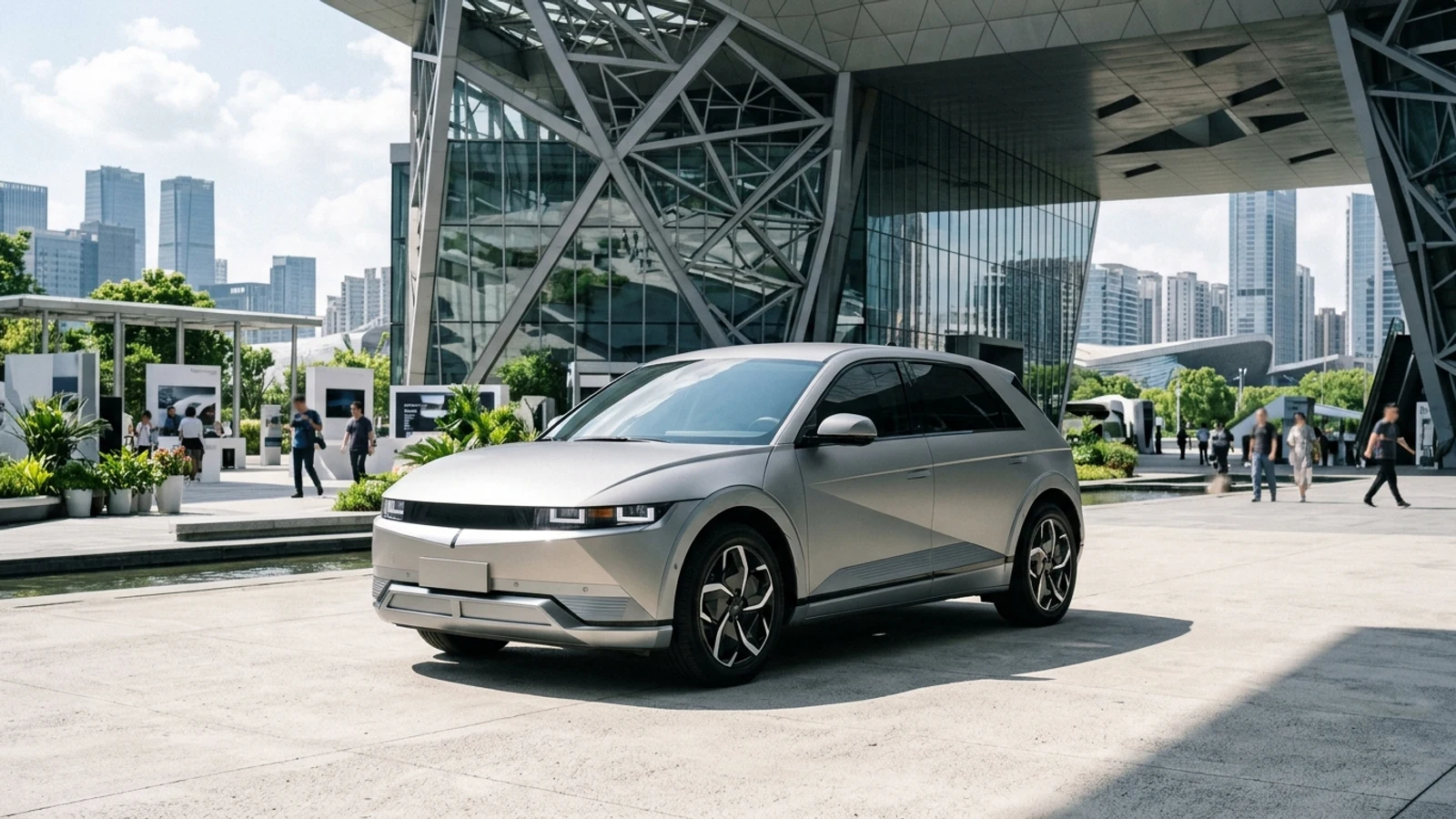
On November 27, 2026, Hyundai Motor Company introduced the Mercury Concept at the Guangzhou International Automobile Exhibition in China. This vehicle serves as a preview for the upcoming IONIQ M, an all-electric, B-segment premium smart SUV designed specifically to address the needs and driving conditions of the Chinese market. The company confirmed that the production version of the model is scheduled to reach consumers in China during the first half of 2027. Source
The Mercury Concept is the third vehicle in Hyundai's China-focused IONIQ Planet lineup, following the release of the IONIQ V earlier in September 2026 and the announcement of a larger Earth SUV. Development of the Mercury was handled entirely by Hyundai Motor's local Chinese design and engineering teams. This localized approach marks a strategic shift for the automaker, which aims to improve its competitiveness by utilizing regional research, development, and supply chain resources directly within the Chinese market. Source
The vehicle's aesthetic features a futuristic, low-slung profile that the company states is inspired by the orbit of Mercury. Key exterior elements include a sharp shark-nose front end, slim H-shaped lighting signatures that represent the Hyundai badge, and a steeply raked windscreen. The concept is finished in a bold yellow-green color officially designated as Citrine Neon and incorporates an integrated rear spoiler along with concealed M emblems to distinguish the model's identity. Source
Hyundai intends for the IONIQ M to become the most accessible entry-level model within the broader IONIQ product universe. While official powertrain and battery specifications remain unconfirmed, the model is expected to share technical similarities with the existing IONIQ V. For context, the current IONIQ V in China utilizes CATL-supplied lithium iron phosphate (LFP) batteries, with options including a 53.5 kWh pack linked to a 140 kW motor or a 66.8 kWh pack matched with a 168 kW electric motor. Source
In addition to the standard electric architecture, Hyundai has confirmed that a battery-swapping version of the IONIQ M will be available. This variant is being developed through a partnership with Contemporary Amperex Technology Co. Limited (CATL) and will be compatible with the Choco-Swap system. This strategic inclusion allows the vehicle to cater to urban drivers who may prioritize charging flexibility and minimized downtime as part of their daily commute. Source
The technology stack of the IONIQ M is heavily localized, featuring the Zhuoyu L2++ advanced driver-assistance system. While labeled as L2++, Hyundai emphasizes that this is an assistance system rather than an autonomous driving solution. The cabin will also integrate a smart cockpit powered by ByteDance's Doubao AI model, which is engineered to handle natural language interaction and proactive services tailored specifically to the preferences of Chinese vehicle owners. Source
Following the IONIQ M launch in 2027, Hyundai's roadmap for China includes several other upcoming energy vehicles. The production version of the larger Earth SUV is expected in 2028, and the brand plans to introduce two additional models to the lineup in 2029. These vehicles are intended to span various segments, including sedans, SUVs, and multipurpose vehicles, as part of a push to maintain relevance in a market where new energy vehicles represent a large share of sales. Source
Although the IONIQ M is explicitly designed for the Chinese market, Hyundai Australia spokespeople have stated that the company is exploring expansion opportunities for the model into other global regions. However, no official confirmation has been provided regarding whether the vehicle will reach markets outside of China. This uncertainty leaves a potential gap for Hyundai, especially in regions where compact electric SUV options have recently been withdrawn or shelved, such as the previously considered Ioniq 3. Source
The decision to lean on local Chinese suppliers—specifically CATL for battery modules, Zhuoyu for assistance software, and ByteDance for AI cockpit integration—represents a change in strategy for the automaker. By sourcing from providers who operate in close proximity to the end-users, Hyundai hopes to iterate on software and hardware faster than it could through traditional cross-border development cycles. This reflects a broader industry challenge where foreign brands are adapting to high-speed local development demands. Source
The following table summarizes key details regarding the IONIQ M as provided in the manufacturer's disclosure at the Guangzhou Auto Show. Source
| Feature | Specification or Status | Source
| :--- | :--- | | Market Focus | China | | Vehicle Type | B-segment compact SUV | | Launch Date | 2027 | | Driver Assistance | Zhuoyu L2++ ADAS | | Infotainment | ByteDance Doubao AI | | Battery Options | Standard EV and CATL Battery-Swap | Source

