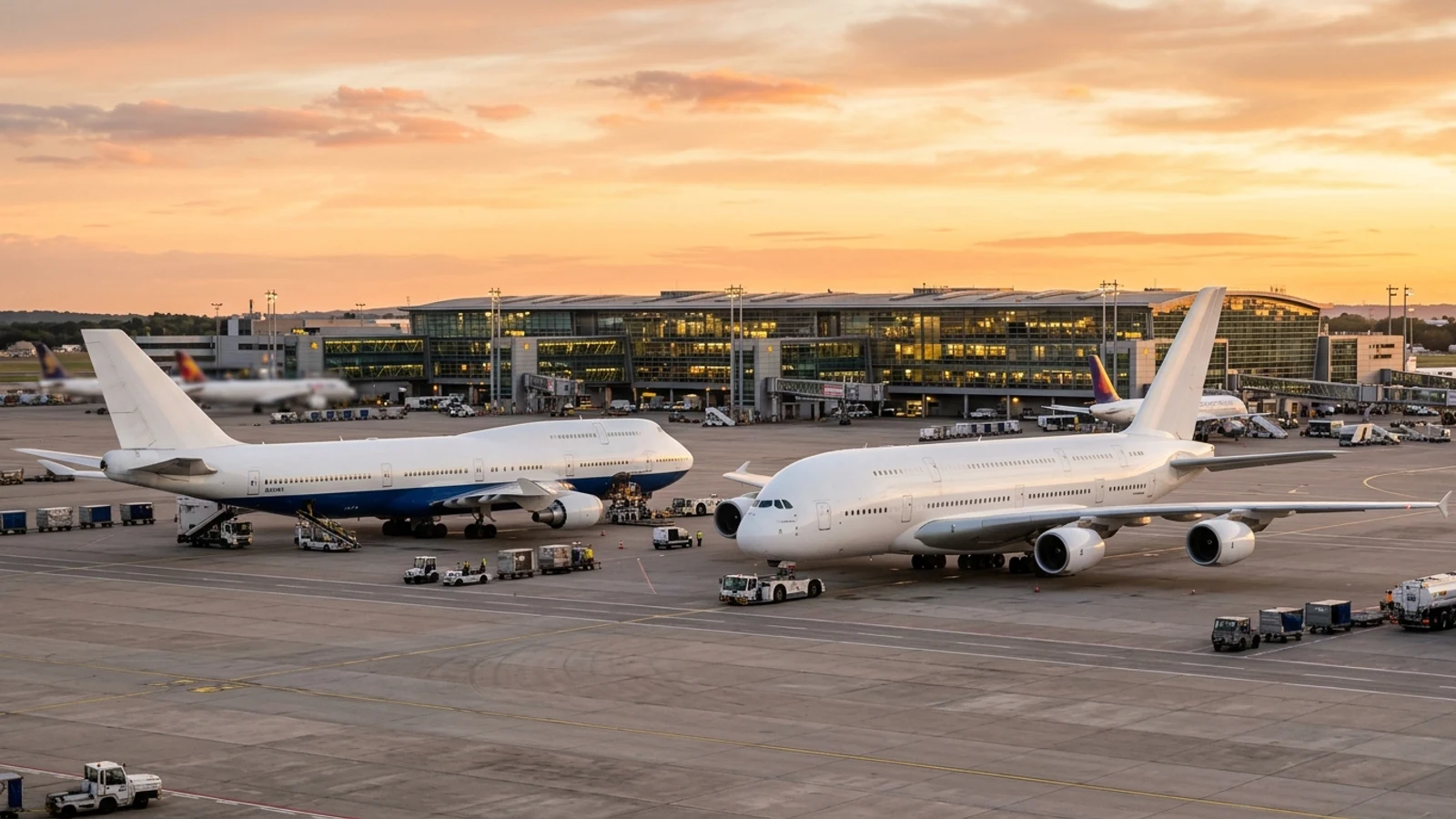
The competition between the Airbus A380 and the Boeing 747-8 Intercontinental has historically defined the peak of four-engine widebody aircraft design. When the A380 entered service, it surpassed the classic 747 in wingspan, height, weight, and passenger capacity. Airbus designed the double-decker with an enormous footprint to dominate in sheer volume, effectively claiming the title of the world's largest commercial jetliner. This transition marked a significant shift in long-haul aviation history by directly challenging Boeing's dominance as the builder of the most massive passenger aircraft in the sky. Source
Boeing responded to this challenge by stretching its classic 747 platform into the 747-8 Intercontinental. Rather than building a new double-decker, the company focused on lengthening the fuselage and enhancing the wing aerodynamics. This strategy allowed the 747-8 to maintain compatibility with existing international airport infrastructure, as it features a narrower wingspan compared to the superjumbo. By adding two fuselage sections—one in front of and one behind the wings—Boeing successfully increased the aircraft length to 250 feet 2 inches, securing the record as the longest commercial airliner in service. Source
The length difference between the two aircraft is substantial, with the 747-8 measuring approximately 11.5 feet longer than the Airbus A380. Beyond this length advantage, the Boeing 747-8 also claims the title of the fastest commercial airliner currently in operation. Cruising at Mach 0.855, or roughly 567 mph at 35,000 feet, the aircraft edges out the A380, which cruises at Mach 0.85. This speed advantage, while minor, allows dispatchers to better manage arrival schedules and mitigate the impact of headwinds during long-haul international flights. Source
In terms of design philosophy, the two manufacturers pursued distinct goals regarding ground logistics and operational efficiency. The A380 requires specialized infrastructure, including dual-level jet bridges and widened taxiways, which limited its deployment to specific mega-hubs. In contrast, the 747-8 was engineered to fit into standard international widebody gates. This pragmatic decision by Boeing aimed to lower ground costs for airlines, although the aircraft's four-engine configuration ultimately struggled against the growing industry preference for more fuel-efficient twin-engine jets. Source
Boeing incorporated advanced technology from the 787 Dreamliner program into the 747-8 to enhance its performance. The installation of four General Electric GEnx engines provided higher thrust and better fuel efficiency than previous powerplants. Additionally, the wings feature a sharp sweep-back design paired with raked wingtips, which minimize drag at high cruising speeds. These aerodynamic features, combined with computer-controlled actuators that manage wing vibrations during turbulence, allow the 747-8 to maintain its performance envelope while carrying over 400 passengers across international routes. Source
The financial trajectory of both projects reflects the changing needs of the global airline market. Boeing ceased 747 manufacturing in January 2023 after delivering 155 of the stretched -8 variants and incurring nearly $4.2 billion in losses. Airbus also ended A380 production in December 2021 following 251 deliveries. Despite these closures, the legacy of these aircraft remains evident in how they shaped current fleet strategies, with many airlines now pivoting toward more efficient, modern widebodies like the Airbus A350, which has garnered significant success with over 1,300 orders to date. Source
The Airbus A350, launched in 2006 to compete against the Boeing 787, currently serves as a backbone for many major carriers. Unlike the massive four-engine jets of the past, the A350 leverages Carbon-Fibre Reinforced Polymer (CFRP) to significantly reduce weight. Major airlines such as Japan Airlines, Air China, Cathay Pacific, Qatar Airways, and Singapore Airlines utilize the A350 for long-haul routes, often replacing older Boeing 777 or 747 fleets to improve operational efficiency and passenger comfort through modern cabin configurations. Source
Operators have adapted their fleet strategies to balance capacity with regional demand. For instance, while some airlines maintain distinct first-class products, others have focused on business class, such as the widely acclaimed Qsuites on Qatar Airways' A350-1000 fleet. The shift toward twin-engine efficiency has effectively superseded the market demand for the four-engine giants, yet the Boeing 747-8 and Airbus A380 stand as technical milestones in aeronautical engineering, representing the pinnacle of large-capacity commercial aviation design that preceded the current generation of ultra-efficient jets. Source
Technical specifications for the 747-8 highlight the trade-offs between size and weight. While initial program estimates suggested the aircraft might be overweight by 8 to 10 tonnes, Boeing engineers utilized redesigned wings and advanced materials to maintain performance commitments. The aircraft eventually solidified its role in both cargo and VIP configurations. The freighter variant, in particular, was delivered to clients as early as October 2011, reflecting Boeing's push to keep the 747-8 relevant within global logistics markets despite the challenges associated with four-engine operating costs. Source
Comparing the two flagship aircraft provides clarity on their physical and operational differences. The following table summarizes key comparative statistics based on reported aircraft data for the 747-8 and A380. Airlines such as Lufthansa have historically operated both types, strategically placing the 747-8 in standard gates at hubs like Frankfurt and utilizing the A380 for high-density, high-demand routes from Munich. These operational choices underline the flexibility that airport compatibility brings to airline scheduling when managing different aircraft sizes within a single fleet. Source
Comparison Summary Source
The future of long-haul aviation is currently shifting toward the Boeing 777-9, which promises to challenge the current records. With an expected length of 251 feet 9 inches, the 777-9 will surpass the 747-8 as the longest commercial airliner. Featuring folding wingtips and GE9X engines, this twin-engine aircraft aims to maintain large passenger capacities at a significantly lower fuel burn. As these newer, highly efficient models enter service, the historical giants—the A380 and 747-8—will continue to be recognized as the final generation of true four-engine passenger heavyweights. Source