
A321neo Certification and Cabin Changes
Delta Air Lines encountered significant operational challenges with its newest Airbus A321neo aircraft after the carrier could not install its planned premium cabin design. The airline had intended for these narrowbody jets to feature the Safran Vue business class seat, which was designed to offer a reverse-herringbone layout with window-facing positions. However, certification delays involving US Federal Aviation Administration safety standards, specifically regarding human factors and crashworthiness, rendered the seats unusable for commercial operations. Source
The certification process for the Safran Vue seat proved more complex than anticipated due to the reverse-herringbone design, which differed significantly from conventional aircraft seating layouts. Every deviation from established standards requires rigorous regulatory review to ensure safe passenger movement and efficient cabin evacuation during emergencies. As these safety requirements remained unresolved, several factory-fresh A321neos were forced into storage in desert facilities rather than entering active service as initially planned by the airline. Source
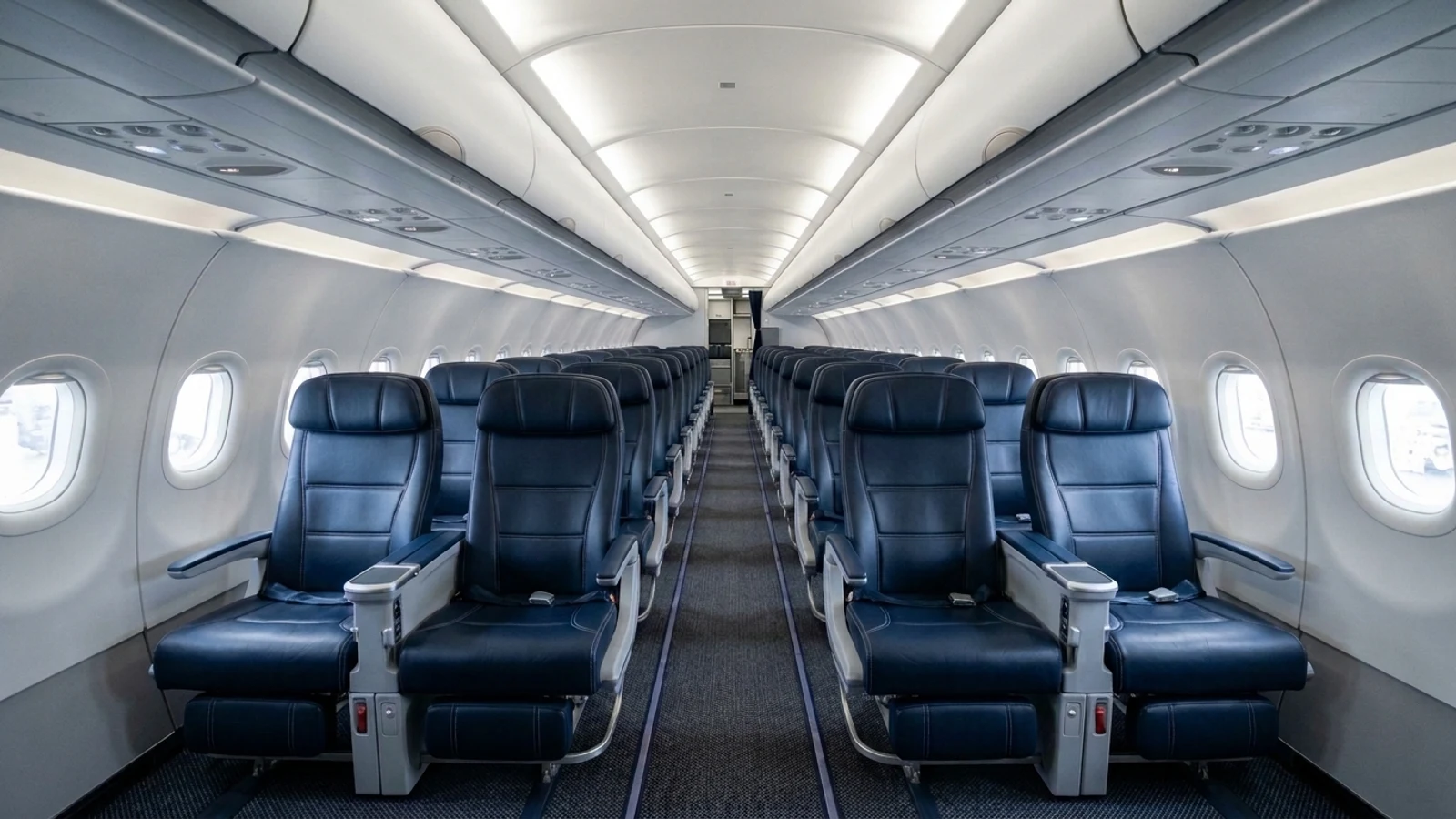
To mitigate revenue losses and aircraft inactivity, Delta introduced a temporary interior configuration for these A321neo aircraft in May 2026. This interim layout replaced the originally envisioned 16 lie-flat business class suites with 44 domestic first class recliner seats. The full modified cabin now comprises 44 first class seats, 54 Comfort+ seats, and 66 economy class seats. This adjustment allowed the aircraft to enter the network while providing a high-capacity premium offering, though it lacks the lie-flat product originally targeted. Source
The operational reality of the temporary 44-seat first class cabin presents unique challenges, particularly regarding lavatory access. With a large number of premium passengers served by a single forward lavatory, the passenger-to-bathroom ratio is significantly higher than in standard configurations. This mismatch may lead to queues, complicating the premium experience that Delta aims to provide on transcontinental routes. The airline is reportedly evaluating a potential switch to the Thompson Vantage Solo seat for future configurations. Source
Strategic Fleet Modernization and Replacement
Delta maintains a focus on fleet modernization and efficiency, distinct from its seat certification issues. The airline has ordered 145 Airbus A220 aircraft, split between the 109-seat A220-100 and the 130-seat A220-300, to replace its aging Airbus A319-100 fleet. While the A220-100 is sized similarly to Delta's Boeing 717s, the larger A220-300 provides a nearly identical capacity to the 132-seat A319. These acquisitions are part of a broader shift toward larger, more economical narrowbody aircraft across major US carriers. Source
Unlike Delta, competitors American Airlines and United Airlines have not ordered the A220 or similar current-generation regional jets. Instead, these carriers are upgauging to larger narrowbodies like the A321neo and Boeing 737 MAX 10 to improve per-seat economics. American has ordered 206 A321neos and 115 737 MAX 10s, while United has ordered 210 A321neos and 167 737 MAX 10s. Both airlines are displacing smaller, less efficient aircraft from their highest-demand routes to consolidate their domestic networks. Source
Delta's strategy also includes leveraging scope clauses in its pilot agreements. Purchasing small mainline narrowbodies like the 717 and A220 unlocks the ability to operate additional 76-seat regional jets under the Delta Connection brand. This makes the A220 particularly valuable to Delta, as it balances mainline fleet requirements with regional capacity expansion. By contrast, United and American rely on aggressive fare segmentation to manage capacity on major routes, reducing their reliance on smaller narrowbody aircraft for right-sizing demand. Source
The evolution of Delta's long-haul fleet further illustrates its commitment to operational efficiency. In December 2020, Delta retired all 18 of its Boeing 777 aircraft, including ten 777-200LR variants, during the financial impact of the 2020 global health crisis. This move involved significant noncash restructuring charges between $1.4 billion and $1.7 billion. The carrier replaced the 777 fleet with Airbus A350-900s, which operate with a 21% lower fuel burn per seat, providing a critical improvement in Cost per Available Seat Mile. Source
The Boeing 777-200LR was a boutique asset within Delta, boasting a maximum range of 8,555 nautical miles (15,844 km) that enabled specific ultra-long-haul routes like Atlanta to Johannesburg. However, the requirement for dedicated maintenance and unique spare-parts inventories for a fleet of only 18 aircraft created structural inefficiencies. In contrast, standardizing on the Airbus A350 and A330 families allows Delta to unify pilot training and engine maintenance, effectively optimizing resource allocation across its global network. Source
The transition to a unified Airbus widebody fleet simplifies Delta's operations, as the A350 and A330 aircraft share similar cockpit designs and maintenance systems. This simplification is central to CEO Ed Bastian's long-term modernization strategy. By removing the 777, Delta avoided future capital expenditures on legacy platforms and improved its overall cost baseline. The move reflects a broader industry trend where operational efficiency and fleet commonality take precedence over the niche performance capabilities of diverse legacy widebody types. Source

