
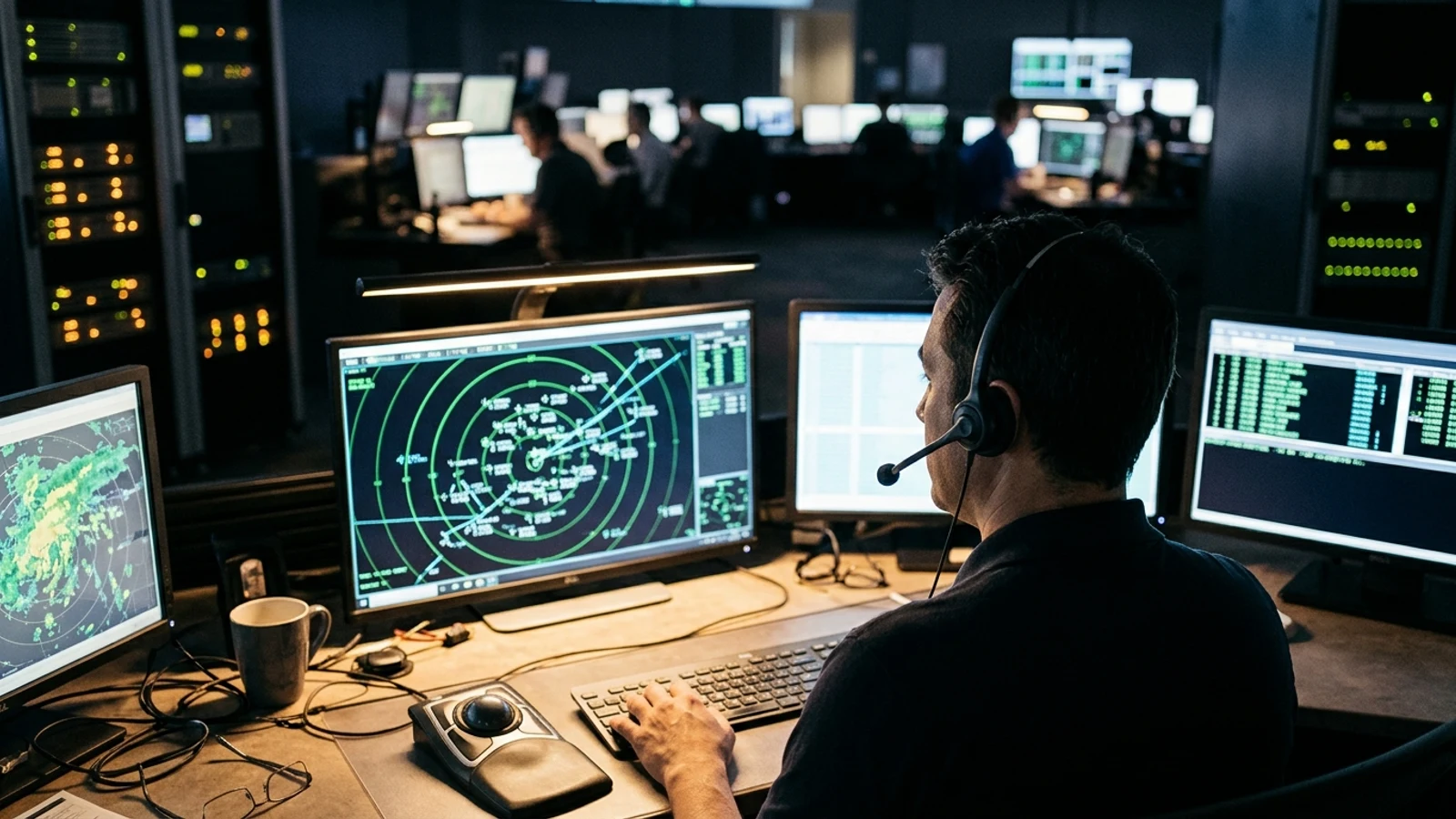
The Federal Aviation Administration lifted a nationwide ground stop on November 14, 2026, after a telecommunications and technology outage disrupted air traffic control centers across the United States. The ground stop, which commenced on Friday, lasted for more than four hours and was the most significant disruption of its kind since the September 11 attacks in 2001. The agency moved to restrict all flight departures as a safety measure until systems could be stabilized and confirmed for operational use. Source
The operational failure originated at approximately 3:36 PM on Friday when air traffic control centers observed instability in radar and communication systems. According to the Department of Homeland Security, the introduction of new technology into an existing framework caused older systems to become overwhelmed. The resulting data inconsistencies from overloaded routers and switches forced officials to pause all aircraft departures to maintain safety within the National Airspace System. Source
While aircraft already airborne during the onset of the technical issues were permitted to continue to their planned destinations, no jets were allowed to depart from airports within the United States. Transportation Secretary Sean Duffy confirmed that radar and communication capabilities were never completely lost. However, the requirement to halt departures resulted in thousands of aircraft becoming stranded at gates and tarmac locations across the country, creating significant displacement for both flight crews and passengers. Source
The impact of the ground stop extended well beyond US borders. Eurocontrol, the European network manager, issued an advisory suspending US-bound departures from the European Civil Aviation Conference region between 10:00 PM UTC on Friday and 5:00 AM UTC on Saturday. International flights were handled individually by the FAA under a case-by-case arrival policy. Similar restrictions on US-bound traffic were reported in Mexico and Brazil, while Montreal-Trudeau International Airport suspended US-bound services entirely. Source
The technical issues triggered widespread travel disruptions. Flight tracking data indicates that more than 6,600 flights were canceled on Friday, with over 8,600 additional flights experiencing delays. Operations remained hampered into Saturday, with at least 1,500 flight cancellations already recorded for the following day. Aviation analysts noted that the scale of the grounding and the need to reposition displaced crews and aircraft will likely result in schedule disruptions for several days. Source
Despite the resumption of departures at 8:15 PM on Friday, officials have cautioned that the return to normal scheduling will be a gradual process. Transportation Secretary Duffy described the recovery as a slow effort. The situation forced many travelers to wait in terminal halls overnight, and several college sports teams and professional entities were required to charter buses or reschedule flights to reach their weekend destinations as a direct result of the lack of available departures. Source
The incident has renewed focus on the aging infrastructure of the US air traffic control system. Secretary Duffy and other administration officials have pointed to the necessity of a broad modernization effort, citing the current systems' vulnerability to data overloads. The administration has requested $50 billion to modernize these systems. In the lead-up to the failure, the Department of Transportation had already urged Congress to approve $30.1 billion for infrastructure upgrades to address these ongoing technical challenges. Source
Some air traffic controllers have expressed skepticism regarding the explanation provided by federal officials, with reports suggesting that technical switches of this nature are typically conducted during low-traffic windows rather than on a busy Friday afternoon. While the National Security Agency is working with the Department of Homeland Security on the investigation, officials stated there was zero evidence that the failure was caused by a cyberattack or a rogue artificial intelligence system. Source
The FAA indicated that it thoroughly tested and verified the stability of its systems before authorizing the resumption of flight departures. Nevertheless, the backlog of flights and the need to rebalance personnel and equipment remain key variables in the recovery timeline. Travelers have been advised to verify their flight status directly through airline applications rather than relying solely on airport departure boards, as scheduling changes may occur frequently while systems are restored to full capacity. Source

