
Operational Impact at Miami International Airport
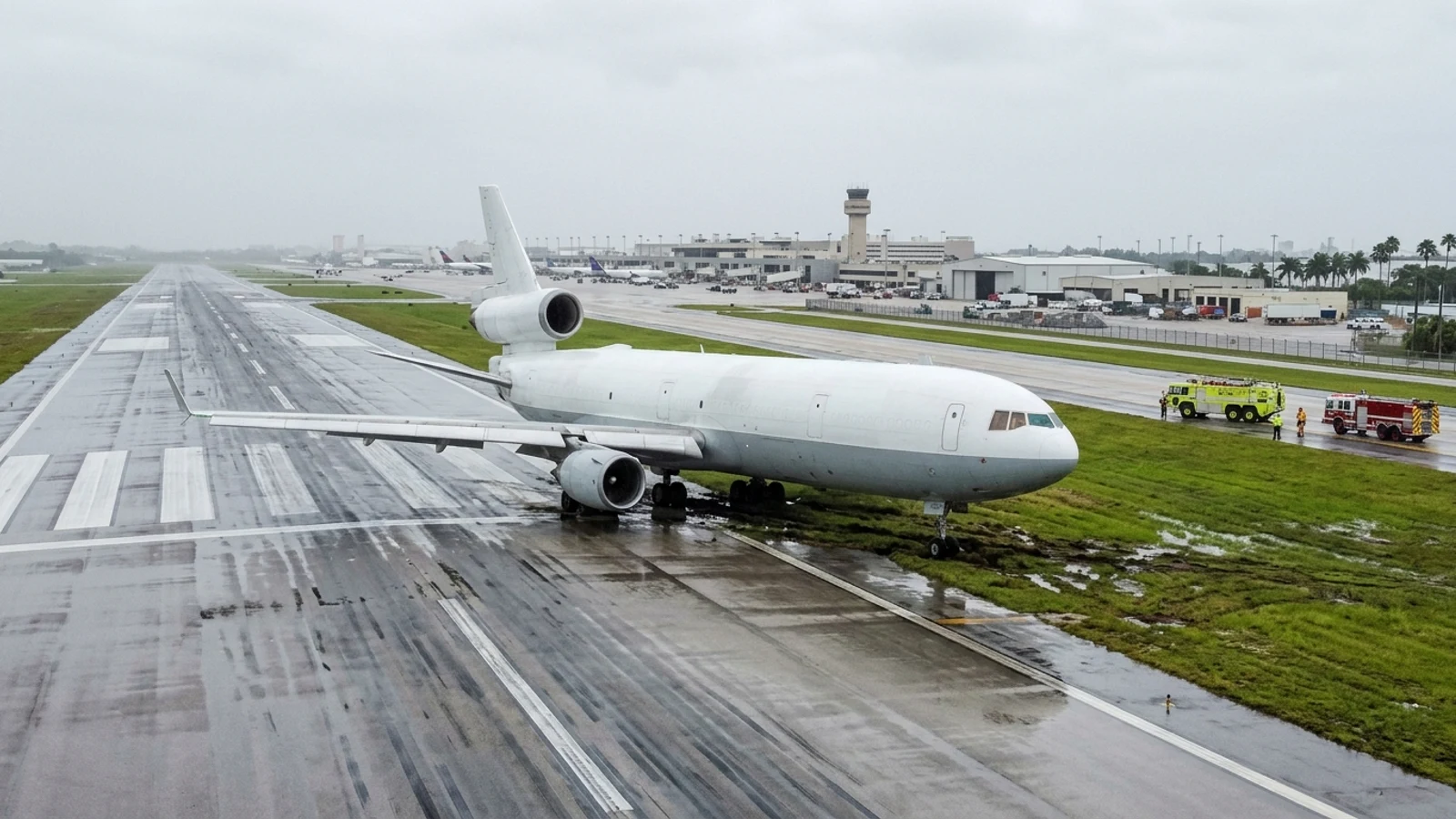
On Wednesday, November 25, 2026, a McDonnell Douglas MD-11 cargo aircraft operated by FedEx Express was involved in a runway overrun incident at Miami International Airport (MIA). The flight, identified as FX910, was arriving from the carrier's primary hub at Frederick W. Smith International Airport in Memphis, Tennessee. According to reports, the aircraft departed from the paved runway surface while landing during a period of heavy rainfall. Emergency personnel were quickly dispatched to the site of the incursion. Source
The aircraft came to a rest in the grass area near Northwest 67th Avenue. Visual documentation described by BNO News indicated that the airframe remained largely intact, with no visible damage to the front section of the freighter. Miami-Dade Fire Rescue confirmed to local authorities that no injuries or medical transports were required following the incident. Despite the severity of the incursion, all personnel aboard the aircraft were reported safe, and emergency crews were seen surrounding the vessel. Source
Following the runway departure, the Federal Aviation Administration (FAA) initiated a ground stop at Miami International Airport at 8:16 p.m. Eastern Time. The agency acted to halt all incoming air traffic as officials assessed the safety of the remaining operational runways. By shutting down most of the facility's runway capacity, the FAA effectively paused surface operations, preventing aircraft from arriving at the airport while the situation was managed by local emergency response and airport teams. Source
The ground stop necessitated complex coordination across multiple regional air traffic control centers that oversee flight paths destined for Miami. Reports indicate that the restriction encompassed operations managed by centers in Atlanta, Washington, and Houston, which serve as key nodes for incoming flights. This regulatory action forced numerous aircraft to either delay their departures or hold outside the immediate airspace, creating significant operational challenges for carriers attempting to navigate the holiday surge. Source
Conflicting internal advisories highlighted the uncertainty surrounding the duration of the ground stop. One advisory suggested the restriction would remain in effect until at least 9:45 p.m. Eastern Time, while other reporting cited a terminal time of 9:35 p.m. The FAA provided a 30% to 60% probability that the ground stop could be further extended, depending on the progress of runway clearance efforts and the successful removal of the FedEx MD-11 from the perimeter area near the taxiways. Source
To manage the influx of displaced aircraft, the FAA projected varying delay windows for the impacted facilities. Estimates suggested an average delay of 44 minutes for flights arriving in Miami, though maximum potential delays were projected to reach 78 minutes. These figures underscore the pressure placed on the aviation network during the Thanksgiving travel period, when approximately 81 million travelers were estimated to be in transit across the United States. Air traffic control informed pilots that the closure caused a temporary halt. Source
Regional Aviation Context and Safety
This event marked the second runway overrun involving a large freighter at Miami International Airport within a three-month span. In September 2026, an Amazon Prime Air-branded Boeing 767-300 freighter also departed the runway at the same facility, an incident that tragically resulted in multiple fatalities and injuries on the ground. These back-to-back incidents have placed renewed scrutiny on airport operations and runway safety protocols, particularly during periods of adverse weather conditions, which often complicate aircraft landing profiles. Source
The broader aviation system experienced additional strain due to separate technical outages occurring simultaneously. Travelers faced further complications following an unrelated equipment failure that triggered a ground stop at Chicago O'Hare International Airport the previous day, alongside a separate automated systems issue at Delta Air Lines. These cumulative disruptions, combined with the Miami incident, impacted the ability of flight crews to maintain schedules and forced many operators to re-evaluate their flight path planning for the remainder of the holiday. Source
Investigators and airport officials are currently tasked with clearing the runway to restore full operational status at Miami International Airport. While the exact cause of the FedEx MD-11's runway incursion remains under evaluation, early observations noted the presence of heavy rainfall, which may have influenced the landing conditions. Until the investigation provides formal conclusions, the airport is focusing on gathering data and ensuring the safe recovery of the aircraft from the non-paved surface adjacent to the runway. Source
For travelers currently affected by the flight schedule changes, the primary advice remains checking directly with airline carriers for updated arrival and departure times. Airlines are in the process of communicating specific rebooking options and connection alternatives for those whose flights were significantly delayed by the grounding order. The FAA and aviation authorities continue to monitor the status of the runway and will issue updates regarding the status of incoming flights to the region as progress is made on recovery. Source
FAA Operational Delay Estimates
The FAA provided specific delay metrics as part of its advisory to the aviation industry during the initial response phase. The following data points represent the estimated impact on traffic flow for the night of the incident, intended to provide pilots and dispatchers with an expectation of the ground stop's scale and duration during the active management of the Miami International Airport airspace on November 25, 2026. These metrics highlight the severity of the operational disruption caused by the incident. Source
| Operational Metric | Value | Start Time | Expected Impact |
|---|---|---|---|
| Ground Stop Initiation | 8:16 p.m. ET | November 25 | All inbound traffic |
| Average Delay | 44 Minutes | November 25 | Affected arrivals |
| Potential Maximum Delay | 78 Minutes | November 25 | Affected arrivals |
| Extension Probability | 30% to 60% | November 25 | Continued stoppage |

