
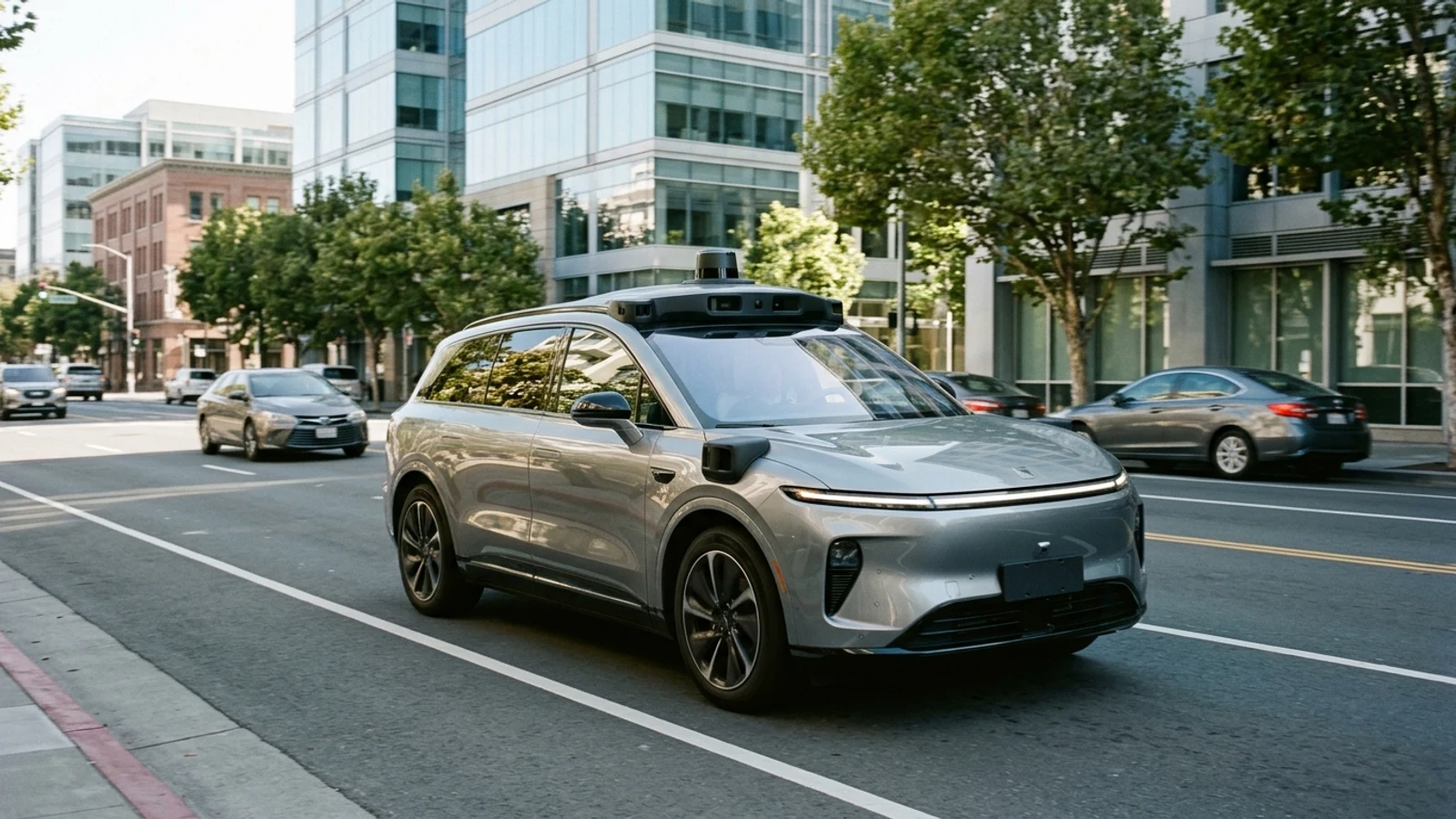
Driverless Testing and Rollout
Nuro, in collaboration with Lucid Group and Uber Technologies, has commenced testing its autonomous robotaxi service using Lucid Gravity SUVs on public roads in the San Francisco Bay Area. The program has reached a new milestone with the removal of human safety drivers from the vehicles, marking the first time the company has operated a passenger vehicle in a fully driverless state. This testing is currently confined to four specific municipalities: Palo Alto, Mountain View, Los Altos, and Sunnyvale. Source
The transition to driverless operation follows approximately eleven months of around-the-clock supervised testing. Since December 2025, Nuro has operated the Lucid Gravity fleet in the Bay Area and Houston with a safety operator present behind the wheel. The companies stated that before permitting driverless public road operations, the autonomous driving system underwent rigorous evaluation at a closed-course facility in Las Vegas. These tests simulated complex scenarios, including pedestrian encounters and various right-of-way violations. Source
Lucid Group has delivered a fleet of more than 100 modified Gravity SUVs to support this phase of the program. These vehicles are equipped with Nuro’s proprietary autonomous driving software, referred to as the Nuro Driver. The hardware suite integrated into the SUVs includes high-resolution cameras, solid-state lidar sensors, and radar arrays. A rooftop-mounted LED halo serves as an interface, flashing the passenger's initials and identifying pickup status to potential riders as the vehicle arrives. Source
While the current tests are restricted to the Peninsula and South Bay areas, the companies indicate that testing will expand to additional Bay Area cities in 2027. Despite the successful removal of the human safety driver, the public commercial launch has experienced a minor schedule adjustment. Originally anticipated for 2026, the service is now scheduled to debut in the first quarter of 2027. Uber employees are expected to gain access to the driverless vehicles for rides shortly before the public rollout. Source
Uber will manage the operation of the robotaxi fleet through partnerships. The business model dictates that the vehicles will be available exclusively through the Uber mobile application. Regarding scaling the program, Uber has committed to a long-term purchase of at least 35,000 Lucid vehicles. This order will encompass both the Gravity SUV model and future midsize models from the manufacturer, which are intended for integration into the global autonomous ride-hailing network over the coming years. Source
Regulatory compliance has been established through multiple permits granted by California state agencies earlier in 2026. The California Department of Motor Vehicles (DMV) issued a permit allowing driverless testing, while the California Public Utilities Commission (CPUC) provided authorization for a drivered pilot program intended for passenger transport. Nuro is currently one of only six companies maintaining active driverless testing permits for public roads within California as of November 5, 2026. Source
The geographical focus on the Peninsula and South Bay provides a controlled environment for testing. These regions consist of suburban and mid-density layouts, incorporating a mixture of residential streets, arterial roads, and commercial hubs. This configuration allows the companies to conduct testing without the heightened complexity found in downtown San Francisco. It also simplifies logistical requirements such as vehicle maintenance, charging, and the monitoring of autonomous systems from a concentrated operational footprint. Source
Although the Bay Area testing has transitioned to driverless, Houston remains part of the program's supervised testing schedule. The announcement does not provide a specific timeline for when Houston may see driverless operations. The partnership's current deployment sequence appears to prioritize the Bay Area for fully driverless capabilities, reflecting a phased approach to risk management and operational readiness across different metropolitan environments as they prepare for a broader commercial launch. Source
Lucid Motors continues to ramp up its production capabilities. Following the construction of pre-production models in October 2026 to satisfy regulatory requirements, the automaker has indicated plans to initiate manufacturing of the commercial-grade fleet at its Arizona facility in the weeks following the testing update. This production volume is critical for meeting Uber's long-term procurement targets, which significantly exceed Lucid's current quarterly output levels. Source
The competitive environment in the Bay Area remains intense. Waymo maintains an established presence with commercial, fully driverless services in similar regions of the Peninsula and South Bay. Consequently, the entry of the Nuro-Lucid-Uber alliance represents a strategic push by Uber to reclaim a significant role in the autonomous ride-hailing sector, having previously abandoned its internal efforts to develop in-house autonomous vehicle technology several years ago. Source
While the operational milestone of removing the safety driver is confirmed, several commercial and technical details remain undisclosed by the participating companies. Specifically, there is no public disclosure regarding the final pricing structure for users, fleet-wide safety statistics, or specific technical redundancies beyond the integration of standard perception sensors. Market observers suggest these gaps in information remain significant factors in evaluating the eventual success of the program. Source
The following table summarizes key aspects of the current program deployment and future rollout targets as identified in the provided documentation for the three-company partnership. Source

