
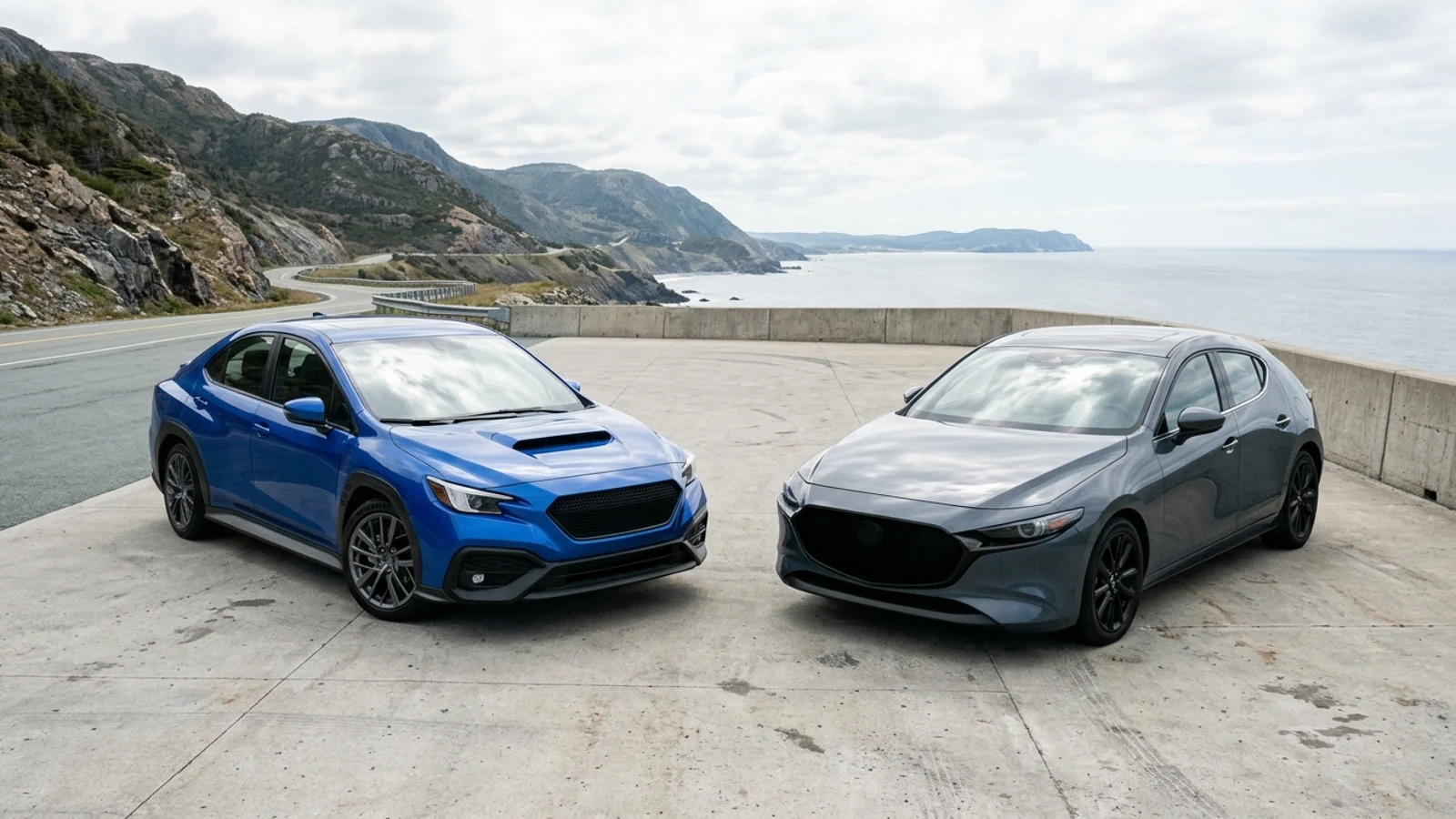
Divergent Performance and Luxury Philosophies
The automotive market for performance-oriented vehicles under $40,000 presents a notable divergence in engineering philosophy between the 2026 Subaru WRX Limited and the 2027 Mazda3 Turbo. While both vehicles leverage turbocharged engines and all-wheel drive to provide grip and power in varied conditions, the two manufacturers prioritize distinct outcomes. Subaru targets the entry-level sports sedan segment with a rally-bred pedigree, whereas Mazda positions its Turbo-equipped 3 as a luxury-oriented cruiser that emphasizes cabin comfort, refinement, and sophisticated interior materials. Source
For buyers evaluating the 2026 Subaru WRX Limited, the vehicle is categorized as an entry-level sports sedan. In comparison, the 2027 Mazda3 Turbo operates as the top-tier version of its specific nameplate, integrating various luxury amenities designed for passenger relaxation. Although the Mazda3 does not match the premium branding of luxury manufacturers such as Mercedes-Benz or Lexus, it utilizes high-quality switches and buttons that provide a weighty, solid feel when manipulated, elevating the perceived quality of the cockpit environment. Source
Mazda designers placed significant focus on cabin insulation to improve the overall driving experience. By utilizing sleek exterior styling, the company directs airflow along the sides of the vehicle to minimize wind noise and high-speed buffeting. This design choice contributes to a cabin environment where passengers can relax during long journeys. Conversely, the 2026 Subaru WRX Limited interior adopts a more utilitarian approach, favoring an angular dashboard layout and performance-oriented, supportive seating over the suppleness prioritized by Mazda. Source
Financial considerations for these models show they remain within a similar price bracket despite their differing target audiences. The base 2026 Subaru WRX starts at $32,495, excluding a $1,195 destination fee. The mid-tier Limited trim referenced for this comparison carries a price of $38,995 when equipped with a six-speed manual gearbox, or $39,995 for models featuring the Subaru Performance Transmission CVT. These figures provide a baseline for the performance-oriented sedan market segment as specified by current Subaru retail data. Source
In the Mazda lineup, the entry point for the 2027 model year is $24,750 for the 2.5 S trim, subject to a $1,315 destination fee. The range-topping 2.5 Turbo Premium Plus begins at $37,040 for the sedan body style. For buyers opting for the hatchback version, the starting price is $38,190. These figures illustrate the price overlap with the mid-tier Subaru WRX Limited, allowing consumers to choose between the WRX's track-oriented focus and the Mazda's luxury-leaning hatchback or sedan configuration within the same $40,000 envelope. Source
Technical Capabilities and AWD Systems
Engine specifications for the 2026 Subaru WRX reveal a 2.4-liter turbocharged boxer four-cylinder that produces 271 horsepower and 258 pound-feet of torque. This unit is designed for a raw, performance-oriented power delivery and is paired in this comparison with a six-speed manual transmission. In contrast, the Mazda3 Turbo utilizes a 2.5-liter turbocharged inline-four engine. This engine offers variable output depending on the fuel octane used, specifically 250 hp and 320 lb-ft on 93-octane gasoline, or 227 hp and 310 lb-ft when fueled with 87-octane gasoline. Source
The following table outlines the power and performance differences for the turbocharged engines found in both vehicles, highlighting how fuel choice influences the Mazda's output metrics relative to the Subaru's standard performance figures. Source
The Subaru WRX and Mazda3 Turbo utilize fundamentally different all-wheel-drive architectures. The WRX features a Symmetrical AWD system governed by a mechanical center differential and Active Torque Vectoring. This configuration allows the vehicle to distribute power to individual wheels in real time, enhancing traction and stability during cornering. It is designed to allow drivers to access throttle input earlier when exiting corners, leveraging lessons derived from Subaru's history in the World Rally Championship at the highest competitive levels. Source
By comparison, the Mazda i-ACTIV AWD system relies on software-driven logic rather than a mechanical center differential. The system monitors parameters such as steering angle, wheel speed, and g-sensor data to determine when to route torque to the rear axle. Under normal driving conditions, the Mazda functions primarily as a front-wheel-drive vehicle. While capable, this system lacks the versatility found in the WRX, which can independently power each wheel based on specific driver inputs and surface conditions through its mechanical setup. Source
Additional handling technology in the Mazda3 includes G-Vectoring control, which modulates engine torque and applies braking force during cornering to assist with rotation. This technology aims to reduce the amount of steering input required by the driver. While this creates a smoother, more refined cornering experience, it contrasts with the WRX, where the steering, braking, and suspension are specifically tuned for aggressive, performance-focused driving. The WRX remains the more tactile and mechanically engaged platform for those who prioritize track-like feedback over comfort. Source
Although both vehicles record 0-60 mph acceleration times in the vicinity of 5.5 seconds, the driving experience differs significantly. The WRX Limited is described as a raucous, performance-tuned animal that feels more connected to the road. In contrast, the Mazda3 Turbo acts as a high-torque, refined cruiser. Drivers seeking a white-knuckle experience may prefer the Subaru's firmer ride and spirited engine note, while those desiring a daily driver that balances performance with interior luxury will find the Mazda a compelling option for the price. Source
Ultimately, the choice between these vehicles depends on the driver's intent. The Subaru WRX stands out for buyers who want an AWD platform capable of tackling twisty roads with high levels of driver engagement. The Mazda3 Turbo provides an accessible route into a high-torque experience without the premium pricing found in luxury segments, such as the 2027 BMW 3 Series, which carries a significantly higher entry cost. Prospective owners should assess if their priority lies with the raw feedback of a sports sedan or the soothing, quiet atmosphere of a luxury-adjacent hatch. Source

