
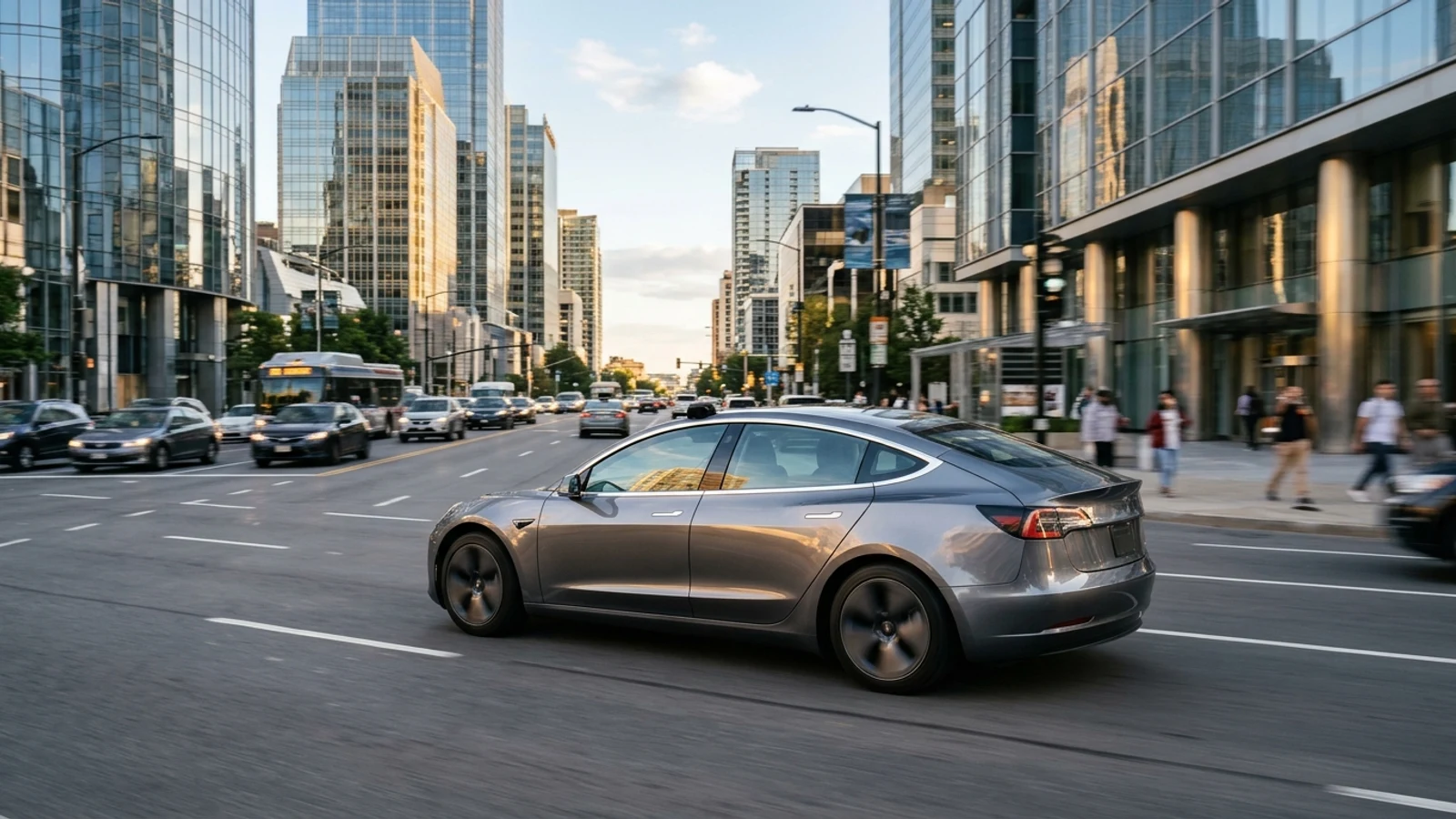
Tesla began distributing its Full Self-Driving (FSD) v15 software update to select early-access participants on November 21, 2026. This release represents a significant update to the company's autonomous driving stack, specifically targeting long-standing performance issues. Tesla stated that the update, categorized as firmware 2026.38.6.11, incorporates improvements to every segment of its end-to-end driving network. The rollout is limited to vehicles equipped with the company's AI4, also known as Hardware 4, computing platform. Source
The update introduces several functional and visual enhancements, most notably the 'Reality View' feature. This visualization provides a real-time, augmented-reality-style rendering of the vehicle's surroundings on the center touchscreen, replacing multiple distinct model signals with a unified end-to-end visualization. According to official release notes, this system is designed to allow drivers to observe and interpret the vehicle's planned maneuvers more clearly than previous iterations, theoretically facilitating easier monitoring. Source
Other functional changes in v15 include the introduction of Bike Rack Mode, which allows users to operate FSD and Autosteer while a hitch-mounted bike rack or similar accessory is attached. When enabled, this mode restricts certain automated behaviors, such as reversing into parking spots, and disables parking chimes and warnings. Additionally, the software now possesses the capability to detect and slow down for speed cameras, with an option for drivers to cancel the maneuver via the accelerator or speed profile adjustments. Source
Tesla claims a 25x improvement in the handling of safety-critical scenarios with this version, although the company has not publicly disclosed a specific baseline or methodology used to calculate this multiplier. The improvements target areas where previous FSD versions have faced criticism, including pothole avoidance, navigation through active school zones, and general sign detection accuracy. The update also modifies driver monitoring protocols, specifically reducing strictness in higher-speed driver profiles. Source
Hardware availability remains a critical constraint for the v15 rollout. The update is strictly for vehicles using the AI4 computer; legacy vehicles using Hardware 3 (HW3) will not receive this software, remaining instead on a separate V14 Lite branch. To verify eligibility, owners are instructed to navigate to the 'Additional Vehicle Information' section within the software settings menu to confirm if their vehicle is equipped with the required AI4 autopilot computer hardware. Source
Technical details regarding the AI4 hardware indicate that computational resources are tightly constrained. Elon Musk stated that the Reality View feature utilizes half of one AI4 TRIP accelerator on the vehicle's SoC (System on a Chip), highlighting limited headroom for additional processing. The vision encoder, which feeds the 3-billion-parameter model producing driving actions, has been optimized to maximize model FLOPs utilization, according to Tesla's silicon engineering team members. Source
The following table outlines the current status of FSD v15 features and hardware compatibility as supported by official notes and reporting: Source
Feature/Condition | Detail/Requirement | :--- | :--- | Hardware Required | AI4 (HW4) | Availability (Initial) | Early Access Program | Availability (Wide) | Scheduled December 2026 | Safety Claim | 25x critical case improvement | Key Visual Feature | Reality View Source
Despite the hardware limitations, the software has demonstrated point-to-point capabilities in various real-world scenarios. Early testers have reported successful, zero-intervention trips between parking locations, along with improved routing logic such as the execution of U-turns when identified as the most efficient path. These early reports, some of which were officially highlighted by Tesla, suggest that the end-to-end model is capable of making more human-like decisions in navigation compared to prior versions. Source
Uncertainty persists regarding the long-term path for HW3 owners and the specifics of failover redundancy in the AI4 system. While Waymo has publicly detailed that its systems run full parallel workloads with independent compute for safety stops, Tesla has not provided equivalent technical clarification on how its FSD system maintains safety in the event of an individual chip failure. Given that SoC B is utilized for the Reality View visualizer, questions remain about available computational overhead for safety-critical fallbacks. Source
The release notes categorize FSD v15 as a 'Supervised' system, meaning the driver remains legally responsible for the vehicle's operation and must remain attentive. Tesla has indicated that a wider public release is slated for December 2026, coinciding with the company's Holiday Update. This marks a departure from typical phased influencer-led rollouts, as the company appears to be moving toward a more direct release for the general fleet. Source
As the software reaches a broader user base, data regarding miles between critical interventions will likely become the primary metric for evaluating the system's progress. While the 25x multiplier is presented as a measure of success, the lack of an absolute baseline makes external verification of these performance gains difficult. Owners continue to monitor the software's interaction with real-world road conditions to determine the practical improvements over previous iterations. Source

