
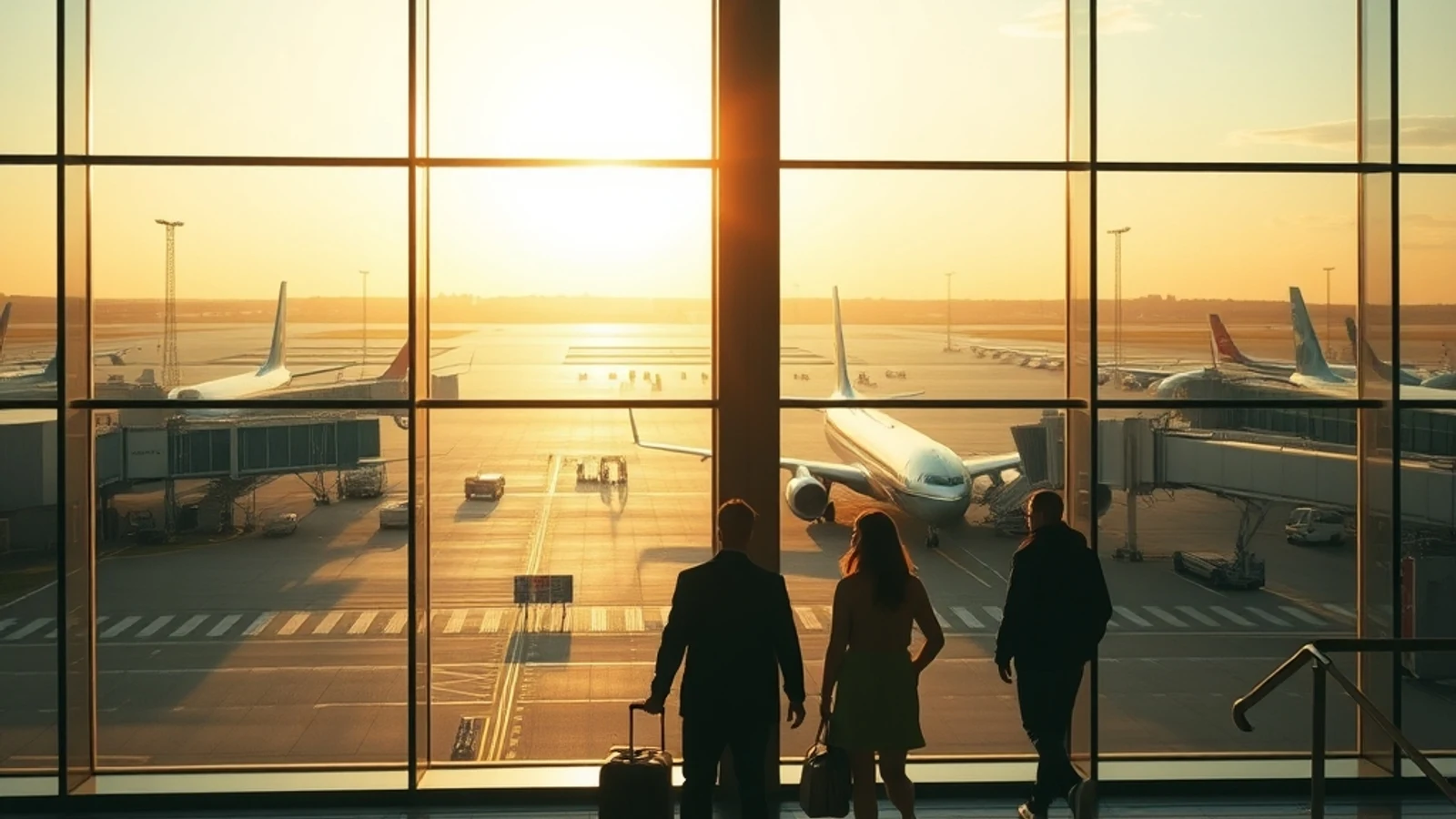
At Chicago O'Hare International Airport, a significant rivalry between United Airlines and American Airlines has shifted from standard competitive lobbying into a series of courtroom challenges and aggressive gate acquisitions. The tension originates from the city's unique gate redistribution formula, which relies on departure share and historical flight activity to manage terminal real estate. As airport construction constraints collide with rising demand, both carriers are maneuvering to maintain their footprint and operational scale in a key Midwestern hub. Source
Unlike airports governed by FAA slot rules, Chicago O'Hare utilizes an airport use and lease framework that facilitates annual gate reallocations by the Department of Aviation. Under this mechanism, gate assignments are not permanent. The city reviews usage data, which creates a direct, mathematical incentive for airlines to maintain high departure volumes. Carriers that fail to demonstrate consistent usage risk losing preferential-use gates to competitors. This environment transforms scheduling discipline into a vital tool for long-term real estate defense. Source
United Airlines, maintaining between 95 and 99 gates at O'Hare, has prioritized the protection of its Midwestern stronghold. Following gains in late 2025, the carrier focused on expanding its schedule and acquiring additional capacity. During the restructuring of Spirit Airlines, United secured two preferential-use gates, G12 and G14, for $30.2 million. This move was intended to support higher flight frequencies and prevent rivals from occupying strategic space, ensuring United remains the dominant carrier within its home base. Source
American Airlines has employed a different strategy to defend its position, particularly after suffering a gate loss ahead of the October 2025 transition. The airline challenged the city's redistribution process in federal and state courts but did not succeed in halting the transfer. As of April 1, 2026, American held 66 gates at the airport. To regain ground, the airline purchased gates G8 and G10 from Spirit Airlines for $30 million. These gates were specifically chosen due to their proximity to an existing Admirals Club. Source
Operational challenges are exacerbated by ongoing infrastructure projects, such as the ORDNext expansion, which has seen its budget increase from $8.5 billion to $12 billion. While minor expansions like the 10-gate addition to Terminal 5 have occurred, major milestones including the Global Terminal are not expected until 2034. These construction zones effectively shrink the available space, forcing airlines to operate within a constrained environment where gate access and taxiway margins are highly limited. Source
The Federal Aviation Administration intervened on April 20, 2026, to address congestion by capping daily operations at 2,708 flights. This order was necessitated by schedules that had climbed to between 3,038 and 3,080 daily operations, which exceeded the capacity of available staffing and taxiway throughput. These limits are expected to remain in effect through October 30, 2027. Carriers have been forced to upgauge aircraft and adjust seasonal schedules to adhere to these strict limits rather than simply expanding flight counts. Source
Beyond the gate fight, loyalty programs represent a critical economic factor in the battle for Chicago. High-spending travelers who hold co-branded credit cards provide significant revenue for both airlines. Hub connectivity and terminal access are essential for capturing this loyalty, as travelers often shift their spending to the airline that offers the most convenient schedule. For American Airlines, losing relevance in Chicago would jeopardize its standing among these high-value corporate and individual accounts in the Midwest. Source
The aviation industry in the United States also dealt with broader technical disruptions in November 2026. On November 16, United Airlines experienced a system outage that hindered pilot-facing applications and impacted departure weight calculations. Pilots reportedly utilized manual performance calculations to facilitate departures, and the airline stated the issue was resolved by early evening. This event was separate from a nationwide FAA ground stop that occurred on November 13, 2026, which was caused by a communications system failure. Source
The FAA ground stop on November 13, 2026, resulted in significant passenger delays and strandings at airports across the country, including Charlotte Douglas International. Experts noted that these consecutive IT outages, occurring alongside other technical failures at major firms, raised concerns about the reliance on aging infrastructure. Although no definitive connection between the individual outages has been established, the frequency of these disruptions has prompted further discussion regarding cybersecurity preparedness and the robustness of shared digital systems in aviation. Source
In a separate incident on November 16, 2026, American Airlines Flight 496, traveling from Tampa to Washington, D.C., was diverted to Orlando following a reported engine failure. The flight carried Senator Ashley Moody, who subsequently missed Senate votes due to the unscheduled landing. The aircraft landed safely, and all passengers were reportedly accounted for without injury. The senator later secured travel on a subsequent flight to complete her journey, though she arrived in Washington after the session concluded. Source
The cumulative effect of these incidents, including regulatory scheduling caps at O'Hare and nationwide IT outages, illustrates the fragile nature of modern commercial aviation operations. Airlines must balance intense competitive pressures for airport real estate with the necessity of maintaining reliable and safe service in the face of infrastructure constraints and unpredictable technical hurdles. As the construction at O'Hare proceeds toward 2035, the ability of United and American to navigate these operational obstacles will largely define their competitive standing. Source
Upcoming judicial and operational milestones will continue to influence the future of Chicago's aviation market. An Illinois Appellate Court order from November 19, 2026, marks one of several turning points in the ongoing litigation regarding gate allocations. Furthermore, the scheduled completion of new terminal concourses in the coming years will shift the balance of available capacity. Airline management will need to remain disciplined in their growth projections to align with the evolving physical and regulatory environment at the airport. Source

