
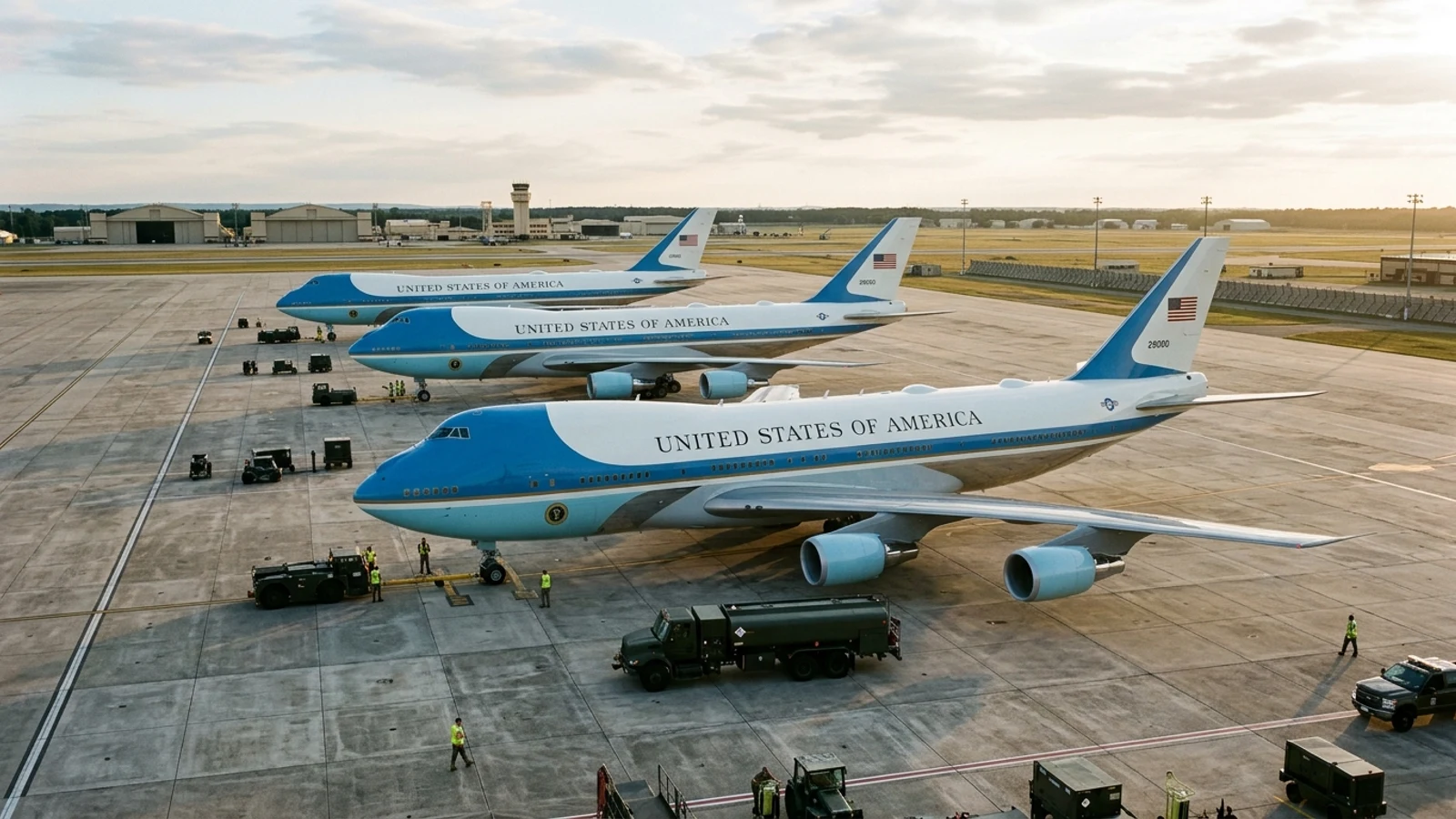
Presidential Fleet Deployment
The United States government deployed all three Boeing 747 aircraft currently designated for presidential travel during the President's recent trip to Shenzhen, China. According to Simple Flying Aviation Discovery, the fleet included the newly utilized Boeing 747-8, which bears a distinctive red, white, and blue livery, alongside two older Boeing 747-200 models. These jumbo jets were observed congregating in Manila during a stopover, an action that deviates from typical operational patterns where only one backup aircraft usually follows the primary transport. Source
The Boeing 747-8, formally known as the VC-25B, arrived in China on November 18, 2026. Simple Flying Aviation Discovery reports that while the aircraft is being integrated into the presidential mission, questions previously raised by analysts regarding its suitability for international travel due to perceived limited defensive modifications were addressed by its successful operation during this trilateral summit. The aircraft is part of a broader transition plan involving the eventual retirement of the aging VC-25A models. Source
The two older Boeing 747-200 aircraft, designated as VC-25A with registrations 82-8000 and 92-9000, maintain the traditional blue-and-white presidential livery. These aircraft have served as the primary Air Force One transports since the 1990s. Simple Flying Aviation Discovery notes that these planes are nearing 40 years of service. They remain a core component of the presidential fleet, serving as backup assets to ensure mission continuity if mechanical issues arise with the primary aircraft during overseas travel. Source
The integration of the VC-25B into the presidential fleet represents a significant investment, with costs estimated at $5.3 billion to ensure the aircraft possesses the capability to withstand nuclear electromagnetic pulses and evade surface-to-air missiles. According to Simple Flying Aviation Discovery, these aircraft feature over 200 miles of specialized insulated wiring, which is double the amount found in a standard Boeing 747. This complex conversion program is vital for supporting uninterrupted global communication. Source
The operational future for these aircraft is established through a planned phase-out. Simple Flying Aviation Discovery reports that the VC-25A models are scheduled for final retirement in 2029, even after the VC-25B platforms become fully operational. The fate of the retired 747-200s remains undetermined, though it is anticipated that they may be scrapped or transferred to museums once the required government-specific technology is removed following their decommissioning from active service. Source
Operational Security and Upgrades
Reporting from NBC News clarifies that the VC-25B currently in use by the President has undergone several cosmetic interior enhancements. However, government officials have not confirmed whether the aircraft has completed the extensive 'maxed out' security upgrade process previously discussed by the administration. While the President indicated in July 2026 that the plane would require approximately 30 to 60 days for these comprehensive modifications, the aircraft has remained active for travel throughout the autumn months. Source
A senior administration official stated to NBC News that the government maintains a posture designed to ensure safe, secure, and reliable transportation for the President. The official declined to comment on specific modification timelines or technical details regarding the aircraft's defensive systems. Despite these modifications, the White House maintains that the platform is safe for both domestic and international missions, having been used extensively during October 2026 for a series of high-profile travel engagements. Source
During the return flight from China on November 19, 2026, the White House implemented strict security protocols for journalists and staff aboard the presidential aircraft. The Jerusalem Post reports that passengers were required to surrender communication devices used within China to mitigate potential cyberespionage risks. Electronic devices were collected by the flight crew for either destruction or data erasure to prevent unauthorized surveillance or the installation of spyware following the delegation's time in the country. Source
The protocol required that phones used in China be placed in Faraday bags designed to block wireless signals. The Jerusalem Post explains that this measure was limited to devices that were not already secured in protective shielding upon the delegation's arrival. Journalists who had brought secondary devices for use during the visit were permitted to resume using their primary phones once the aircraft was in flight to the United States, provided their initial devices were properly surrendered. Source
This security directive created operational distinctions among the passengers, as those who had not brought spare phones were left without mobile access for the duration of the return journey. The Jerusalem Post reports that these measures were specifically tied to cybersecurity and information security concerns rather than any emergency modification to the flight path. The aircraft continued its planned mission without recorded disruptions to its scheduled return to the United States from Shenzhen. Source
When comparing the characteristics of the primary aircraft currently in service, there are notable differences in age, designation, and mission profiles. The following table provides a summary of the current presidential fleet status based on reports from Simple Flying Aviation Discovery and NBC News regarding operational roles and equipment. Source
| Aircraft Model | Designation | Role | Expected Retirement |
|---|---|---|---|
| Boeing 747-8 | VC-25B | Primary Presidential Transport | Post-2028 |
| Boeing 747-200 | VC-25A | Secondary/Backup Transport | 2029 |

