
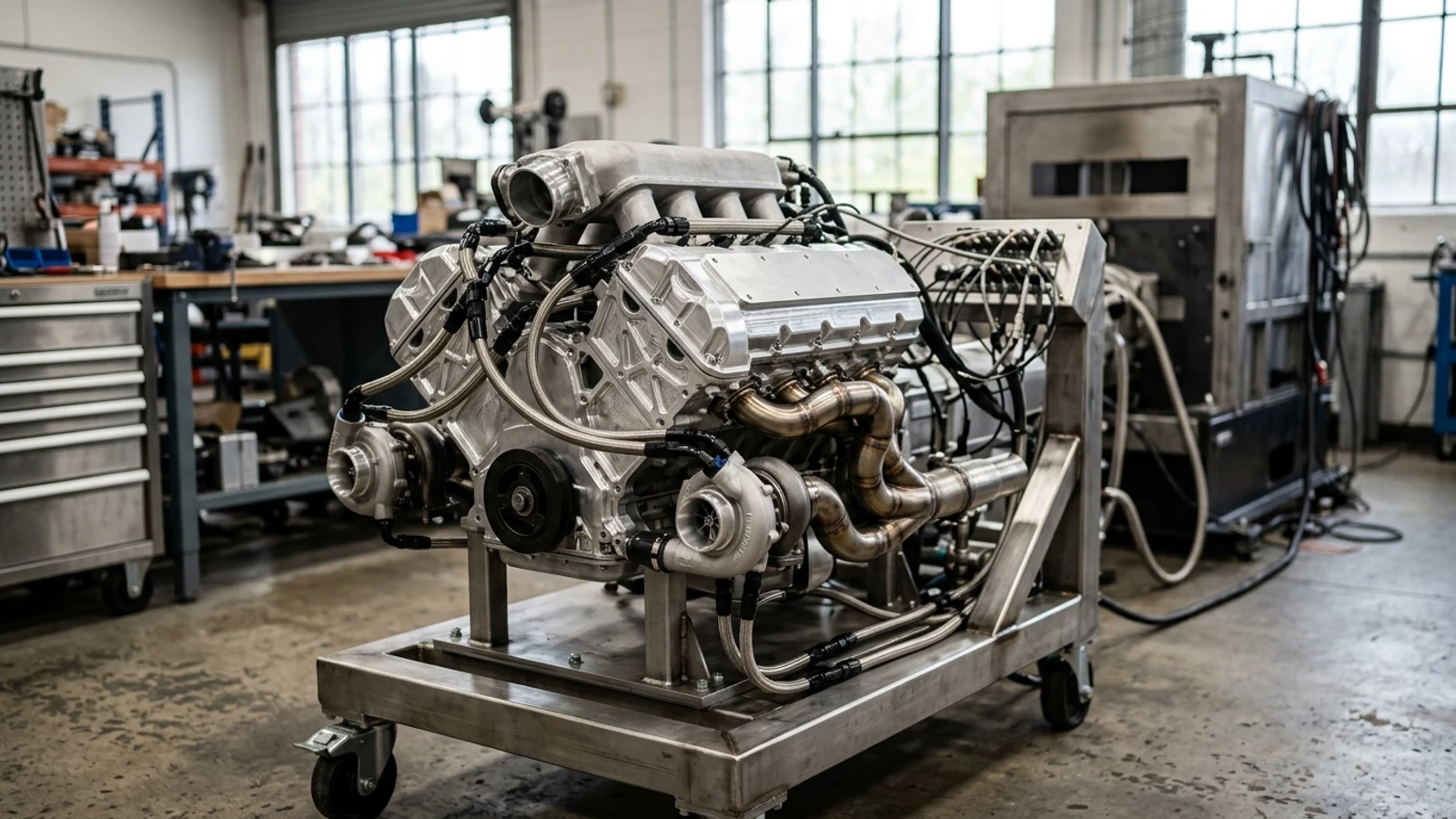
In the early 2000s, Volvo sought to address a specific demand from the North American market for a V8-powered SUV to supplement its lineup of turbocharged inline-five and inline-six engines. The manufacturer faced significant engineering constraints, as it needed to integrate a V8 into the XC90's transverse architecture while maintaining the vehicle's structural integrity and frontal crash safety zones. Volvo engaged Yamaha to jointly develop an entirely new 4.4-liter engine, designated as the B8444S, to solve this packaging challenge. Source
The B8444S engine design diverged from traditional V8 configurations, which typically utilized a 90-degree cylinder layout. Instead, Yamaha and Volvo opted for a narrower 60-degree setup to reduce the unit's overall width, which was essential for a transverse installation. To mitigate the resulting vibration characteristics, engineers incorporated a counter-rotating balance shaft. Furthermore, the left-hand cylinder bank was offset half a cylinder forward relative to the right-hand bank, an arrangement that allowed the engine to clear the vehicle's structural beams. Source
Space-saving measures extended to the integration of various components. The alternator was mounted directly to the engine to eliminate bulky brackets, while the starter motor was repositioned above the transmission housing. Additionally, secondary chains were utilized to drive the exhaust camshafts from the intake camshafts, a departure from conventional designs that required extended timing systems to drive all four overhead camshafts. These modifications resulted in a lightweight assembly weighing approximately 419 lbs. Source
The naturally aspirated 4.4-liter B8444S debuted in the 2005 model year XC90 for the United States market. According to manufacturer data, the engine produced 311 hp and 325 lb-ft of torque. Power delivery was managed by a six-speed Geartronic automatic transmission paired with an electronically controlled all-wheel-drive system developed alongside Haldex. The manufacturer claimed the XC90 could reach 62 mph in 7.3 seconds, with the engine providing 273 lb-ft of torque at 2,000 rpm. Source
Following its success in the SUV segment, Volvo expanded the use of the B8444S to its second-generation S80 sedan beginning with the 2007 model year. This application provided the brand with a flagship luxury sedan specifically for the American market. The engine's flexibility and compact nature eventually attracted interest outside of the Volvo ecosystem, leading to its adoption by the British supercar manufacturer Noble Automotive for its M600 project, which was unveiled in 2009. Source
Noble Automotive significantly modified the B8444S for use in the M600, mounting the engine longitudinally behind the passenger cabin. The company partnered with the American specialist Motorkraft, which revised internal engine components and added twin Garrett turbochargers. These modifications increased the engine's displacement to 4,439 cc compared to the standard 4,414 cc found in the production Volvo V8. This iteration enabled three distinct power outputs controlled by the driver to suit different operational requirements. Source
From Family SUV To Supercar Performance
The performance specifications for the Noble M600 varied by drive mode. In Road mode, the engine produced 450 hp. Activating Track mode increased the output to 550 hp. The most aggressive Race mode released 650 hp at 6,800 rpm, accompanied by 604 lb-ft of torque at 3,800 rpm. The manufacturer claimed the lightweight supercar could achieve a 62 mph sprint in approximately 3 seconds, with an estimated maximum speed of 225 mph. Later versions pushed this output to 662 hp. Source
| Setting | Noble M600 Power Output |
|---|---|
| Road Mode | 450 hp |
| Track Mode | 550 hp |
| Race Mode | 650 hp |
Before the Noble M600, Volvo explored the potential of a high-performance B8444S variant internally. At the 2004 SEMA Show, the company unveiled an XC90 PUV concept featuring a supercharged version of the V8. While Volvo never brought the supercharged concept to mass production, it continued to utilize the B8444S architecture for motorsport activities. In 2014, Volvo Polestar Racing entered the V8 Supercars Championship in Australia using a 5.0-liter, naturally aspirated version of the engine. Source
The Australian race-spec engine incorporated extensive modifications, including individual throttle bodies and revised cylinder heads to achieve its performance goals. This engine reached a 650 hp target without the twin-turbocharging system used in the Noble M600. The transition of the B8444S from a family-oriented SUV powertrain to a specialized racing and supercar engine illustrates the mechanical adaptability that resulted from the joint engineering efforts of Volvo and Yamaha at the turn of the century. Source

