
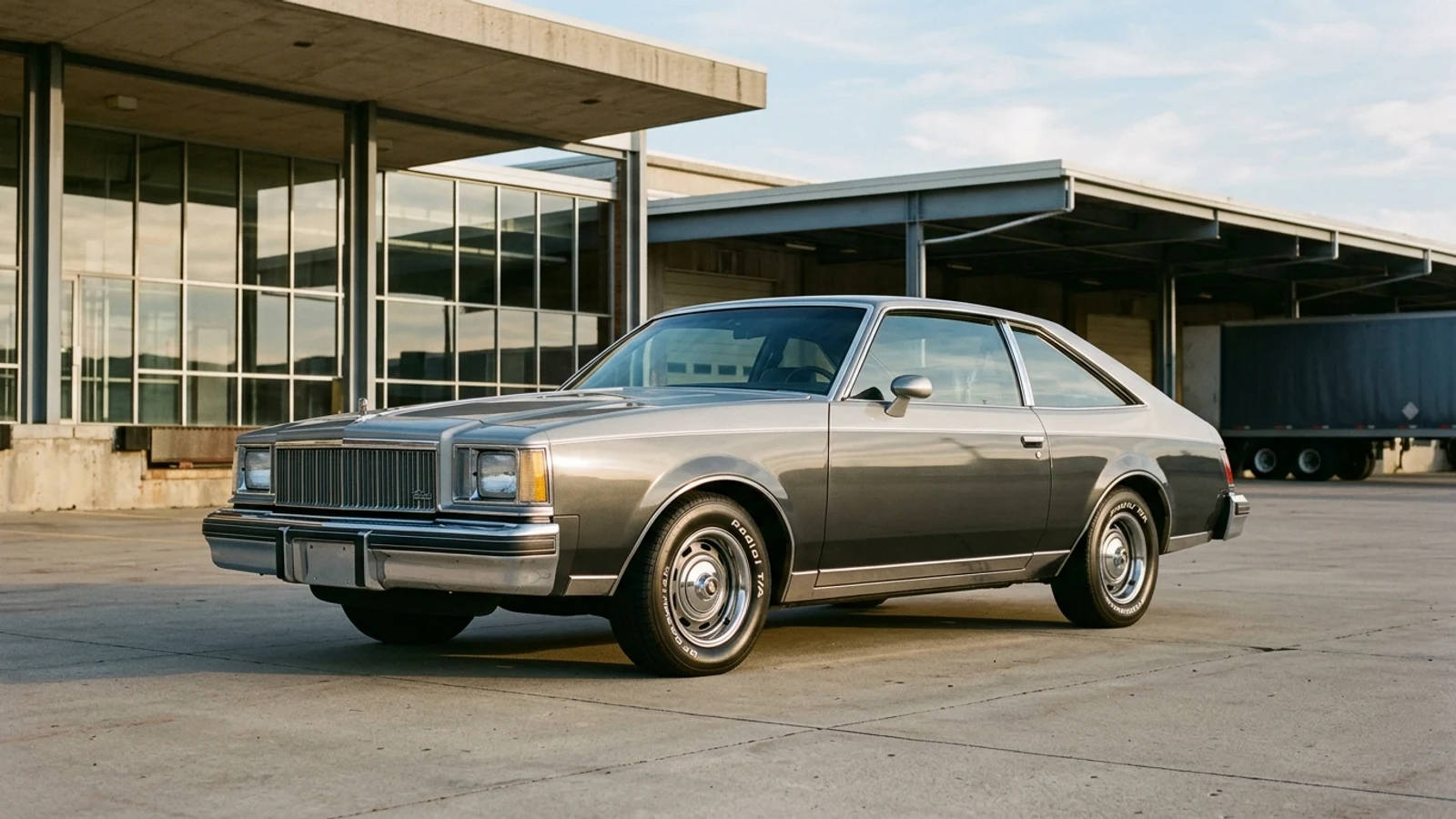
The 1979 Buick Century Turbo Coupe represents a distinct departure from the brand's historically sedate identity. While Buick vehicles traditionally catered to professionals and community pillars as a step up the General Motors hierarchy, the Turbo Coupe introduced a more aggressive aesthetic. Features such as a rear-deck spoiler, wider tires, and a dual-exhaust system differentiated the model from standard Buick offerings. Car and Driver reported that the vehicle served as an image-building project intended to showcase new performance capabilities. Source
Technical Specifications and Development
The development of this performance-oriented model began under the direction of chief engineer Lloyd Reuss, who sought to incorporate turbocharging into the division's V-6 engine platform. This initiative initially gained visibility through a 1975 Indy pace car, which utilized a non-standard suspension setup. By 1978, the turbocharged motor reached production status, providing the foundational technology for the Turbo Coupe. Engineering efforts were focused on creating a vehicle that would handle and stop differently than previous Buick models. Source
To achieve desired handling characteristics, Buick engineers developed the FE1 suspension package. This configuration featured significantly stiffer spring rates compared to the standard Sport Coupe. The front springs were upgraded to 440 pounds per inch, while the rear springs were set to 140 lbs/in. These modifications were intended to provide a more rigorous driving experience, further supported by the installation of 35,000-lbs/in rear upper-control-arm bushings to enhance transient response during maneuvering on the road. Source
The FE1 package included specific chassis adjustments that distinguished the Turbo Coupe from other Century variants. A quicker 14:1 steering ratio was implemented to improve responsiveness. The vehicle utilized seven-inch rims fitted with P205/70R-14 radial tires. While anti-roll bars remained consistent with the FE2 package at 32 mm in the front and 22 mm in the rear, the combination of upgraded bushings and steering geometry was designed to create a more dynamic, albeit still understeer-prone, driving experience. Source
A notable aspect of the Turbo Coupe's design was its exhaust configuration, which was intentionally engineered to produce a distinct sound. By routing the exhaust through a single converter into dual pipes equipped with resonators rather than traditional mufflers, engineers achieved the desired acoustic profile. Buick reported that the reduced back pressure provided an additional ten horsepower, helping the turbocharged V-6 engine reach a total output of 175 horses, despite the lack of a manual transmission option. Source
Design Choices and Market Positioning
Mechanical limitations were largely attributed to development and certification costs. The decision to forgo a manual transmission was driven by the requirement for a 50,000-mile EPA durability test, which would have cost hundreds of thousands of dollars. Similarly, the absence of a performance-oriented instrument panel was due to the lack of pre-existing components that would have fit the vehicle, with new tooling and design also requiring significant financial investment for a model with limited projected sales volume. Source
The Turbo Coupe featured a rear-deck spoiler that Buick reported reduced overall drag by 18 percent compared to the base design. Interior options included vinyl bucket seats, although cloth was offered as an alternative. The dashboard included a tricolor turbo-boost indicator to provide feedback during operation. Despite these touches, testers noted that the interior lacked traditional gauges, such as a tachometer, which might have been expected in a performance-focused vehicle of that era. Source
Driving characteristics remained a mixture of Buick comfort and performance aspirations. While the suspension modifications were effective, testers observed that the steering remained somewhat numb. The car was identified as an understeerer, as General Motors prioritized stability over the oversteer characteristics found in some other contemporary performance vehicles. The engine, while capable, was observed to have torque delivery limitations that impacted the ability to perform high-speed, tail-out maneuvers on the road. Source
When assessing the vehicle against other options, the Turbo Coupe faced challenges in satisfying traditional Buick buyers and performance-car enthusiasts alike. Buyers interested in vehicles like the Trans Am or Z28 generally looked for specific handling and transmission attributes that the Century did not prioritize. The manufacturer positioned the model as an image car, with limited allotments provided to individual dealerships. Pricing for the base version was noted to be slightly above $6,000. Source
Ultimately, the Turbo Coupe represented a specific experiment in combining turbocharging with a traditional sedan platform. While it provided a unique aesthetic and specific performance noises, its appeal was constrained by the inherent limitations of the platform and the absence of certain performance-car features. The legacy of the program was its contribution to the refinement of turbocharged V-6 engines, which some proponents believed would eventually lead to a new generation of efficient muscle cars. Source

