
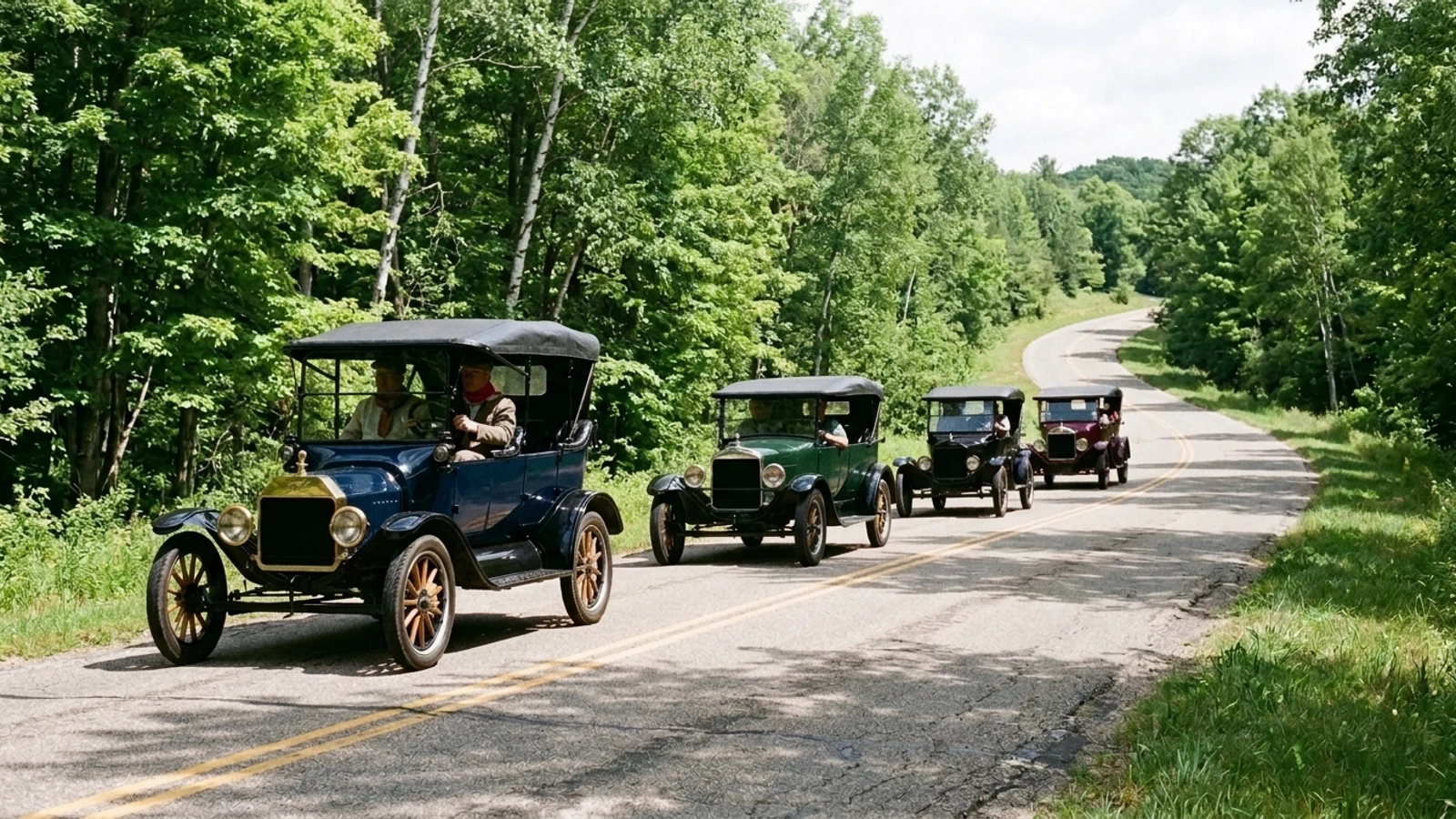
The long-running English vintage-car meet known as the RM Sotheby’s London to Brighton Veteran Car Run served as the inspiration for a 2026 event held in Michigan. Organizers selected a 57-mile route spanning between London Township and the main street of Brighton. This local initiative gathered owners of early-20th-century automobiles, including Fords, Oldsmobiles, Pullmans, and REOs, to traverse tree-lined country lanes that are better suited for the lower operating speeds of antique vehicles than modern highway infrastructure. Source
Historical Context and Event Organization
Finding a suitable date for the 2026 gathering presented logistical difficulties due to the busy schedules of collectors involved in multiple regional and national events. Potential participants indicated conflicts ranging from specific steam-car rallies to vintage Bentley meets and Horseless Carriage Club of America (HCCA) tours held in other states. The organizers eventually selected a date, hoping that the collective community of enthusiasts would accommodate the trip despite their ongoing commitments to the hobby. Source
The original London-to-Brighton run, established in 1896, commemorated the end of the Emancipation Run regulations in the United Kingdom. Prior to 1896, an 1865 act required a person to walk in front of roadgoing mechanical vehicles while carrying a red warning flag. These early laws limited speeds to 4 mph on highways and 2 mph within populated areas, primarily targeting steam-powered road locomotives. The 1896 legislation permitted an increase in speed to 14 mph, sparking the tradition of the commemorative rally. Source
Despite inclement weather during the day preceding the Michigan event, eight vintage cars participated in the drive. The vehicles spanned a range of early automotive history, including a 1904 Ford Model AC and a 1913 Buick Model 31. Enthusiasts emphasized that the hobby requires a collaborative spirit, as drivers often face mechanical challenges during tours. Because these antique cars may experience overheating or other technical faults, participants often travel in pairs to ensure support can be provided if a vehicle breaks down. Source
Technical Considerations for Antique Vehicles
Technical communication among owners of these vehicles differs significantly from modern standards. Enthusiasts rarely discuss engine performance in terms of cubic-inch displacement. Instead, horsepower serves as the primary metric for evaluating early engines. For example, a vehicle such as a Curved Dash Oldsmobile might feature a single-cylinder engine with a displacement of 95 cubic inches, yet generate only four horsepower. Owners find measuring by output more useful than volume, particularly when comparing early motorized designs that prioritize basic mechanical operation. Source
The following table details select vehicles and specifications documented during the event, illustrating the variety of early automotive hardware present during the 57-mile tour. Source
| Vehicle Model | Year | Notable Detail |
|---|---|---|
| Ford Model AC | 1904 | Owner: Rick Lindner |
| Buick Model 31 | 1913 | Owner: Larry and Joyce Schramm |
| Pullman | 1910 | Observed cabin features |
| Regal | 1911 | Loaned by John Grace |
| Oldsmobile Model X3 | 1909 | One-of-one survivor |
Modern automotive enthusiasts can enter the antique car market at varying price points. While rare, high-performance Brass Era vehicles remain expensive, common models like the Ford Model T are often available for between $7,000 and $20,000 depending on condition. The availability of reproduction parts allows owners to maintain these vehicles by sourcing components through specialized catalogs. Mentorship from experienced collectors remains a key factor in attracting younger drivers who want to learn the specific operating techniques required for early manual controls. Source
Drivers of Model T vehicles must manage several manual inputs, including throttle levers, spark advancement, and specialized pedal-based gear selection. This process requires significant physical coordination. Younger drivers, such as 16-year-old Jonathan Sinclair, noted that the complexity of operating these antique machines provides a distinct driving sensation compared to modern vehicles. During the tour, participants utilized vehicles like the 1911 Regal and 1909 Oldsmobile, with observers monitoring for mechanical indicators like the MotoMeter for overheating. Source
The event highlighted the economic variance in collectible automotive assets. A 1909 Oldsmobile Model X3, noted by its owner as the only known surviving example, was documented as having a new price of approximately $2,000 in its era. Records indicate that this specific vehicle changed hands earlier in 2026 for $55,105. Such transactions underscore that even one-of-one historical survivors can offer value within the collector market compared to the multi-million dollar prices associated with some other prewar automobiles. Source
For the enthusiasts involved, these tours serve as a practical way to preserve mechanical history. By navigating the specific challenges of early motoring—such as managing temperature gauges and manual transmissions—participants maintain skills that are disappearing from general driving. The shared experience of potential mechanical failure, such as the overheating issues experienced by the 1913 Buick on this run, creates a sense of camaraderie. Participants view these incidents not as obstacles, but as part of the authentic historical experience. Source
The 2026 Michigan tour concluded with participants reflecting on the exhilaration of driving vehicles at lower speeds. Traveling at 35 to 53 mph in an open-cockpit or minimally protected antique car provides a sensory intensity often absent from modern vehicle operation. As these cars continue to circulate within collector networks, the focus remains on educational outreach and the maintenance of a community that values the hands-on mechanical labor required to keep these century-old machines operational on public roads. Source

