
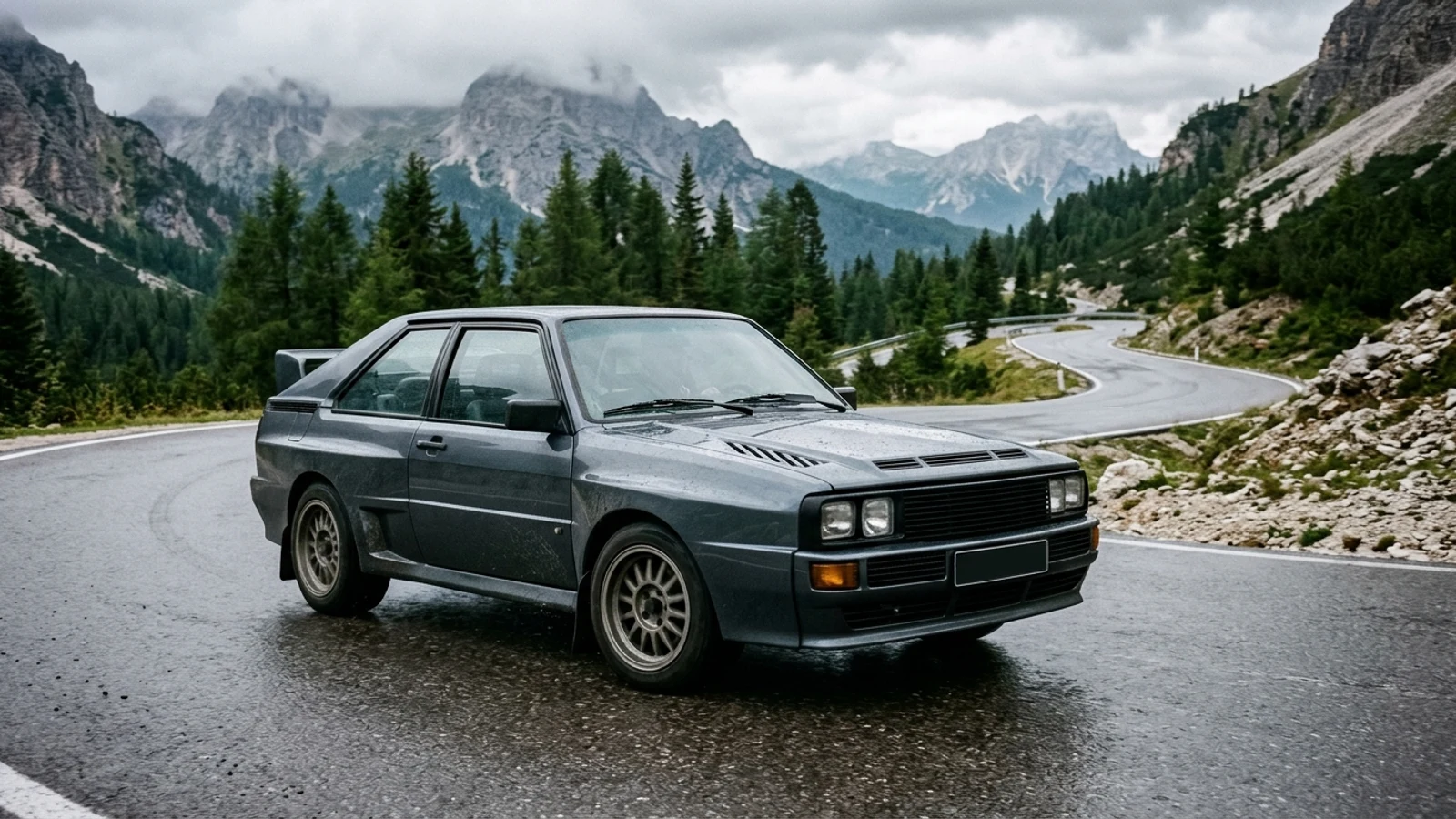
The Rise of a Rally Icon
The Audi Quattro represents a pivotal milestone in automotive engineering, serving as a primary driver for the brand's shift toward high-performance, all-weather vehicle capabilities. According to CarBuzz, Audi began its development journey as the 1980s approached, seeking a way to distinguish itself from German competitors like BMW and Mercedes-Benz. By adapting all-wheel-drive technology inspired by the Volkswagen Iltis utility vehicle, Audi engineered a system that could be integrated into a compact road car, thereby establishing a new standard for performance and traction. Source
The launch of the Audi Quattro at the 1980 Geneva Motor Show introduced the public to an aggressive, angular coupe design that prioritized mechanical innovation over traditional styling. At its core, the vehicle utilized three separate differentials located at the front, center, and rear. While the rear differential could be locked to equalize torque and improve traction, the front remained open to preserve steering precision. A vacuum-operated switch allowed the driver to lock the center differential, forcing front and rear axles to turn at identical speeds. Source
This configuration delivered a 50:50 power split between the front and rear wheels, an arrangement that was fixed due to the limitations of the early technology. The result was a profound increase in traction, particularly on off-road terrain or wet surfaces. However, as noted by CarBuzz, the system imposed a weight penalty. In dry conditions, the added mass often allowed lighter, more agile rear-wheel-drive vehicles to maintain a performance edge, forcing the Quattro to rely on its superior grip to overcome these structural disadvantages. Source
Performance and Technical Limitations
While the Quattro was a technological triumph, it faced challenges regarding its chassis balance. The vehicle employed an independent MacPherson strut configuration on all four corners, yet it suffered from a nose-heavy weight distribution of 61:39%. This bias resulted from the placement of the turbocharged 2.1-liter inline-five engine, which had to be mounted far forward to accommodate the intricate all-wheel-drive system components. This setup frequently forced drivers to brake early to avoid chronic understeer while navigating tight corners at speed. Source
The 2.1-liter five-cylinder powerplant was capable of delivering 197 horsepower in standard configurations, allowing the vehicle to accelerate from 0–60 mph in just over seven seconds. However, for the US market in 1983, emissions regulations necessitated a restriction that reduced power to 160 hp. To address agility concerns, Audi experimented with iterations like the Sport Quattro, which featured a shorter wheelbase. Despite these efforts, the underlying issue of nose-heavy weight distribution remained a persistent characteristic of the platform throughout its production. Source
In the arena of competitive rallying, the Quattro made an immediate impact upon its World Rally Championship debut in 1981. Although the vehicle struggled with reliability during its first season, it secured three rally wins. By 1982, technical refinement led to dominance, with the Quattro claiming seven victories out of 12 events and securing the manufacturers' championship. Hannu Mikkola and Stig Blomqvist followed this success by winning the drivers' titles in 1983 and 1984, respectively, cementing the car's legacy as a world-class rally machine. Source
The evolution of the Quattro system continued long after the original model's success. Audi eventually integrated more sophisticated hardware, such as the Torsen center differential in 1987, which enabled power to be intelligently transferred to the axle with the most grip. In the 2000s, further developments introduced electronic differential locks that could brake individual wheels to optimize cornering. These advancements significantly mitigated the understeer issues that plagued earlier models, allowing modern Audi vehicles to offer improved handling alongside traditional all-weather stability. Source

