
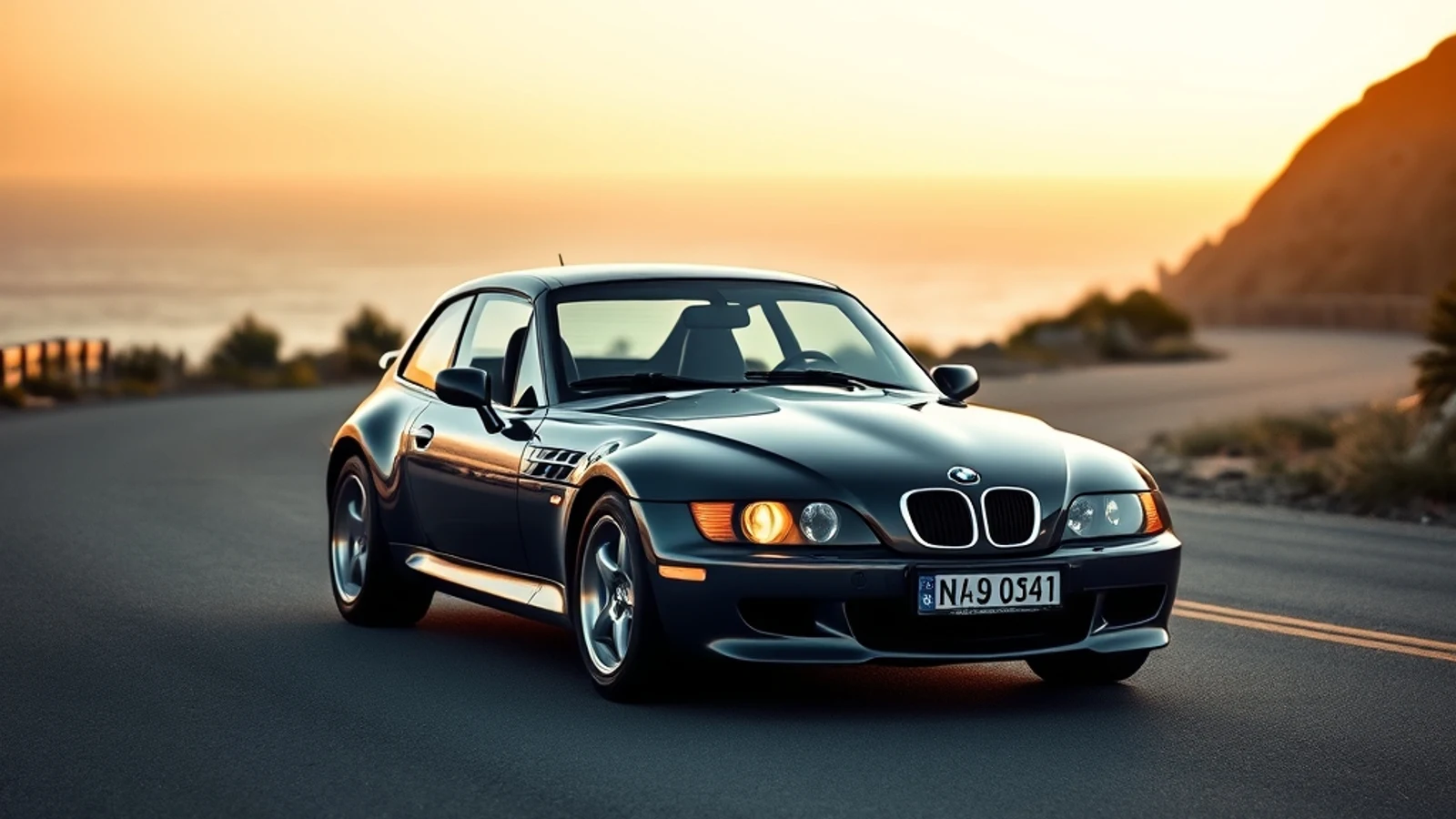
The BMW M Coupe, famously nicknamed the Clownshoe due to its distinctive and unconventional hatchback silhouette, was originally developed as a side project by a team of BMW engineers in Bavaria. While the base Z3 roadster was designed as a direct competitor to the Mazda MX-5, the M Coupe was an internal initiative to create a higher-performance variant. Using extensive parts-sharing with the standard Z3, the engineering team successfully brought the vehicle to production in 1998, prioritizing a stiffer chassis for improved on-road dynamics. Source
The vehicle's mechanical foundation evolved throughout its production cycle, which ended in 2002. Early examples manufactured until 2000 utilized the 3.2-liter S52 inline-six engine, which produced 240 horsepower and 236 lb-ft of torque. These components were largely sourced from the contemporaneous E36-generation BMW M3 to maintain cost efficiency. While initially criticized for its exterior design by the public, the M Coupe gained a substantial following among automotive enthusiasts long after it was discontinued. Source
Performance Specifications and Market Dynamics
The later production models gained significant performance upgrades, most notably the transition to the S54 inline-six engine taken from the 2001–2006 BMW M3. This powertrain is widely regarded by enthusiasts as one of the most significant engines in BMW's history. Capable of reaching 8,000 rpm, the naturally aspirated S54 engine surpassed the milestone of 100 horsepower per liter, utilizing specialized components like forged lightweight aluminum pistons and reinforced forged conrods to achieve its output of 315 horsepower and 273 lb-ft of torque. Source
Performance output for the Z3 M Coupe varies depending on the specific engine configuration and model year. The following table summarizes the key power and torque figures associated with the two primary engine variants utilized during the vehicle's production run. These figures represent factory specifications for the North American market engines described by CarBuzz. Source
| Engine Variant | Horsepower | Torque | Years Produced |
|---|---|---|---|
| S52 Inline-Six | 240 hp | 236 lb-ft | 1998–2000 |
| S54 Inline-Six | 315 hp | 273 lb-ft | 2001–2002 Source |
Engineering for the Z3 M Coupe focused heavily on chassis rigidity and braking capabilities. The chassis was developed to be 2.7 times stronger than the standard Z3, contributing to its balanced on-road handling. Braking systems were derived from the M3, with specific calipers sourced from older iterations of the BMW M5. Despite these high-performance credentials, both engine variations were paired with a Getrag five-speed manual transmission, which was reportedly tuned to ensure the M3 remained the flagship performance model of the era. Source
In the current 2026 collector market, values for these vehicles have shown a consistent upward trend. Recent auction results on platforms like Bring a Trailer highlight a price disparity based on condition, mileage, and engine specification. While non-M versions of the Z3 often trade for less than $30,000, and S52-equipped M Coupes generally hover under the $45,000 mark, the S54-equipped models command a premium, with some examples trading for over $100,000 depending on the vehicle's condition and rarity. Source
Collector Value and Recent Sales Data
A notable 2002 BMW M Coupe in Imola Red recently sold at auction for $63,000. This specific example featured only 24,000 miles and was documented as a rare non-sunroof configuration, a detail often sought by enthusiasts for the additional chassis stiffness it provides. The condition of the interior, including the performance dials and seating, remained well-preserved, and the vehicle was equipped with functional features such as Harman Kardon audio and air conditioning, making it a viable car for regular usage. Source
Comparing the investment value of the M Coupe reveals an interesting dynamic when placed against the E46-generation BMW M3. Although the 2001–2006 M3 often sells for less than $40,000, the M Coupe maintains higher values due to its unique historical status and rarity. Collectors in 2026 appear to favor the M Coupe for its lack of modern driver aids, particularly in the S52-equipped models, and the distinct driving engagement offered by the platform compared to modern iterations of the M brand. Source
The M Coupe’s practicality is often understated by the general public, despite its compact design. It functions as a daily-drivable sports car with sufficient cargo space, bolstered by functional interior amenities. For prospective buyers, the primary distinction in value and performance remains the choice of the S54 engine, which offers a broader power band and higher technical specifications compared to the earlier S52. The current market suggests that well-maintained, low-mileage examples continue to see appreciation as they represent a specific era of automotive engineering. Source
As the Z3 M Coupe becomes increasingly viewed as a classic, its lack of modern electronic assists serves as a selling point for purist enthusiasts. The vehicle's history—having been born from an un-marketed skunkworks project within BMW—adds a layer of historical intrigue that continues to drive interest. While original marketing was non-existent during its launch window, the retrospective appreciation for the M Coupe in Bimmer circles ensures that high-quality, factory-spec examples retain significant value in the current automotive landscape. Source
Prospective buyers and collectors looking to acquire a Z3 M Coupe should weigh the engine difference carefully, as the S54 represents the pinnacle of this model's performance. With the total production of these vehicles having concluded in 2002, the pool of available, low-mileage cars is inherently limited. As observed in recent auction data, transparency regarding the car's history, non-sunroof configurations, and color combinations significantly impacts the final hammer price, affirming that condition and specific provenance are central to the vehicle's market standing. Source

