
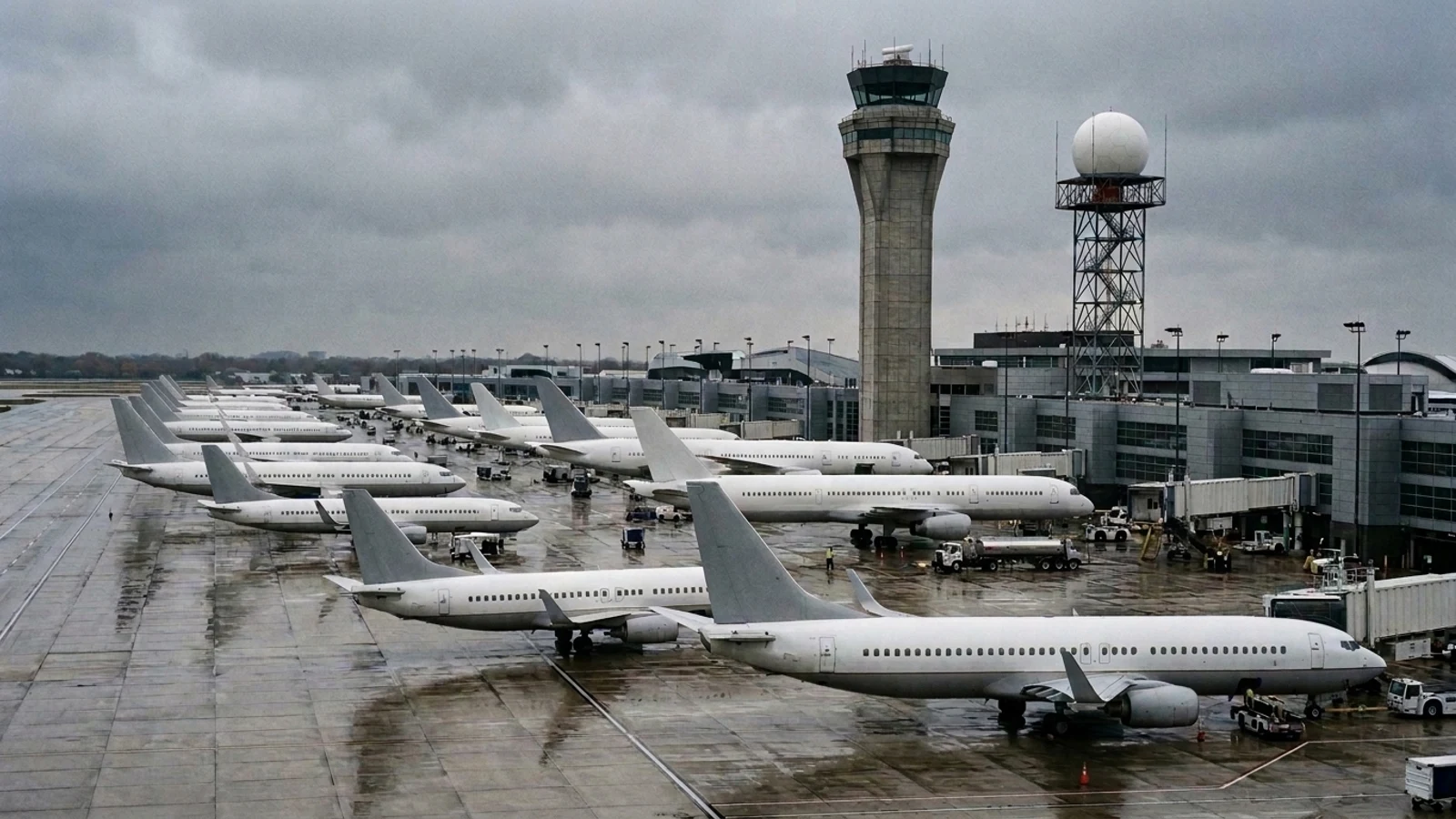
O'Hare Operational Disruption
On November 24, 2026, the Federal Aviation Administration implemented a ground stop for flights bound for Chicago O'Hare International Airport. The measure began at 13:15 local time as officials addressed a critical equipment outage. The disruption centered on the Airport Surface Detection Equipment, Model X, a surveillance system essential for monitoring aircraft and vehicle movements on runways and taxiways. This failure necessitated a reduction in arrival capacity, limiting the airport to 72 arrivals per hour to maintain safe operations without the system's full conflict-alert capabilities. Source
The ground stop remained in effect until shortly after 16:00 local time, when the FAA transitioned to a ground delay program. This secondary measure was scheduled to continue through midnight local time, impacting arrivals from across the continental United States and four Canadian airports. The transition from a stop to a delay program allowed traffic to flow at a reduced rate rather than halting all incoming flights entirely, though travelers experienced significant scheduling pressure as the airport managed peak holiday volume. Source
Technical teams were deployed to perform necessary repairs on the surface radar system during the outage. The ASDE-X unit serves a safety-critical role by alerting controllers to potential runway conflicts, which is particularly vital during hours of darkness or inclement weather. Without the system functioning at full capacity, air traffic control implemented spacing constraints, causing average delays exceeding 45 minutes, with some individual flights experiencing delays of up to 99 minutes according to the updated operations plans. Source
This incident occurred on what the FAA identified as the busiest day of the Thanksgiving travel period, with over 52,000 flights projected nationwide. By the time of the latest reporting, flight monitoring services recorded 373 delays at O'Hare, representing approximately 13% of the airport’s scheduled traffic. The timing exacerbated congestion as many travelers departed for the Thanksgiving holiday, which falls on November 26, 2026. O'Hare serves as a primary hub for both American Airlines and United Airlines. Source
Sequence of Air Traffic Constraints
The events of November 24 followed a previous disruption at O'Hare that took place on November 23. During that earlier incident, the FAA issued a brief ground stop caused by staffing constraints at the Chicago Terminal Radar Approach Control facility. That specific stop was successfully cleared by 12:30 local time on November 23. The back-to-back occurrences presented substantial logistical challenges for the airport and its operators, leading the Chicago Department of Aviation to warn passengers of heavy traffic conditions surrounding the airport terminals. Source
In response to the ASDE-X outage, the FAA adopted specific traffic management procedures to ensure ongoing safety. These procedures were documented in Command Center advisories, noting the use of a two-runway configuration to manage the reduced arrival rate. The advisory indicated an initial rate of 72 arrivals per hour, which was intended to be scaled down in subsequent hourly slots to 54 and then 34. These measures were designed to prioritize safety in the absence of automated surveillance, preventing aircraft from circling in the sky. Source
The following table outlines the operational impacts recorded during the November 24 event at O'Hare, illustrating the sequence of traffic management measures taken by the FAA during the equipment failure. Source
| Measurement | Status/Value | Date | Source
| :--- | :--- | :--- | Source
| Ground Stop Issuance | 13:15 Local Time | November 24, 2026 | Source
| Ground Delay Program | Active until Midnight | November 24, 2026 | Source
| Average Delay Duration | > 45 Minutes | November 24, 2026 | Source
| Max Delay Per Flight | Up to 99 Minutes | November 24, 2026 | Source
| Arrivals Limit | 72 per hour | November 24, 2026 | Source
The FAA's reliance on ASDE-X is part of a broader infrastructure framework that has been in operation for over 20 years. Industry experts note that the radar technology is approaching its service life limit and is scheduled for future replacement by the SMR4 model. The recent outage highlighted the sensitivity of modern terminal operations to legacy equipment status, particularly at high-volume hubs where automated surveillance is foundational to current ATC rules regarding runway operations and the 'line up and wait' clearance process. Source

