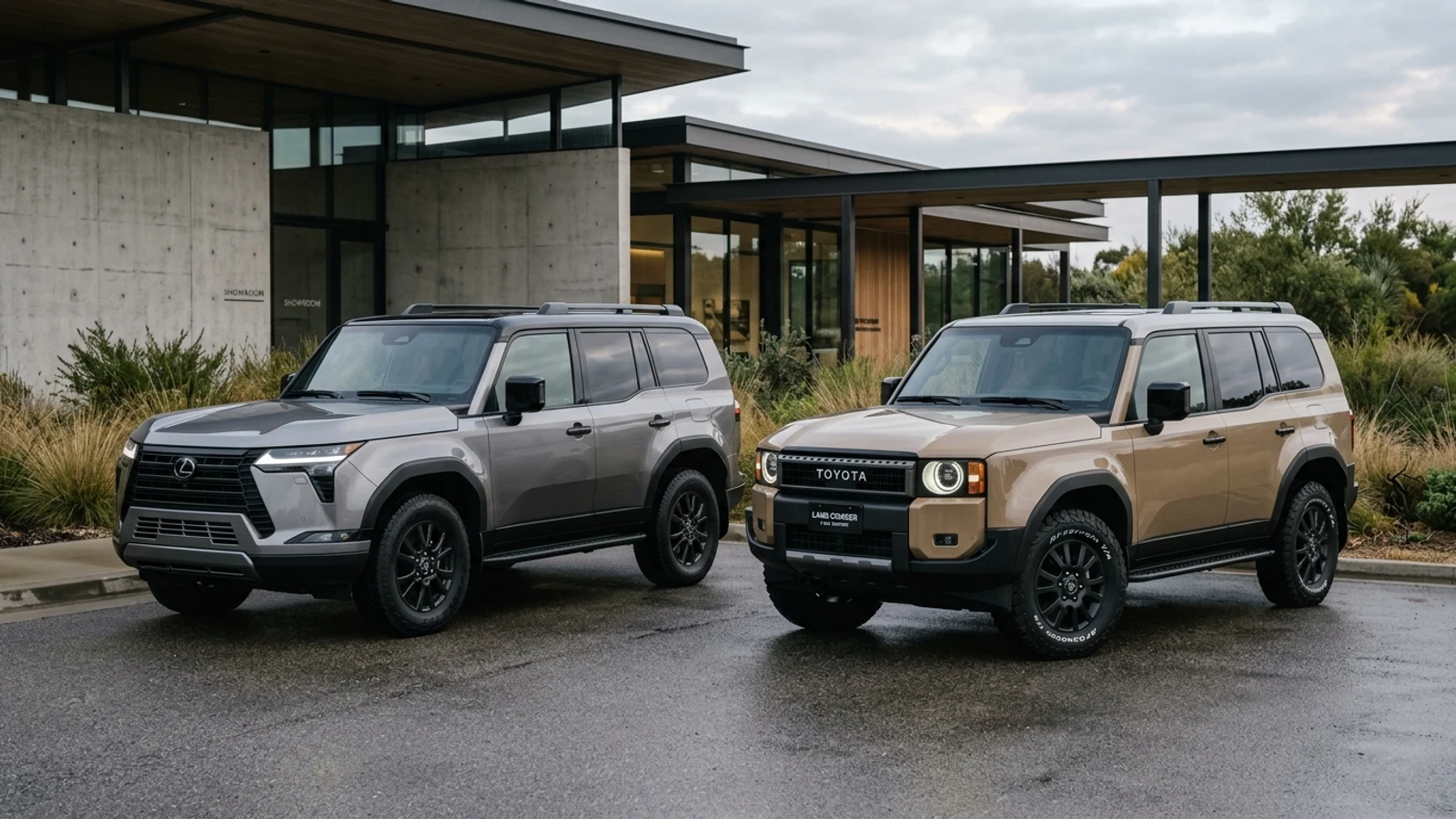
The competition between the Lexus GX and the Toyota Land Cruiser represents a distinct choice for premium off-road SUV seekers. While both vehicles are constructed using the same core Toyota DNA and exhibit significant capabilities in challenging terrain, they offer different priorities for the driver. The Lexus GX positions itself with a more sophisticated, luxury-oriented interior environment, while the Toyota Land Cruiser emphasizes a rugged, purpose-built identity, supported by its distinctive hybrid powertrain configuration. Source
Performance and Capability Specs
Under the hood, the Lexus GX is equipped with a 3.4-liter twin-turbocharged V6 engine that delivers 349 horsepower and 479 pound-feet of torque. This powertrain choice provides a higher output compared to the Toyota Land Cruiser, which utilizes a 2.4-liter turbocharged four-cylinder hybrid system featuring two electric motors. The Land Cruiser produces 326 horsepower and 465 pound-feet of torque. Beyond pure output, the Lexus GX holds a significant advantage in towing, offering a maximum capacity of 9,096 pounds depending on the specific trim selected. Source
The Land Cruiser is rated for a maximum of 6,000 pounds. This disparity in raw power and trailer-towing ability contributes to the GX’s position as a more performance-focused option. Furthermore, ground clearance is a critical metric for off-road usage. While the Premium and Luxury trims of the GX offer 8.66 inches of clearance, compared to the 8.7 inches found on the Land Cruiser, the Overtrail trim of the Lexus GX elevates this to 9.84 inches, exceeding the clearance level of the standard Land Cruiser. Source
Cargo utility varies based on seating configurations. The three-row version of the Lexus GX provides a maximum cargo volume of 76.9 cubic feet, whereas the two-row variant increases this figure to 90.5 cubic feet. The Toyota Land Cruiser offers 82.2 cubic feet of cargo space. Unlike the Land Cruiser, which is strictly limited to a five-seat, two-row layout, the Lexus GX provides flexibility with both two-row and three-row configurations, allowing for a second-row bench or captain's chairs in the latter. Source
Interior refinement distinguishes the two vehicles significantly. The Lexus GX features an upscale atmosphere utilizing premium materials, including available Nappa leather and wood trim. A 14-inch infotainment touchscreen is standard across all Lexus GX grades. In contrast, the Toyota Land Cruiser enters the market with an 8-inch touchscreen as the base display, with a 12.3-inch screen available as an optional upgrade. The GX also provides luxury amenities not found in the Land Cruiser, such as available massaging seats. Source
The starting price for the 2025 Lexus GX is approximately $67,735, while the Toyota Land Cruiser starts near $57,600. Despite the price premium associated with the Lexus, depreciation estimates suggest it holds value well. CarEdge data indicates the Lexus GX 550 loses about 33% of its value over the first five years of ownership. The Land Cruiser is estimated at approximately 35% depreciation over the same period, although its long-term residual values remain subject to ongoing market establishment. Source
Used Performance Alternatives
For buyers considering older high-performance Lexus sedans, the Lexus GS F serves as an alternative interest point. Produced from 2016 through 2020, the GS F was powered by a 5.0-liter naturally aspirated V8 producing 467 horsepower and 389 pound-feet of torque. This engine was paired with an eight-speed automatic transmission. The vehicle featured a torque-vectoring rear differential, Brembo brakes, and forged 19-inch wheels. Original prices for the 2016 model were approximately $85,000, rising above $86,000 by 2020. Source
Used examples of the Lexus GS F can now be found for roughly half of their original purchase price. While they are not as fast as contemporary German competitors, they offer a naturally aspirated V8 experience that remains highly regarded. When shopping for a used GS F, it is advisable to focus on 2017 or newer models. In 2017, Lexus introduced Linear Adaptive Variable Suspension. The 2018 model added All-Speed Dynamic Radar Cruise Control and Lane Keep Assist, improving the vehicle's daily usability. Source
Potential GS F owners should be aware of specific maintenance considerations. Reports indicate that the torque-vectoring differential, while highly advanced, can be expensive to repair. Additionally, the carbon-fiber interior trim may experience delamination or peeling over time. Certain 2016-2018 models were subject to a recall involving high-pressure fuel pumps, which could crack and leak. Verification of completed recall work via the VIN is essential before finalizing a purchase to ensure all necessary repairs have been conducted. Source
The following table highlights key performance and capacity specifications for the current generation Lexus GX and Toyota Land Cruiser based on manufacturer reporting. Source
| Feature | Lexus GX | Toyota Land Cruiser |
|---|---|---|
| Engine | 3.4L Twin-Turbo V6 | 2.4L Turbo Hybrid |
| Power (hp) | 349 | 326 |
| Torque (lb-ft) | 479 | 465 |
| Max Towing (lbs) | 9,096 | 6,000 |
| Max Cargo (cu ft) | 90.5 (2-row) | 82.2 |
| Ground Clearance | 9.84" (Overtrail) | 8.7" |
Ultimately, the choice between the Lexus GX and the Toyota Land Cruiser depends on whether the buyer prioritizes luxury features, towing power, and seating flexibility or seeks a more budget-friendly, hybrid-powered off-roader. The Lexus GS F provides a different ownership proposition for those looking for a naturally aspirated V8 sports sedan, with the 2017-2018 model years offering a favorable balance of performance features and modern driver-assistance technology for the current used-market price point. Source