
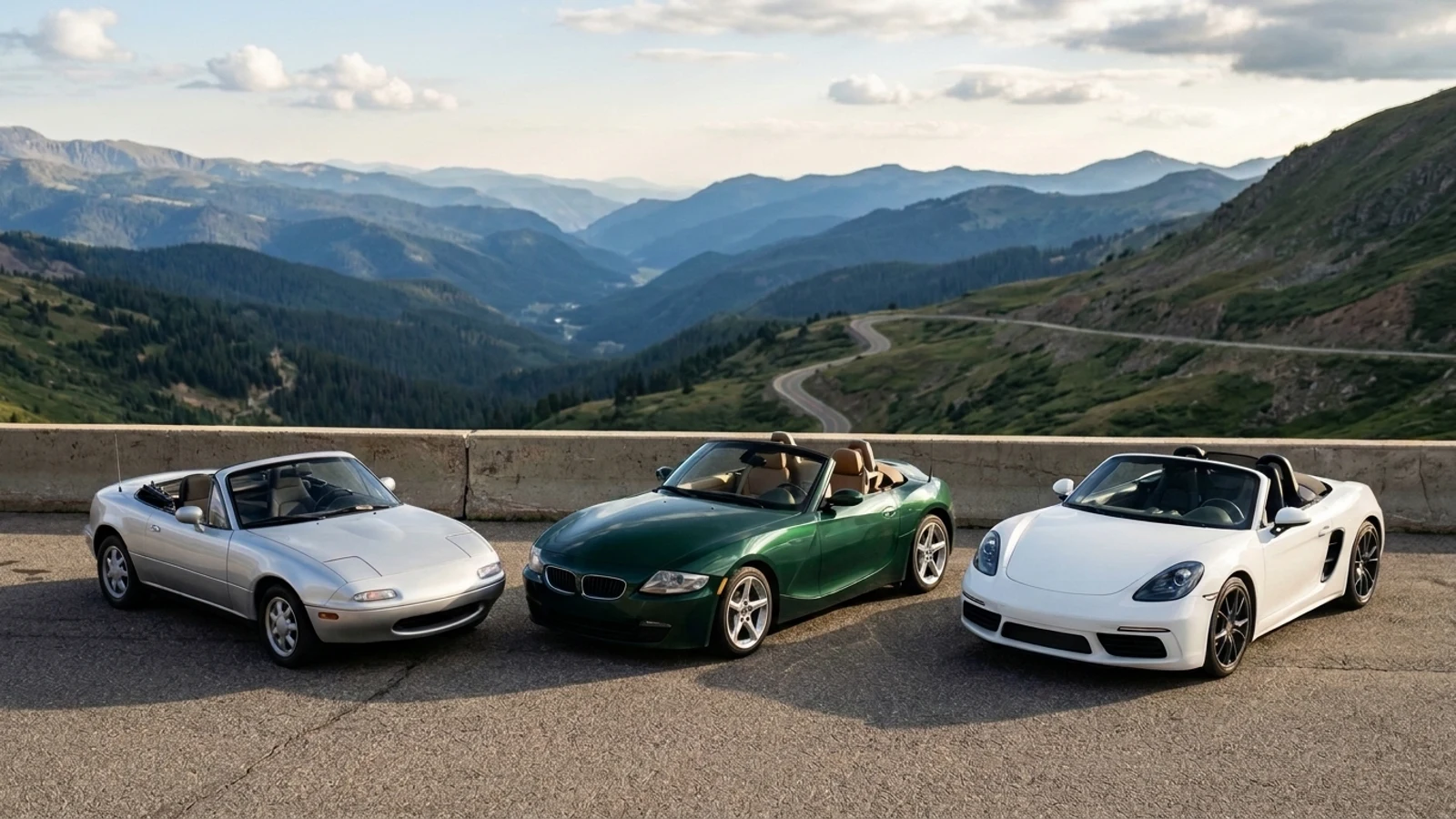
The Mazda Miata has long established itself as a benchmark for affordable, driver-focused roadsters. Its design philosophy centers on a lightweight chassis, a willing engine, and precise balance. These characteristics allow the vehicle to function across diverse roles, from a weekend canyon carver to a dedicated track tool or a reliable daily commuter. This enduring formula has solidified its status as the measuring stick by which the automotive community evaluates compact roadsters across multiple generations. Source
While the Miata remains a popular choice, several alternatives offer similar driving experiences through different engineering routes. CarBuzz has compiled a list of five models that compare favorably in terms of size, price, and overall performance. These selections are organized alphabetically by manufacturer, utilizing value estimates from the Classic.com platform to provide an overview of current secondary market availability and expected price ranges for these specific sports cars. Source
Performance and Technical Comparison
The Fiat 124 Spider Abarth, introduced in 2015, represents a direct alternative to the Miata. It shares the same foundational platform and dimensions, including height, width, and interior cabin space. Unlike the naturally aspirated Miata, the Abarth utilizes a turbocharged 1.4-liter four-cylinder engine. While the Miata possesses a more powerful naturally aspirated 2.0-liter engine, the Abarth benefits from higher torque delivery. It currently maintains an average used market value of approximately $20,000. Source
Developed as a response to the Miata, the BMW Z3 Roadster entered production in the mid-1990s. The vehicle was based on the BMW E36 platform and features dimensions that are slightly longer, wider, and heavier than the Miata. The base model utilized a 1.9-liter naturally aspirated four-cylinder engine that generated nearly 140 hp. While its mass impacts overall agility, it remains a notable driver-oriented vehicle with current average market values ranging between $4,000 and $14,000 for non-M variants. Source
The Honda S2000, which began production in 1999, stands as an iconic high-revving sports car. It was offered in two distinct versions, the AP1 and the AP2, the latter of which was sold between 2003 and 2009. The vehicle features a power-dense naturally aspirated engine that produces more peak power than the current Miata. Its market value remains high, with average prices for the AP2 generation at roughly $33,676, though specific low-mileage examples have reached $71,500. Source
MG launched the mid-engined MG-F in the mid-1990s to compete in the roadster segment, later updating it to the MG-TF in 2002. The facelifted MG-TF model featured improved suspension geometry and electronic power steering. While these vehicles are noted as affordable bargains on the used market, it is important to observe that the MG-TF was never sold as a new vehicle in the United States. Consequently, most available domestic units consist of imported vehicles originating from the United Kingdom. Source
The third-generation Toyota MR2 Spyder, introduced in 1999, features a mid-engine layout that provides distinct handling characteristics compared to front-engine alternatives. Powered by the 1ZZ-FE engine, the car produces nearly 140 hp. Its compact design is smaller than that of the modern Miata. This model is categorized by its sharp turn-in capabilities and high-speed stability, and it is currently available on the used market for a lower price point than a brand-new Miata roadster. Source
Sports Car Market Data Summary
The following table summarizes key technical and market data for the highlighted alternatives to the Mazda Miata as reported by CarBuzz based on historical and market data. Source
The engineering philosophies across these models vary significantly, ranging from turbocharged four-cylinder units to naturally aspirated power-dense engines. Buyers looking for specific driving dynamics should account for the weight and handling differences that arise from these layout choices. Whether selecting a mid-engine configuration like the Toyota MR2 or a front-engine design like the BMW Z3, the secondary market provides a diverse array of performance options that challenge the Miata as the market leader. Source
Technical specifications for these vehicles reflect their era-specific development. The Honda S2000 and Toyota MR2 focus on power density and mid-engine balance, respectively. The Fiat 124 Spider Abarth offers a modern turbocharged alternative that shares the Miata's footprint. The BMW Z3 and MG-TF provide alternative chassis experiences, with the Z3 offering an inline-six option in later years and the MG-TF offering a compact, mid-engine British roadster option for buyers, provided they can secure an imported unit. Source
In evaluating these vehicles, one must distinguish between the performance claims made by manufacturers at the time of release and the current market valuations provided by the Classic.com platform. While the Mazda Miata remains the baseline, the longevity of these alternative models indicates sustained interest in compact roadsters. Future buyers should conduct thorough inspections of these aging sports cars, particularly regarding the specific differences between AP1 and AP2 Honda models or the import status of MG-TF units. Source
Ultimately, while the Miata is often cited as the most complete sports car in this segment, these five alternatives offer distinct benefits that appeal to a wide spectrum of automotive enthusiasts. The choice between them frequently depends on whether a driver prioritizes high-revving performance, mid-engine handling, or turbocharged torque delivery. Each vehicle contributes a unique legacy to the compact roadster market, ensuring that the driving experience remains competitive despite the passage of time since their respective launches. Source

