
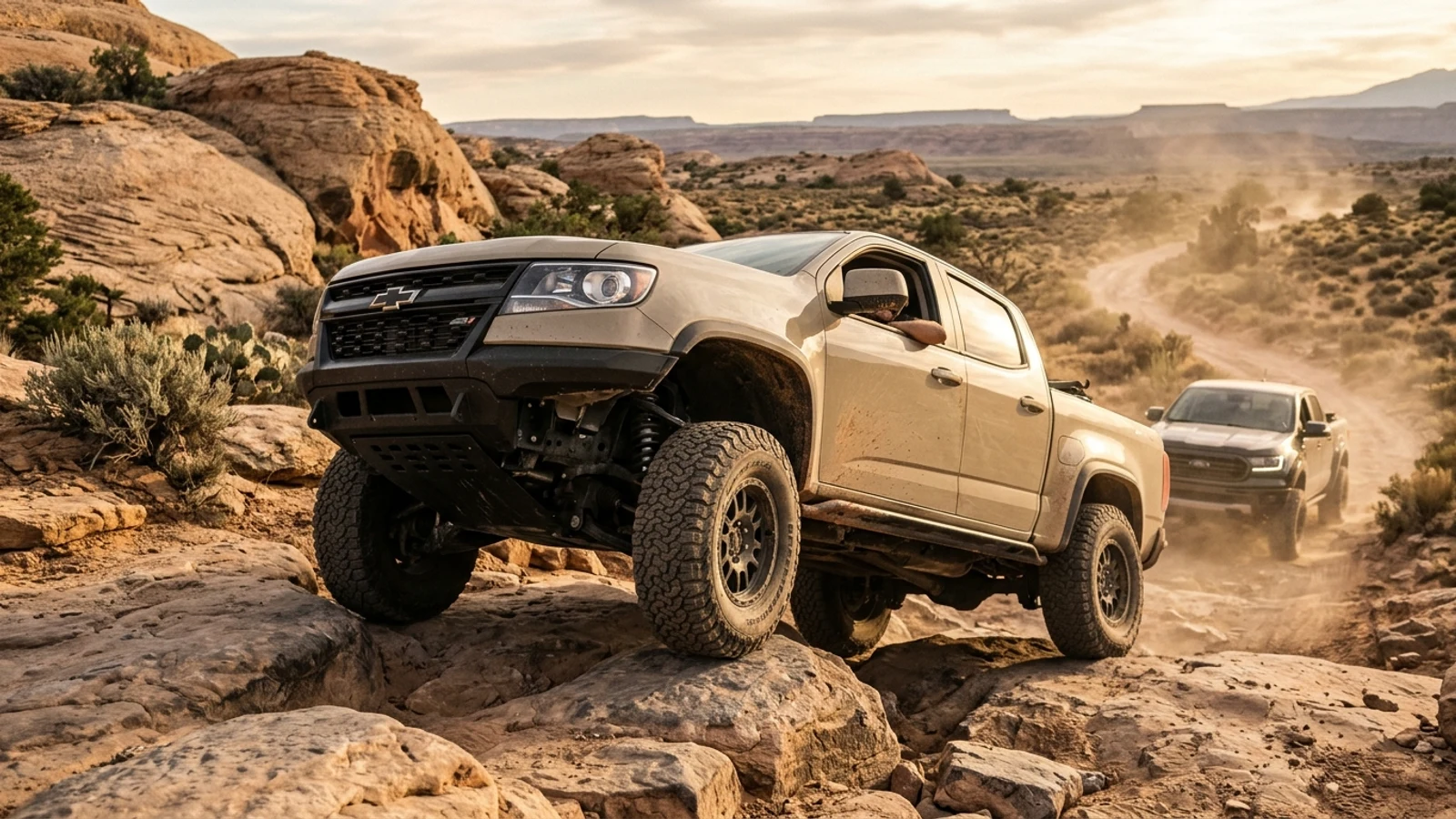
Midsize pickup trucks have carved out a specific market segment for drivers seeking off-road capability in a package more manageable than full-size alternatives. According to CarBuzz, ground clearance is a primary concern for these buyers as it directly affects a vehicle's ability to navigate rugged terrain and avoid underbody damage. While manufacturers offer various factory-installed modifications, the relationship between tire diameter, suspension lift kits, and drive modes defines how these trucks perform on trails. Source
Performance and Clearance Specs
The Ford Ranger Raptor leads among high-performance options, utilizing a bespoke suspension system and 33-inch all-terrain tires to achieve 10.7 inches of ground clearance. Ford equips this model with a 405-horsepower twin-turbo 3.0-liter EcoBoost V6 engine paired with 2.5-inch FOX Racing Shocks. The truck includes aluminum underbody protection as standard equipment. Drivers can select between various modes, including Baja for high-speed sand driving and Rock Crawl for slow, technical maneuvers. Source
For the 2027 model year, the GMC Canyon AT4X features a 2.7-liter turbocharged four-cylinder engine producing 350 hp and 450 lb-ft of torque. This configuration represents a 40-hp increase over previous iterations. The AT4X includes a 2.0-inch factory lift and mud-terrain tires on 17-inch wheels. GMC also offers an AEV Edition, which distinguishes itself with 35-inch Goodyear Wrangler Territory MT tires and five high-strength boron steel skid plates for enhanced underbody protection. Source
Toyota's 2026 Tacoma TRD Pro variant delivers 11.5 inches of ground clearance, utilizing 18-inch wheels wrapped in all-terrain tires. The powertrain consists of a turbocharged 2.4-liter four-cylinder engine combined with a hybrid motor, generating a total of 326 hp. The vehicle retains a multi-terrain select system designed to adjust performance for dirt, sand, mud, or rock surfaces. Additionally, the model remains available with a six-speed manual transmission. Source
Jeep offers the Gladiator Mojave and the 35-Inch Tire Launch Edition for off-road enthusiasts. Both models are powered by a 3.6-liter Pentastar V6 engine delivering 285 hp. While the standard Mojave rides on 17-inch wheels with a 1.0-inch suspension lift, the 35-Inch Tire Launch Edition enhances this with larger factory-installed rubber. The Gladiator remains the only American-made pickup available with both an automatic transmission and a manual transmission option. Source
The Chevrolet Colorado ZR2 Bison serves as a mechanical peer to the GMC Canyon AT4X AEV Edition. It features 35-inch Goodyear mud-terrain tires on 17-inch wheels and stands more than 12 inches off the ground. The engine is the same 2.7-liter turbocharged four-cylinder unit used in the GMC trucks. Both the Colorado and the Canyon AEV variants share identical underbody shielding and structural components, providing comparable off-road hardware for buyers in this segment. Source
Comparison of Midsize Off-Road Trims
When comparing these vehicles, the impact of tire size and suspension geometry becomes evident in the clearance figures provided by the manufacturers. The table below summarizes the key configuration differences for the primary off-road trims discussed in recent model years. These figures reflect factory-standard specifications as identified by CarBuzz research, noting that certain models allow for aftermarket modifications like 35-inch tires if not originally equipped by the factory. Source
| Model | Engine | Standard Tire Size | Clearance |
|---|---|---|---|
| Ford Ranger Raptor | 3.0L V6 Turbo | 33-inch | 10.7 inches |
| Toyota Tacoma TRD Pro | 2.4L I4 Hybrid | 18-inch wheels | 11.5 inches |
| GMC Canyon AT4X | 2.7L I4 Turbo | 33-inch | Factory Lift |
| GMC Canyon AEV Edition | 2.7L I4 Turbo | 35-inch | Factory Lift |
| Chevy Colorado ZR2 Bison | 2.7L I4 Turbo | 35-inch | >12 inches |
| Jeep Gladiator Mojave | 3.6L V6 | 17-inch wheels | 1.0-inch lift |
Drive modes significantly impact how these trucks manage different environments. The Ford Ranger Raptor, GMC Canyon AT4X, and Toyota Tacoma TRD Pro all feature specialized settings for sand and rock crawling. For instance, the Baja mode in the Ranger Raptor and Canyon AT4X is specifically calibrated for high-speed desert driving. Multi-terrain systems like those found in the Tacoma allow drivers to toggle settings for specific surface conditions, enhancing traction control efficiency during low-speed maneuvers on uneven terrain. Source
Transmission choice continues to be a point of distinction for buyers. While most modern off-road trucks utilize automatic transmissions for improved torque management and multi-mode capability, some nameplates maintain manual gearboxes. Toyota and Jeep provide these manual options, which are highly valued by a segment of the enthusiast community. This ensures that even as power levels increase across the midsize segment, the tactile experience remains accessible for traditional drivers preferring mechanical control over their gear ratios. Source
Underbody protection serves as a crucial differentiator for the most aggressive trims. Models like the Canyon AEV Edition and the Colorado ZR2 Bison utilize heavy-duty skid plates, such as high-strength boron steel, to protect vital components from trail debris. This is a factory-integrated approach that contrasts with the more basic protection found on base models. Buyers choosing these high-end packages gain enhanced durability, which is often cited as a requirement for serious off-road use. Source
Ultimately, the selection of a midsize off-road truck depends on the intended application, whether it be high-speed desert running or technical rock crawling. Vehicles with larger factory tires, such as the Colorado ZR2 Bison and the Canyon AEV Edition, offer superior initial ground clearance. Meanwhile, models like the Ranger Raptor focus on specialized suspension damping to handle high-speed impacts. Prospective owners should review the specific trim packages to ensure the factory-installed hardware aligns with their planned activities. Source

