
Regulatory Timeline and Mandate Changes
The National Highway Traffic Safety Administration has officially announced a postponement of federal regulations requiring mandatory automatic emergency braking and pedestrian automatic emergency braking systems. While these safety-critical technologies have been a focus of regulatory discussion for over a decade, the agency confirmed that the compliance deadline has been pushed back by two years. New vehicles manufactured for the American market will now be required to meet these updated safety standards no later than September 1, 2031. Source
NHTSA Administrator Jonathan Morrison provided rationale for the shift in the enforcement timeline, citing the need for additional development time. Morrison stated that the current state of technology has not reached the expected level of progress. The agency contends that providing automakers with two additional years of lead time will ensure that the automatic emergency braking systems are thoroughly tested, reliable, and ultimately more trusted by the driving public, specifically regarding high-speed and low-light detection capabilities. Source
The logic behind this extension has drawn scrutiny due to conflicting assessments of current automotive technology. Administrator Morrison acknowledged that automatic emergency braking is already standard equipment on nearly all light-duty vehicles currently available on the market and that these existing systems already prevent a significant number of crashes. This acknowledgement suggests that the vast majority of automakers have already successfully engineered, tested, and implemented the necessary hardware and software to meet performance expectations. Source
Beyond the shift in the final deadline, the NHTSA has proposed further adjustments to the regulatory framework. These changes aim to clarify the specific parameters of the standardized tests used to evaluate safety performance and to introduce requirements for automatic emergency braking systems to proactively detect and report their own internal malfunctions. These proposed additions are intended to refine the reliability of the safety suite, ensuring that drivers are aware if a primary collision-avoidance system becomes inactive. Source
Industry Performance and Safety Impacts
The history of these safety mandates reveals a lengthy effort to standardize collision-avoidance technology across the automotive sector. In 2016, the NHTSA and the Insurance Institute for Highway Safety established a voluntary agreement with automotive manufacturers to make automatic emergency braking standard across new vehicles by 2022. That industry-led effort failed to meet its target date, prompting the government to shift toward formal federal regulation, which was first finalized in 2024 to enforce strict performance requirements. Source
The Insurance Institute for Highway Safety previously expressed dissatisfaction with the five-year implementation timeline set during the 2024 finalization of the rules. The organization, which conducts independent safety evaluations, estimated that the full implementation of these features could prevent 1,000 traffic fatalities annually. Following the most recent announcement of a two-year delay, concerns persist that the extended timeline will result in thousands of preventable deaths among vulnerable road users, including cyclists and pedestrians. Source
While nearly all new vehicles on the road today feature some version of emergency braking, the federal standards finalized in 2024 set higher performance bars than current common equipment. Specifically, the new regulations mandate the ability for systems to function effectively during nighttime conditions and to detect obstacles at higher speeds. The NHTSA suggests that the additional two-year extension is necessary to prevent what it describes as the premature rollout of technology that still requires optimization for challenging environments. Source
For vehicle owners and industry observers, the delay creates a distinct gap between the current proliferation of driver-assistance features and the legally required federal safety standard. As technology continues to evolve, the distinction remains between consumer-facing driver-assistance features and the government-mandated safety baselines meant to provide a final, automated layer of protection. This regulatory pause maintains the current status quo for manufacturers, who are not currently obligated to meet the advanced night-vision benchmarks. Source
The following table summarizes key milestones in the development of automatic emergency braking regulations in the United States, illustrating the progression from voluntary commitments to the current federal delay. Source
| Milestone | Year | Status/Outcome |
|---|---|---|
| Voluntary AEB Commitment | 2016 | Established by NHTSA and IIHS |
| Voluntary Deadline | 2022 | Not met by automakers |
| Finalized Federal Regulation | 2024 | Established new high-speed/night standards |
| Delayed Compliance Date | 2031 | Pushed back from previous target |
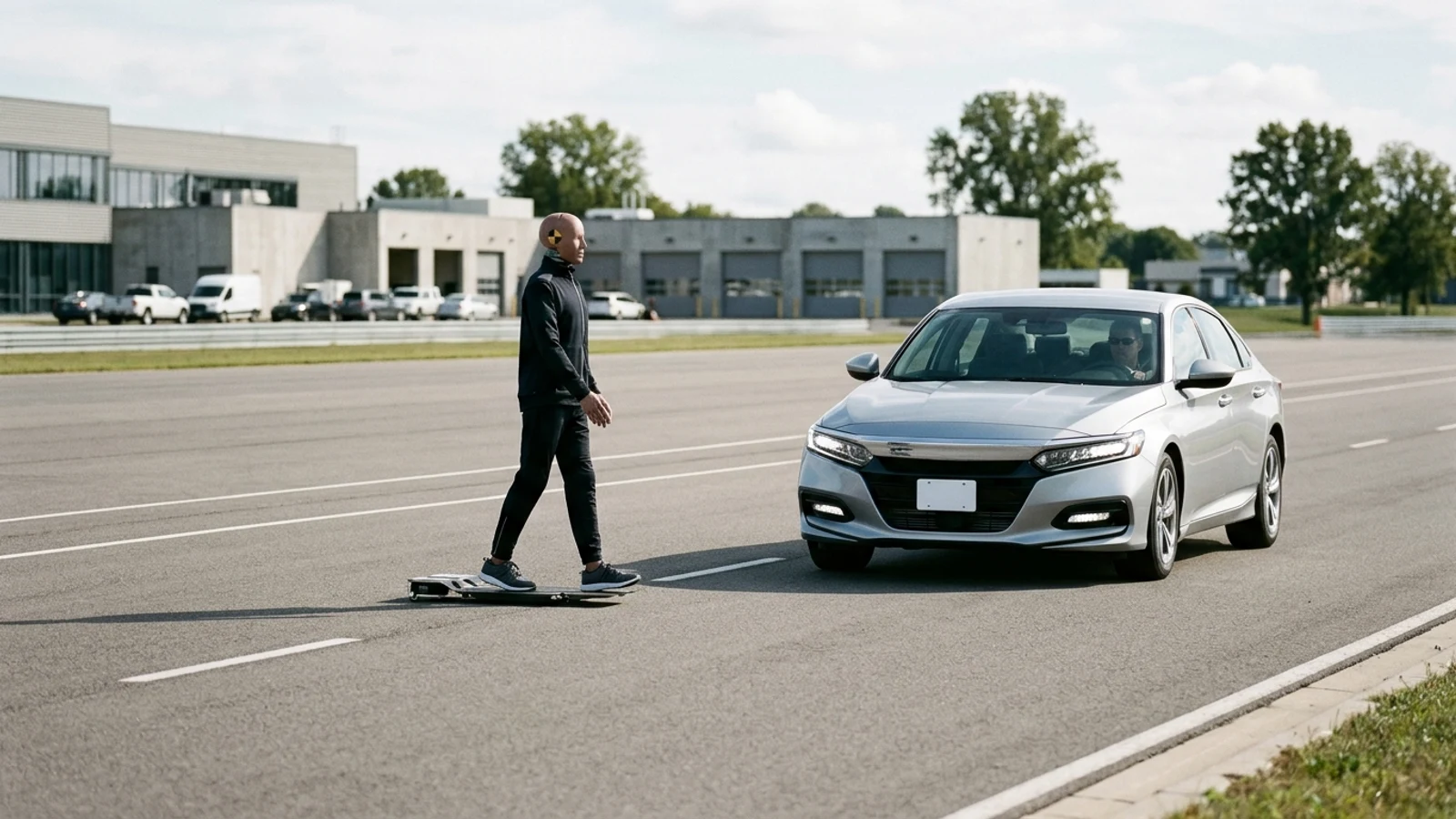
Despite the delay, the Insurance Institute for Highway Safety remains focused on the efficacy of these systems. Their testing protocols, which evaluate vehicle performance with dummies in crosswalks and low-light scenarios, highlight the physical capabilities required to protect pedestrians. Because drivers may be prone to distraction or fatigue, the institute continues to lobby for the rapid adoption of systems that serve as a last line of protection, regardless of the official government mandate status for automakers. Source
Ultimately, the tension between the safety potential of advanced braking and the technical readiness of the automotive industry remains the core of this policy shift. By extending the date to September 1, 2031, the NHTSA argues it is creating a more stable foundation for long-term safety, despite the criticism from safety groups regarding the lives that could have been saved with an earlier implementation. The automotive industry now has additional lead time to finalize the software and hardware for high-speed detection. Source

