
Tesla Hardware Strategy and AI Evolution
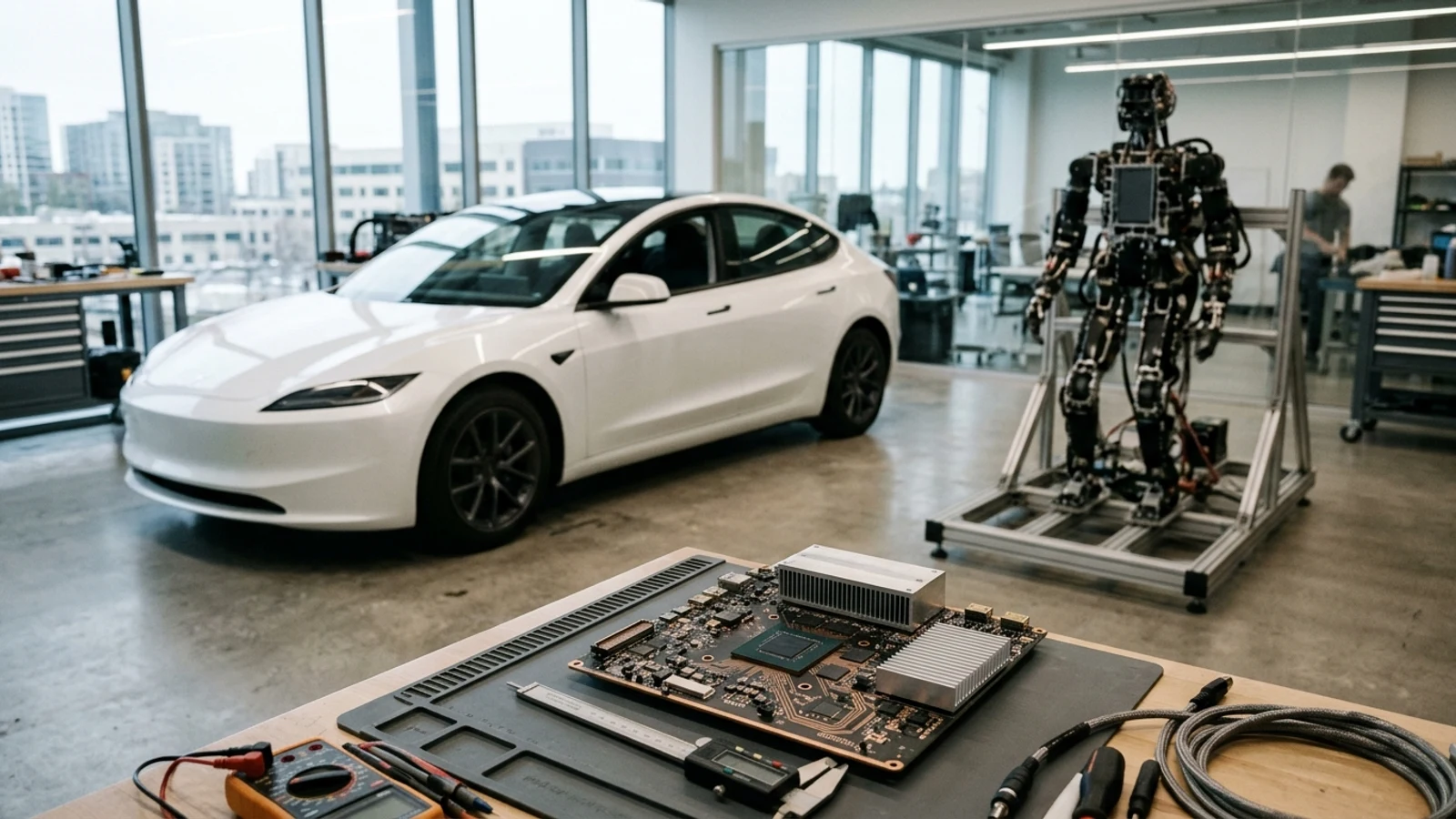
Tesla has clarified its long-term hardware strategy, confirming that the forthcoming AI5 chip will be prioritized for the Optimus humanoid robot and internal training infrastructure rather than for automotive applications. According to CEO Elon Musk, recent discussions and statements made on November 22, 2026, indicate that Tesla vehicles will remain on the existing AI4 computer platform. The company believes this current hardware iteration possesses the necessary computational headroom to achieve fully autonomous, superhuman driving capabilities in its vehicles. Source
The focus on AI5 for Optimus follows earlier commentary from the company’s first-quarter earnings call in 2026. At that time, Musk indicated that AI4 had already demonstrated sufficient computing power for unsupervised self-driving tasks at safety levels surpassing human performance. By designating the high-performance AI5 silicon for robotics and training clusters, Tesla aims to address the more complex perception, planning, and motor-control requirements inherent in general-purpose humanoid robots compared to the task of vehicle navigation. Source
Hardware 3, or HW3, remains a subject of concern for many owners who previously expected their vehicles to be capable of unsupervised full self-driving. During the 2026 first-quarter earnings call, it was noted that HW3 vehicles would not possess the required capacity for full autonomy. Consequently, the company has begun exploring an upgrade plan for owners of these earlier systems who wish to bolster their vehicle capabilities with updated cameras and computer hardware to bridge the gap toward current autonomy standards. Source
AI4, also identified as HW4, currently serves as the standard computer in new Tesla vehicles. This architecture supports the latest Full Self-Driving software, including the v15 series. A primary feature introduced with this software is the Reality View overhead visualization, which is rendered in real time using the vehicle’s AI accelerators. While the feature has been praised, early user feedback identified slight input latency when manipulating the display, a challenge Tesla is actively working to mitigate. Source
To address the observed latency in the v15 Reality View, Tesla plans to implement a software-based optimization. Musk stated that the company will interleave newer Universal Vision Encoder features along the diffusion transformer layers. By injecting fresher encoder data into the denoising process, rather than relying solely on older feature sets, the model can converge on visualizations with greater speed. This approach is expected to reduce the latency by approximately 35 percent without requiring new physical hardware. Source
The underlying architecture of Reality View relies on a 1-billion-parameter diffusion model that operates independently of the main driving stack. It processes UVE frames at 18 Hz, generating eight images at 36 frames per second. This process utilizes half of a single TRIP accelerator engine and distributes the computational workload across four cycles. As Tesla continues to refine these systems, the firm is also tracking the development of AI5, which has reached tape-out and pilot production stages. Source
Broader volume manufacturing for the AI5 chip is currently targeted for 2027. This timeline aligns with Tesla's strategy of directing its most advanced silicon toward the Optimus program. Despite the move to next-generation chips for robotics, the company maintains that the current AI4 computer provides the foundational infrastructure needed for the vehicle line. Discussions regarding an intermediate AI4.5 variant, which would focus on increased memory and storage, remain ongoing as component costs fluctuate. Source
Technical Foundations of Performance and Speed
The technical evolution of Tesla's performance features also historically includes hardware-based enhancements, such as the Ludicrous Speed upgrade. This feature introduced a specialized safety fuse and a modified contactor to the dual-motor Model S P85D and the Model X. The original contactor, typically steel, was replaced with Inconel, a high-temperature superalloy. This upgrade allowed the electrical system to sustain a current draw of 1,300 to 1,500 amps, enabling improved acceleration performance for longer durations. Source
The proprietary smart fuse utilized in the Ludicrous upgrade represented a shift from standard components. Unlike traditional fuses that melt at a set amperage, this system incorporates its own electronics and a small lithium-ion battery. It monitors electrical current at a millisecond-level precision and is pyro-actuated. This design enables the vehicle to safely manage the increased power demands required to reach 0-60 mph in 2.8 seconds, demonstrating the company’s history of hardware-software integration for performance. Source
While Tesla vehicles are performance-oriented, the term 'ludicrous' also appeared in recent law enforcement reports regarding non-Tesla vehicles on public roads. On November 1, 2026, Royal Canadian Mounted Police (RCMP) stopped a driver on the Sea to Sky Highway near Squamish, British Columbia. The blue BMW was clocked at 208 km/h, more than double the posted 90 km/h limit. Authorities characterized the driving as 'ludicrous,' resulting in the immediate seizure and one-week impoundment of the vehicle. Source
The incident on Highway 99 led to significant financial penalties for the California-based visitor. Beyond the seizure of the vehicle, the driver faced towing and impoundment fees starting at $525, which can increase depending on distance. Additionally, the driver was issued a $483 ticket for excessive speeding. RCMP Sergeant Michael McLaughlin emphasized that visitors are held to the same traffic laws as locals, and that the speed represented a dangerous hazard to public safety. Source
The correlation between dangerous driving behaviors and traffic fatalities remains a key concern for local authorities in British Columbia. The RCMP noted that incidents occurring on the Sea to Sky Highway often result in road closures that last for several hours. This enforcement action serves as a reminder that regardless of a vehicle's performance capabilities, regional traffic regulations are strictly enforced, and incidents of high-speed driving can result in significant legal and financial consequences. Source

