
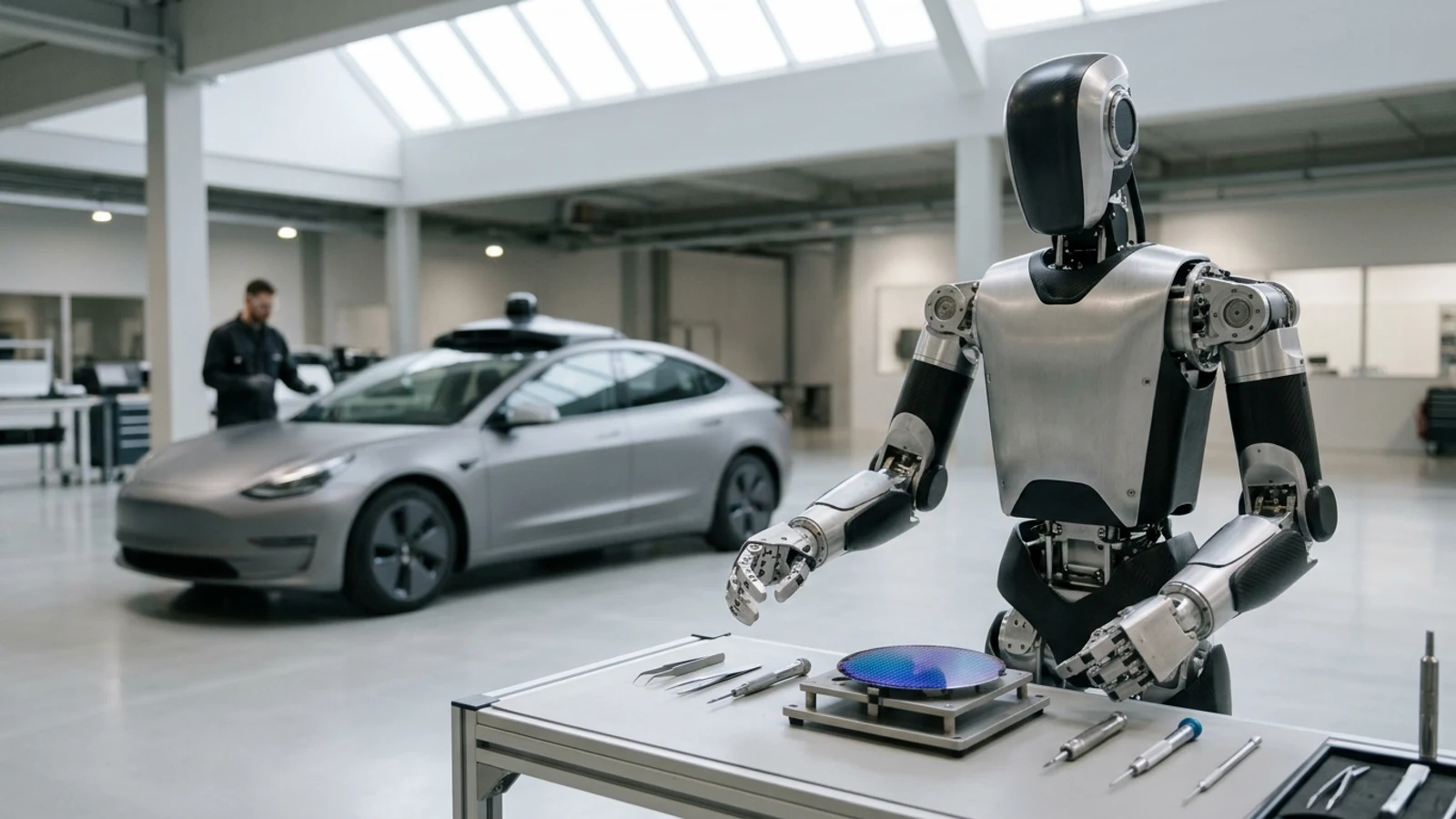
Tesla has officially confirmed its strategy for the upcoming AI5 computing chip, stating that the hardware will be exclusively dedicated to the Optimus humanoid robot. On November 22, 2026, CEO Elon Musk clarified that Tesla vehicles will continue to rely on the current AI4 computer system. According to Musk, the AI4 platform is fully sufficient to achieve superhuman driving capabilities. This decision marks a definitive path for the company's hardware development, contrasting with past consumer expectations regarding future retrofits. Source
The focus on AI5 for Optimus reflects Tesla's assessment of the robot's specialized needs. While vehicle autonomy requires high-performance perception and planning, a general-purpose humanoid robot demands more complex motor-control and perception capabilities. Tesla has already reached tape-out for the AI5 chip, which is currently in pilot production. The company is targeting broader volume manufacturing of the new silicon for 2027, prioritizing these units for the robotics platform and associated training infrastructure. Source
Musk's comments follow inquiries from owners regarding potential AI5 upgrades for vehicles equipped with Hardware 3. The persistent interest in future hardware compatibility stems from past ambiguity surrounding Full Self-Driving capabilities for earlier vehicles. Current and prospective owners are now being informed that the AI4 computer provides the necessary hardware headroom to support fully autonomous travel. This clarification is intended to assist customers in their future vehicle purchasing decisions by defining the expected hardware life cycle. Source
In tandem with these hardware announcements, Tesla is addressing performance feedback on the v15 Full Self-Driving suite, specifically the 'Reality View' visualization feature. Users reported input lag and latency when interacting with the overhead display. To resolve this, Tesla plans to implement a software-based optimization by interleaving newer UVE features along the diffusion transformer layers. This near-term fix is expected to reduce latency by approximately 35 percent without requiring physical hardware changes or new components for the vehicle. Source
The Cybercab has officially entered the personal-use ordering phase for select customers near Austin, Texas. This two-seat vehicle, which lacks traditional pedals and a steering wheel, requires a mandatory 'Autonomy Subscription' to function. Priced at $299 per month, this subscription is a requirement for the vehicle's operation within Tesla's defined geofences. The subscription covers a range of services designed to ensure vehicle functionality and safety, including cellular connectivity, roadside assistance, and remote diagnostics. Source
Cybercab specifications and subscription services are outlined in the table below to provide a clearer overview of the platform's requirements and capabilities. Source
| Feature | Detail |
|---|---|
| EPA-Estimated Range | 279 miles |
| Supercharging (15 min) | 123 miles |
| Cargo Capacity | 20.1 cubic feet |
| Basic Warranty | 4 years / 50,000 miles |
| Battery/Drive Unit Warranty | 8 years / 100,000 miles |
| Subscription Cost | $299 per month |
The subscription agreement ensures the vehicle maintains essential functions, such as tire maintenance, windshield replacement, and exterior camera cleaning, which are vital for the vehicle's autonomous sensors. While the subscription is required, owners are responsible for other costs such as insurance, charging, and parking. Tesla notes that while in-house insurance is an option, it is not mandatory for Cybercab users. The warranty also includes a guarantee of 70 percent battery capacity retention over the 8-year or 100,000-mile period. Source
Regulatory progress for Tesla's driver-assistance technology continues to expand in the European market. On November 20, 2026, Italy's Ministry of Transport granted provisional type-approval for Tesla Assisted Driving (TAD). This makes Italy the 12th European Union country to allow the suite. The approval follows a rigorous technical feasibility assessment and marks a significant milestone as Italy is considered one of the 'big four' European automotive markets. The system will be delivered to customers via an over-the-air update. Source
The Italian authorization is expected to carry more weight than prior approvals in smaller European nations, potentially accelerating broader EU-level acceptance. Full block-wide authorization requires a qualified majority of at least 15 member states representing 65 percent of the EU population. Transport Minister Matteo Salvini supported the move as a step toward innovation and safety. For customers in Italy, the service will be available as a monthly subscription priced at €99, offering a strategic foothold for Tesla in the region. Source
This series of developments highlights the divergence in Tesla's hardware and software deployment strategies. While vehicle autonomy is anchored in the AI4 platform and localized software updates like FSD v15 and TAD, the AI5 chip is explicitly tasked with the advanced computational demands of the Optimus project. By managing these development streams separately, Tesla aims to optimize resources according to the unique performance needs of its humanoid robotics and automotive software products. Source
Future vehicle enhancements remain focused on software iteration rather than hardware overhauls for current models. The company continues to monitor consumer feedback for existing AI4 systems while advancing its goal of fully unsupervised autonomy. As Tesla expands its reach, the combination of regional regulatory approvals in Europe and the targeted application of its newest silicon illustrates a multi-pronged approach to scaling its AI and robotics initiatives through the end of 2026 and into the next year. Source

