
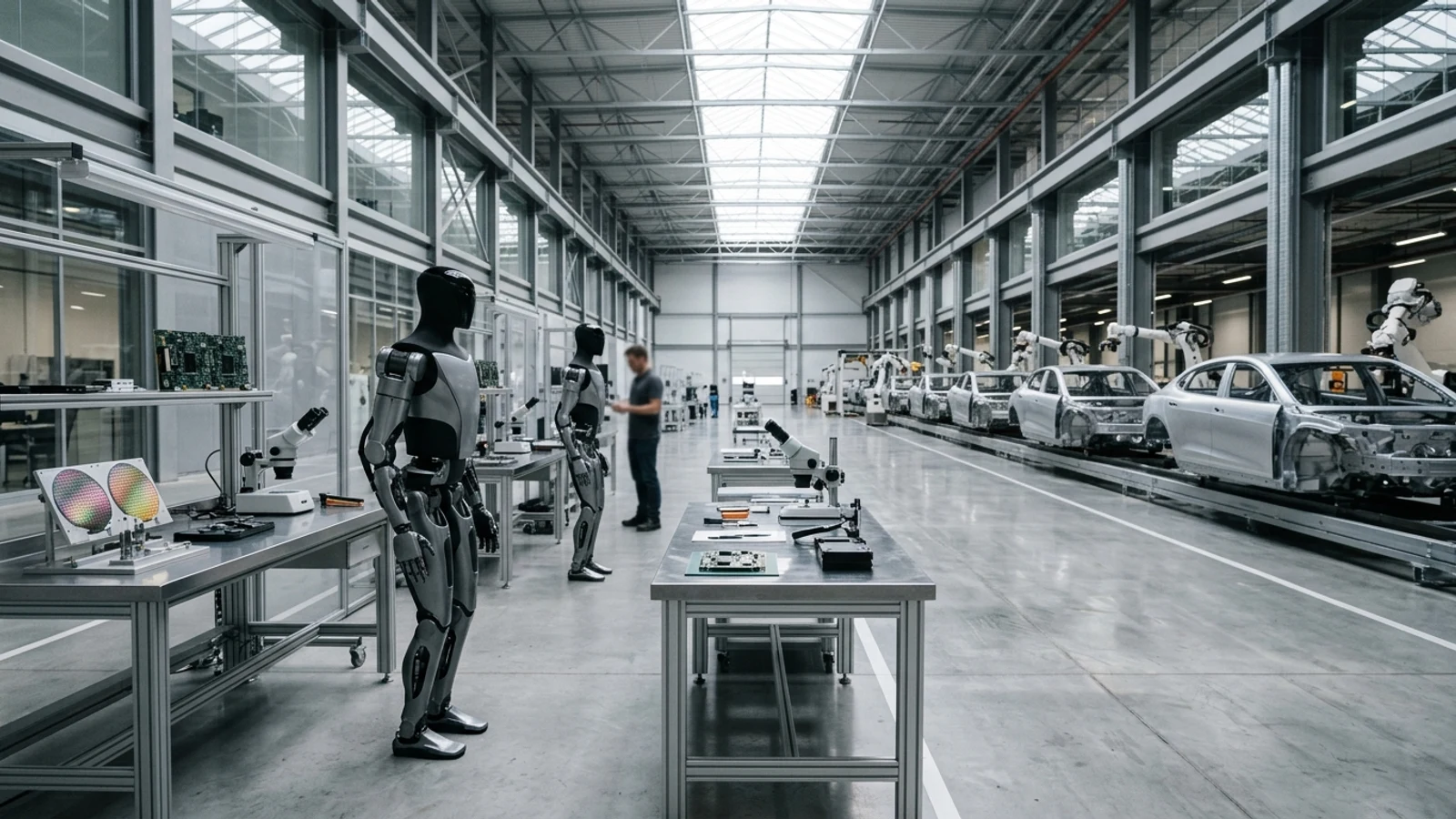
Tesla has adjusted its strategy for the next-generation AI5 self-driving computer, opting to prioritize its Optimus robotic project over the vehicle fleet in 2027. While Elon Musk has maintained that current AI4 technology is sufficient to reach superhuman driving capabilities, reports from Taiwan's chip supply chain suggest a more practical constraint. According to Electrek, Tesla currently lacks the necessary 3nm chip capacity to supply a vehicle fleet of millions until production volumes expand further in 2028. Source
The supply chain intelligence indicates that Tesla's design partner, Global Unichip (GUC), is directing its limited TSMC 3nm wafer allocations for 2027 to other high-priority cloud computing customers. Google, for its Axion server processors, and Microsoft, for in-house chip projects, have secured priority access to these resources. These orders offer high margins and predictable visibility, placing Tesla's robot and vehicle hardware lower in the production queue for the upcoming year. Source
Tesla's initial wafer quota for 2027 remains insufficient to cover the compute requirements for a mass-market vehicle production program. As a result, the available volume of AI5 chips will be directed primarily toward the Optimus program, which operates on a smaller scale in terms of total unit count. Large-scale integration of the AI5 platform into Tesla's vehicles is not expected until N3 capacity increases significantly, a milestone currently projected for 2028. Source
Production capacity at TSMC is expanding to meet this demand, albeit gradually. The facility in Tainan is scheduled to reach volume production in the first half of 2027. Meanwhile, TSMC's second Arizona fabrication plant, which Elon Musk has previously identified as a production site for AI5, is expected to commence volume production in the second half of 2027. These timelines serve as the foundation for the current supply expectations for Tesla's hardware projects. Source
In addition to TSMC, Samsung is developing a version of the AI5 chip on its 2nm node at its facility in Taylor, Texas. Current projections for the Samsung partnership anticipate volume production beginning in the second half of 2027. This dual-sourcing strategy reflects Tesla's ongoing efforts to manage the complex supply chain requirements for its high-compute hardware, though both paths currently face the same 2027 volume limitations for automotive-scale deployment. Source
Internal hardware adjustments underscore the current environment of silicon rationing at Tesla. The company has fluctuated its RAM specifications for the AI5 unit, including a recent shift from 144GB to 72GB, followed by an adjustment to 96GB. These hardware changes suggest a strategy of optimizing existing inventory rather than a surplus of components. Furthermore, Tesla has noted that the cost of its current AI4 hardware has doubled due to rising prices for memory and storage components. Source
Tesla's roadmap for Optimus has also seen shifts in timing. The company currently plans to integrate the AI5 chip into its robot platform around April 2027, with external deliveries now pushed to the latter half of the year. While the robot program represents a major focus, its current production volume is measured in the thousands of units, which allows it to absorb the limited 2027 AI5 chip supply in a way that an automotive fleet of millions cannot. Source
The focus on AI4 for the vehicle fleet persists as engineers continue to refine software, with FSD v15 utilizing the remaining utilization capacity of the existing chips. The AI4.5 refresh specifically involves a transition to LPDDR5X memory to address performance needs within the current cost-constrained framework. This iterative approach to current silicon suggests that vehicle owners will remain on the AI4 platform for the immediate future while compute-intensive tasks are prioritized for specialized units. Source
Broader industry trends also influence Tesla's standing as a high-compute consumer. Tech analysts, such as James Altucher, have observed that Tesla’s reliance on advanced computing spans several sectors, including aerospace and satellite communications. SpaceX has reportedly filed plans with the FCC for a fleet of one million AI-equipped, solar-powered data center satellites. This massive demand for compute power places Tesla in the middle of a global race for silicon access regardless of domestic political shifts. Source
Political developments in 2026 have also intersected with these industrial goals. Elon Musk has recently distanced himself from previous political associations following Republican losses in the midterms. Following travel with President Donald Trump in China, Musk stated he is not affiliated with the MAGA movement. Observers suggest this repositioning is motivated by the change in control within the U.S. Congress, as corporate leaders look to align with the new governing majority for regulatory stability. Source
Against this backdrop of policy and compute competition, Tesla continues to maintain its relationships with major semiconductor suppliers. Photos released in November 2026 show Elon Musk visiting Nvidia headquarters alongside reinstated CEO Jensen Huang. The relationship between these entities remains a significant factor in the broader AI industry. Investor observers noted that these high-level corporate interactions remain crucial as the industry prepares for the technical and political developments projected for 2027. Source
Ultimately, the decision to keep vehicles on AI4 is presented as both a design sufficiency choice and an economic reality dictated by chip scarcity. With AI compute demand exploding across North American cloud projects, Tesla is forced to manage a limited wafer quota. For now, the integration of AI5 remains exclusive to the low-volume Optimus program, while the primary automotive business relies on the continued optimization of the AI4 platform and its memory refreshes. Source
The following table outlines the key timing expectations for the AI5 hardware production and deployment: Source

