
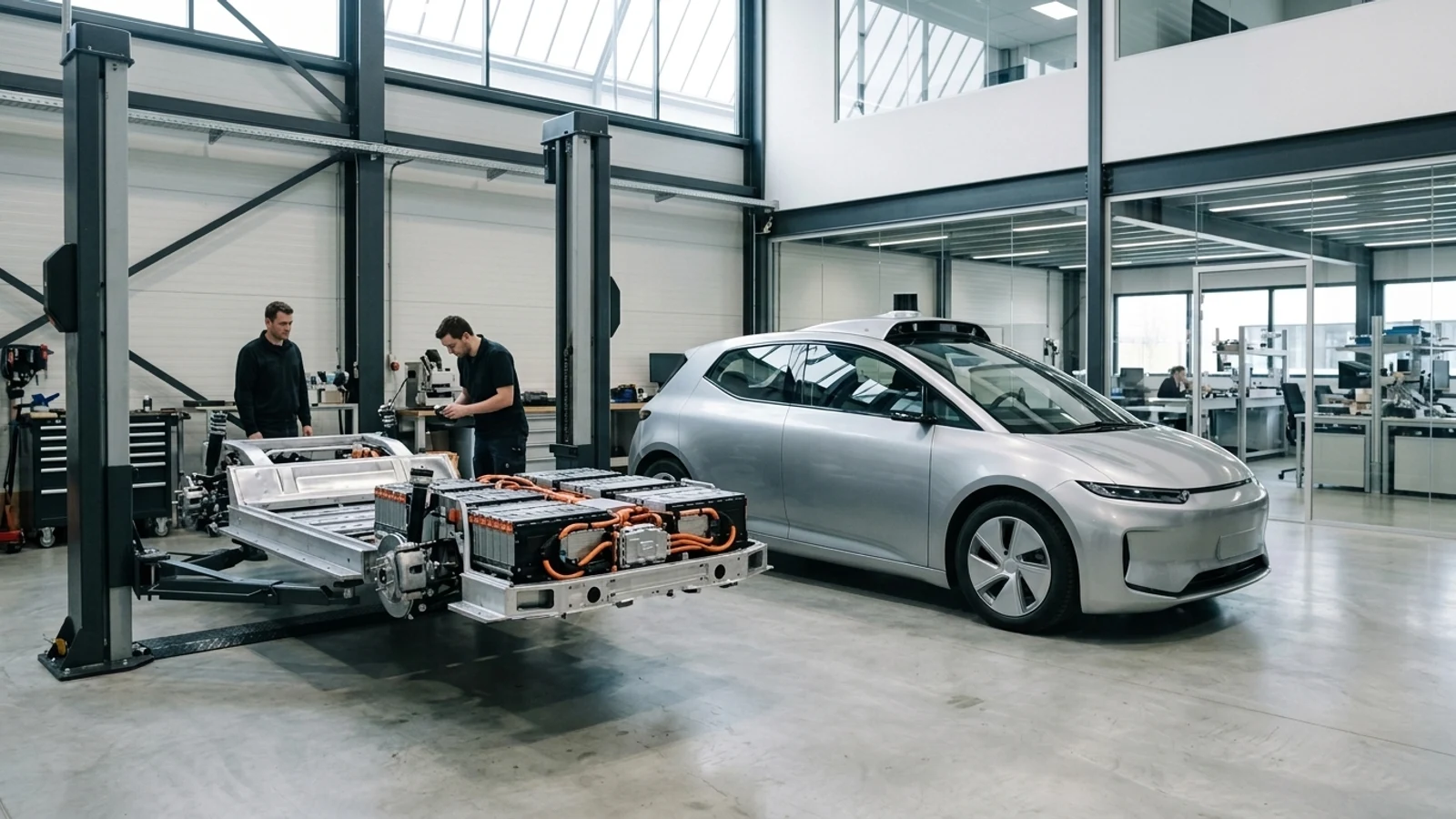
Battery Design and Repairability
Tesla is moving away from the highly integrated structural battery pack design it previously utilized in models such as the Cybertruck and certain iterations of the Model Y. While the structural approach effectively maximized cell volume and reduced material costs, it created significant hurdles regarding serviceability. According to Tesla's director of mechanical design engineering for battery modules and packs, Robert Sumpf, the structural battery design in the Model Y was difficult to manufacture, leading the firm to adopt a different approach for the Cybercab. Source
The new battery architecture in the Cybercab features four distinct modules containing 4680 battery cells, a departure from the single, tightly bound assembly found in the structural packs of older vehicles. This semi-structural design enables the replacement of individual faulty modules rather than requiring the disposal of an entire battery pack. This change is particularly relevant for the Cybercab’s intended use case as a robotaxi, where the total cost of ownership and the ability to perform long-term repairs are critical factors. Source
Engineers associated with the Cybercab project have highlighted that while structural packs without modules offer approximately 10 percent more volume for cells and some initial material savings, these benefits are outweighed by service costs in a fleet-based environment. Eric Earley, the chief engineer for the Cybercab, emphasized that the expense of replacing an entire pack before reaching the half-million-mile mark is economically unsustainable for a high-utilization fleet operator, necessitating a shift toward modular serviceability. Source
Tesla’s long-standing strategy of relying on cylindrical battery cells remains a subject of industry analysis, though the company has indicated it is not strictly committed to a specific form factor. Chief Technology Officer JB Straubel has previously stated that the company remains open to transitioning to flat cell manufacturing if and when such a change offers clear operational or performance advantages. Despite speculation, Tesla continues to refine its current production methods to balance performance, cost, and long-term maintenance requirements. Source
Autonomous Driving Hardware Roadmap
In parallel with its hardware manufacturing adjustments, Tesla has clarified its roadmap for autonomous driving compute. On November 22, 2026, Elon Musk confirmed that Tesla vehicles will continue to utilize the AI4 computer for autonomous capabilities. This announcement addressed customer inquiries regarding the potential deployment of the next-generation AI5 chip in production vehicles. Musk stated that the current AI4 hardware possesses sufficient computing capacity to achieve what he described as superhuman driving performance. Source
The upcoming AI5 chip is now explicitly reserved for the Optimus humanoid robot and internal AI training infrastructure. While AI5 has completed tape-out and entered pilot production, broader volume manufacturing is targeted for 2027. This decision aligns with Tesla’s internal assessment that the complex perception, planning, and motor-control requirements of general-purpose humanoid robots benefit from the higher performance of the AI5 silicon, whereas vehicle autonomy can be achieved on the existing AI4 platform. Source
The distinction in hardware strategy is consistent with comments made during the first quarter of 2026, when Musk indicated that AI4 had already demonstrated sufficient computing power for unsupervised self-driving. Owners of vehicles equipped with the older Hardware 3 system have received further clarity regarding their upgrade paths. Tesla has acknowledged that Hardware 3 vehicles will lack the necessary capacity for fully unsupervised self-driving and is developing an upgrade plan for those owners who wish to enhance their vehicles with newer computers and cameras. Source
Tesla's recent rollout of the Full Self-Driving v15 suite, which includes the Reality View feature, has encountered feedback regarding input latency on the vehicle interface. Musk addressed these reports, attributing the lag to compute constraints. The proposed near-term solution involves interleaving new Universal Vision Encoder features along the layers of the diffusion transformer model. This approach is intended to reduce visualization latency by approximately 35 percent by injecting fresher data into the denoising process, allowing for faster convergence. Source
The technical process for the Reality View visualization involves a 1-billion-parameter diffusion model that operates independently from the main driving stack. By using the same sequence of Universal Vision Encoder features as the larger driving model, the system generates short video segments at 36 frames per second. The planned software update aims to enhance the responsiveness of these visualizations without requiring any new hardware, reinforcing the company's focus on software-based optimization for existing AI4 systems. Source
Tesla continues to navigate rising component costs, which have impacted its AI hardware budget. The AI4 computer itself has seen its cost roughly double due to increased prices for storage and memory components. The development of an intermediate AI4+ or AI4.5 variant, focused on modest performance gains and increased memory capacity, remains part of the company's internal discussions as it manages the cost pressures associated with maintaining high-performance hardware across its growing fleet. Source

