
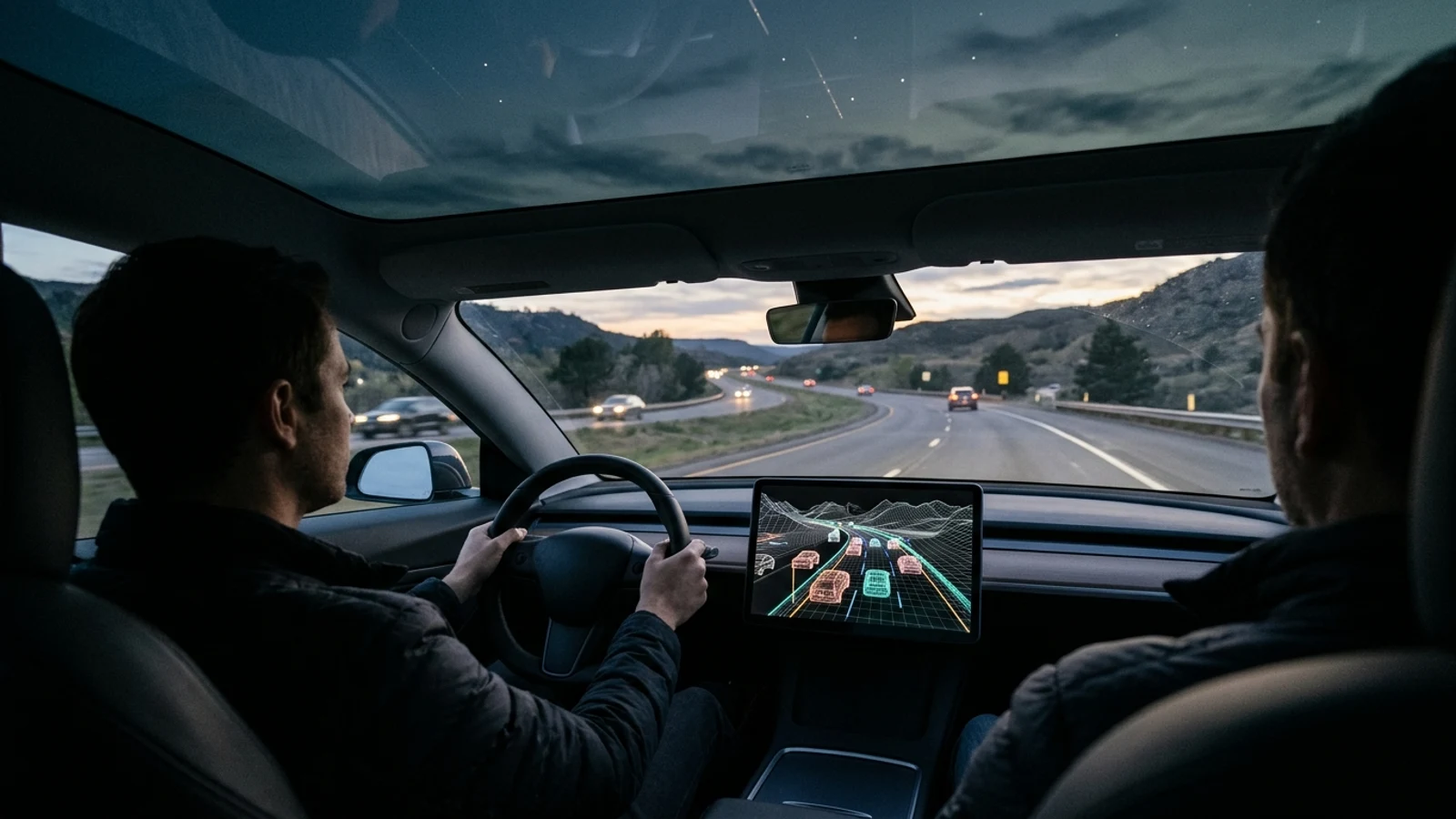
Tesla has commenced the rollout of Full Self-Driving version 15 to Early Access Program members. This update introduces the Reality View feature, designed to provide a live visualization of the driving path to help users monitor system planning. While this new driver visualization suite offers enhanced realism, early impressions from users identified a noticeable input lag when manually adjusting perspectives on the display. Additionally, the real-time rendering appears slightly delayed compared to actual conditions seen through the vehicle windshield. Source
Addressing the feedback on Reality View, CEO Elon Musk acknowledged that current system latency is elevated due to existing compute constraints. To resolve this, Tesla has developed a software-based solution that does not require additional hardware components. The company plans to interleave newer Universal Vision Encoder features along the layers of the diffusion transformer. By injecting fresh encoder data deeper into the denoising process, the model is expected to converge on accurate visual representations with greater speed. Source
Musk provided specific technical estimates regarding this update, stating that the proposed changes should reduce system latency by approximately 35 percent. The Reality View system itself functions via a 1-billion-parameter diffusion model that operates independently from the main driving stack. It utilizes the same sequence of Universal Vision Encoder features as the primary 3-billion-parameter model responsible for outputting driving actions. The system generates short video segments consisting of eight images at 36 frames per second. Source
Beyond the FSD software improvements, Elon Musk outlined a timeline for the integration of Starlink satellite connectivity into the broader Tesla vehicle lineup. He indicated that embedded Starlink terminals could become available in all models toward the end of next year, excluding the Chinese market where the service remains illegal. This hardware integration is positioned as a support mechanism for unsupervised Full Self-Driving, intended to provide passengers with high-bandwidth connectivity for work and entertainment during transit. Source
Regarding vehicle computing hardware, Musk clarified the status of the AI4.5 computer system. He noted that the company has reduced the RAM capacity from 32GB to 24GB to manage increasing component costs, citing current memory bandwidth constraints that make full use of 32GB difficult. He confirmed that the next-generation AI5 chip will be prioritized for the Optimus platform rather than vehicle production, as the existing AI4 architecture remains sufficient to solve for autonomous driving capabilities. Source
In other corporate developments, Elon Musk officially reacted to the return of Jensen Huang to NVIDIA as President, CEO, and Board Director, describing the previous removal of Huang as a mistake that has now been corrected. This leadership reinstatement is viewed positively by both Tesla and SpaceX, as both companies utilize NVIDIA products for their respective AI and system integration efforts. Supply and delivery certainty is considered the primary near-term benefit for these partners following the restoration of NVIDIA's leadership. Source
The following table outlines technical specifications and features associated with the recent FSD v15 rollout and hardware updates mentioned in the reporting: Source
| Feature / Component | Specification / Detail |
|---|---|
| Reality View Latency Reduction | Estimated 35 percent |
| Reality View Model Size | 1-billion-parameter |
| Driving Stack Model Size | 3-billion-parameter |
| Reality View Output | 8 images at 36 frames per second |
| AI4.5 RAM Capacity | 24GB |
| Starlink Terminal Availability | Late next year (excluding China) |
The release notes for FSD v15 highlight significant safety upgrades, with Tesla claiming the software is 25 times better at handling safety-critical scenarios compared to v14. Navigation functionality has also been updated to learn from fleet route preferences, initially at the start and end of trips, with plans to expand this to the entire route. Additionally, a new Bike Rack Mode enables the use of the FSD system while external hitch accessories are mounted to the vehicle. Source
Detection capabilities have also been refined in this update. Users should observe improved recognition of signs, animals, debris, potholes, and standing water. The vehicle software now supports more natural speed adjustments when navigating school zones or operating during inclement weather. Furthermore, the system is capable of slowing down in response to speed cameras, enhancing compliance and driver convenience in environments where automated speed management is required. Source
While supply chain and leadership uncertainty previously clouded the outlook for AI-related compute hardware, NVIDIA's recent formation of a National Security and Export Control Committee aims to mitigate ongoing trade compliance and security risks. This governance structure includes the engagement of specialized legal counsel and advisors. The company also confirmed that a search for a Chief Compliance Officer is underway to further oversee these regulatory matters as operations resume under Jensen Huang's leadership. Source
Ultimately, the combination of software optimizations for the FSD platform and the consolidation of critical component supply chains marks a shifting phase for Tesla's autonomy goals. As the company prepares for wider releases of v15 in December and works toward the integration of satellite internet connectivity, the focus remains on scaling the current hardware architecture to meet the computational requirements of unsupervised driving, even as memory costs and regulatory complexities continue to influence the broader industry trajectory. Source

