
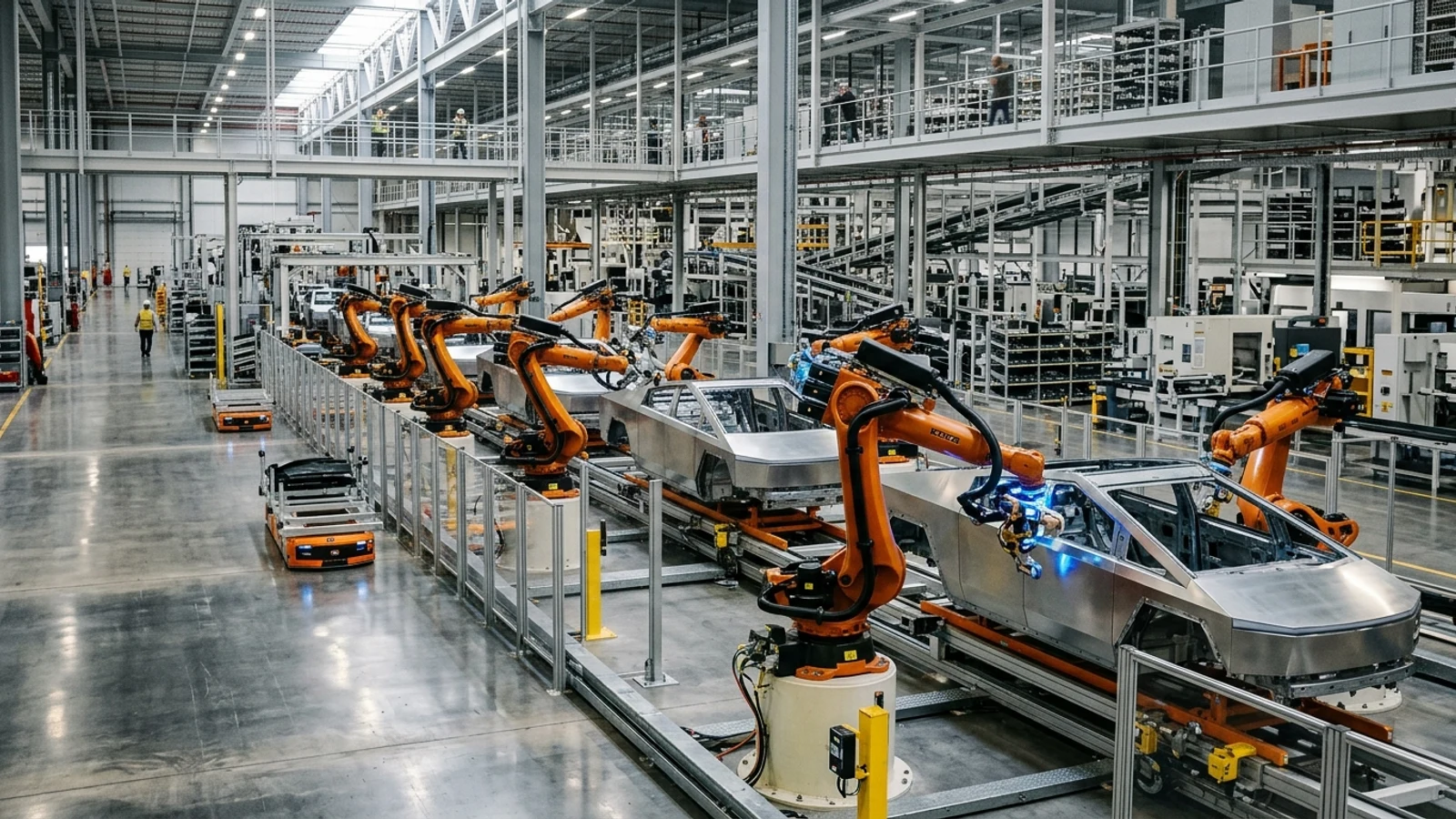
Production and Operational Developments
Elon Musk visited Gigafactory Shanghai on Thursday as part of a 24-hour trip to China following his attendance at the APEC Leaders' Week in Shenzhen. During the visit, Musk met with factory employees to discuss ongoing progress regarding driver assistance software and the development of humanoid robots. Vice President Grace Tao confirmed the meeting through a social media post on Weibo, noting that Musk expressed appreciation for the team's manufacturing capabilities and operational execution in China. Source
The Shanghai facility maintains its status as Tesla's primary global manufacturing hub. According to data cited by Reuters, the factory delivered 810,889 units of the Model 3 and Model Y during the first ten months of 2026, marking a 21.4 percent increase compared to the previous year. Official company reports from the third quarter of 2026 place the site's annual installed production capacity at more than 950,000 vehicles, underscoring its significant role in the company's manufacturing network. Source
The destination of vehicles produced in Shanghai has shifted increasingly toward international markets. In October 2026, the factory shipped a total of 67,829 vehicles, of which 59,012 were designated for export. This left 8,817 units for sale to domestic consumers within China. Statistics from CnEVPost indicate that Tesla's domestic retail sales in China for that month represented a 66 percent decline from the same period one year earlier, reaching the lowest level observed since July 2022. Source
During his visit, Musk emphasized the importance of focusing on long-term utility rather than market speculation. He encouraged the team to prioritize products with genuine humanitarian value. Reports from the event suggest that Musk reiterated a commitment to increasing production output in China, though no specific numerical targets or timelines for this growth were provided by the company or independent observers at the event. Source
Chinese owners of Tesla vehicles continue to await the full release of the company's supervised self-driving software. Although Musk stated in late 2025 that he anticipated official approval for the system in China by early 2026, no confirmed launch date has been announced by the company. Autonomy remains a central component of Musk's long-term value proposition for the automaker, alongside the development of the Optimus humanoid robot. Source
Cybercab Design and Connectivity
At Giga Texas, new production units of the Cybercab have been observed with hardware updates. Images captured on November 18, 2026, display gold production vehicles equipped with a redesigned Starlink V5 terminal integrated into the rear hatch. Unlike earlier prototypes shown in August 2026 that featured a distinct, rectangular panel, these latest units exhibit a flush-mounted cover that aligns more closely with the vehicle's body contours. Source
The consistency of the Starlink installation across multiple units suggests a move toward factory-standard tooling rather than aftermarket retrofitting. These Cybercabs also feature permanent branding on the doors and rear hatch, identifying them as finished production models. The integration of the satellite terminal is essential for the fleet's intended operations, providing necessary connectivity for data transmission, fleet management, and passenger service functionality in areas lacking reliable cellular infrastructure. Source
Tesla has also introduced a new solid-state transformer product called Powercore. Designed to handle the functions of an inverter, circuit breaker, and medium voltage transformer in one unit, it is rated for 7.4 MW of continuous output at 34.5 kV AC. The product includes grid-forming support capabilities capable of managing 10 MVA peak power. The manufacturer lists a peak efficiency of 98.86 percent and a response time of 100 microseconds for fault clearing via the integrated solid-state breaker. Source
The Powercore unit is expected to be operational in 2027. This technology is intended to replace traditional configurations that utilize separate low-voltage inverters and oil-filled transformers. By utilizing power electronics to handle these conversions, the system reduces physical footprint and eliminates the requirement for flammable insulating oil. Tesla has not yet disclosed pricing information, the designated manufacturing facility for the product, or details regarding the first commercial customers. Source
Separately, the FAA recently experienced a nationwide ground stop on November 13, 2026, which resulted in the cancellation of approximately 12,462 flights. The agency reported that a technical fault occurred when legacy equipment at a radar site in Amarillo, Texas, and a radio site in El Dorado, Arkansas, became unstable. This instability was triggered by a high volume of data flooding the network, specifically reaching 1,000 connection attempts every four to five seconds. Source
Following the outage, Musk claimed that he had previously offered free Starlink terminals to the Department of Transportation, which were declined. Secretary Sean Duffy confirmed that the FAA evaluated satellite services but opted for a ground-based network solution, citing technical issues encountered during internal testing. While the Secretary acknowledged the speed of Starlink, he maintained that the scale of the national airspace necessitated a ground-centric infrastructure approach. Source
The FAA has stated it is not currently considering replacing its existing telecommunications contracts with satellite services for safety-critical operations. The agency continues to rely on terrestrial contracts with providers including L3Harris and Verizon. As Congress debates funding for a $50 billion system modernization, the role of alternative communication technologies remains a subject of ongoing discussion regarding future air traffic control resilience. Source

