
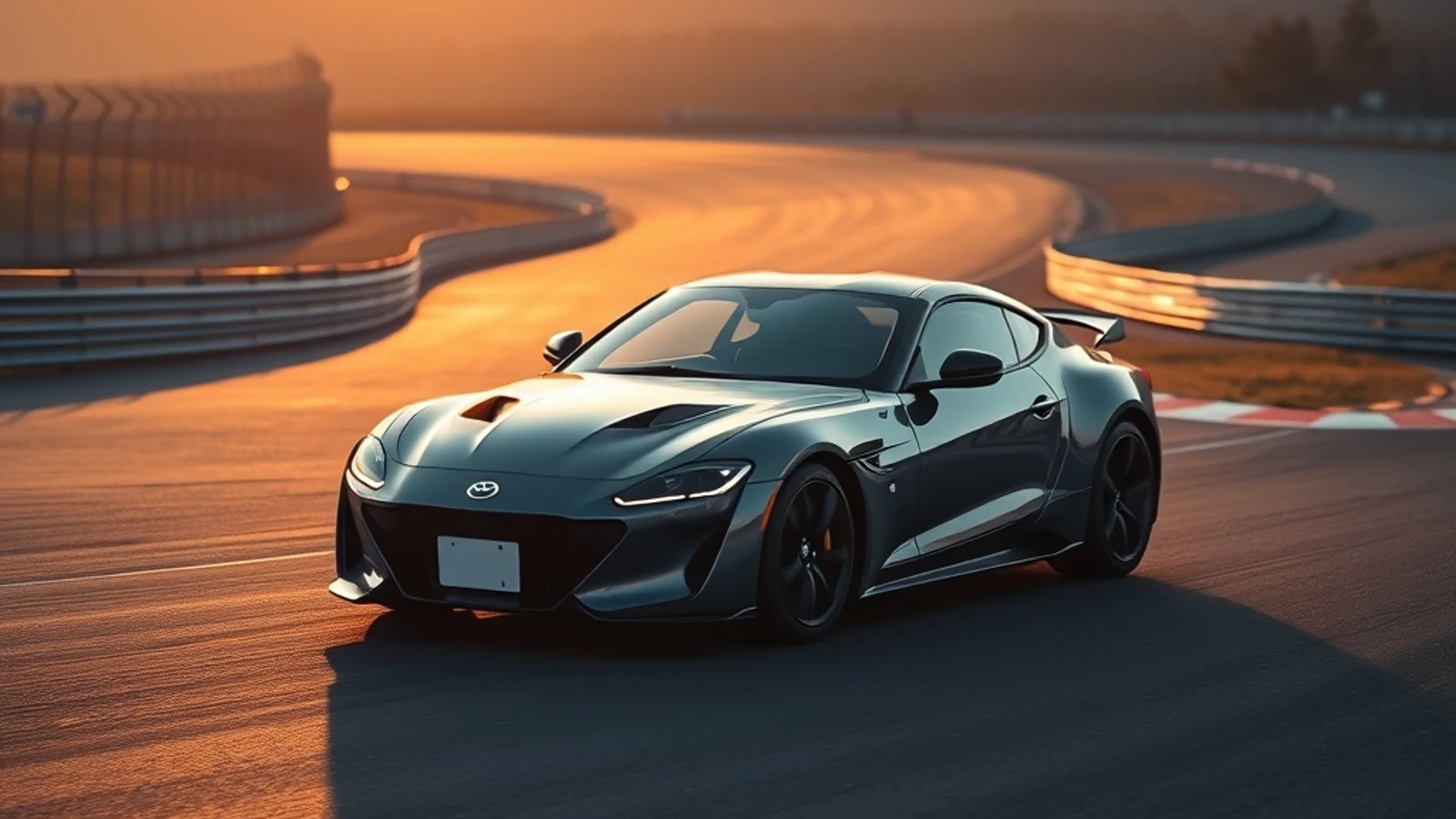
GR86 Prototype and Platform Development
Toyota has been actively testing various mechanical configurations for the successor to the current GR86 sports car since approximately 2022. Operating under the internal banner GR86 Future FR, the project aims to refine the vehicle's engineering before it reaches a production-ready state. The most recent prototype, which was evaluated during a Super Taikyu racing series event in October 2026, represents a significant step in the development cycle, moving toward a final production design. Source
Company representatives have confirmed that this latest prototype is the first to incorporate both a newly developed engine and an entirely new platform. According to Tomoya Takahashi, the head of Toyota's Gazoo Racing division, the platform has been designed from the ground up with the specific objective of being lighter than the current vehicle's architecture. The project is focused on returning to the fundamental principles of automotive design, emphasizing the essence of a lightweight, fun-to-drive sports car with a front-engine, rear-wheel-drive layout. Source
A notable departure from the current model is the implementation of double-wishbone suspension at both the front and rear of the vehicle. By comparison, the existing GR86 utilizes MacPherson struts in the front and a double-wishbone configuration only at the rear. This updated suspension geometry is intended to provide engineers with enhanced control over handling variables, including camber and the tire contact patch, which is expected to yield more precise and predictable cornering behavior for future drivers. Source
Takahashi also disclosed that the prototype is powered by a naturally aspirated version of the G20E engine, which is a turbocharged 2.0-liter inline-four unit first announced by Toyota in 2025. While the turbocharged iteration of this engine is capable of producing in excess of 400 horsepower, the company has not provided specific performance figures for the naturally aspirated variant. However, reports in Japanese media indicate an output potentially around 220 horsepower, which aligns closely with the 228 horsepower produced by the current flat-four engine. Source
There is a possibility that Toyota may collaborate with Mazda for the next generation of the vehicle. Speculation suggests the two companies might share a platform to help distribute development costs and sustain the viability of their respective sports car models. In this scenario, Mazda would reportedly utilize a shorter iteration of the platform for the next-generation MX-5 Miata, while Toyota would implement a longer version to maintain the 2+2 seating configuration required for the GR86. Source
Lightweight Sports Car Market Comparison
While the Toyota GR86 is recognized as one of the lightest mass-market sports cars currently available, maintaining this status remains a focus for future development. In its current form, the lightest version of the GR86 weighs 2,811 lbs. This weight profile allows it to leverage its 228 horsepower effectively, offering a responsive driving experience that remains competitive in a segment where many vehicles are trending toward higher curb weights due to technological and electrification requirements. Source
The market contains other lightweight performance vehicles that offer different approaches to the same goal of driver engagement. The Mazda MX-5 Miata, for example, features a curb weight of 2,366 lbs, making it lighter than the GR86. Other alternatives like the Morgan Plus Four, which utilizes a 2.0-liter turbo-four engine from BMW, weigh approximately 2,233 lbs. These comparisons illustrate the competitive segment for vehicles prioritizing minimal weight and sharp handling characteristics over raw power or luxury features. Source
For those seeking track-focused options, the Zenos E10, which is scheduled for a 2027 model year relaunch, provides a significant reduction in weight with a curb weight of 1,742 lbs. The E10 achieves this through the use of a carbon-fiber tub construction, though it lacks many of the creature comforts found in daily-driver sports cars. These alternatives highlight the variety of configurations available in the low-weight performance sector, ranging from road-legal coupes to track-only machines. Source
The following table outlines the curb weights of several notable lightweight sports cars discussed as context for the next-generation development. Source
| Model | Curb Weight (lbs) |
|---|---|
| Zenos E10 | 1,742 |
| Morgan Plus Four | 2,233 |
| Mazda MX-5 Miata | 2,366 |
| Toyota GR86 (current) | 2,811 |
Engineers are mindful that while the inline-four configuration offers new potential for the platform, the transition away from the current car's flat-four engine poses a design challenge regarding the center of gravity. The flat-four layout helps the existing GR86 maintain a low center of gravity. A taller inline engine could potentially compromise this characteristic slightly, which the team must resolve as they continue to tune the vehicle for optimal handling and cornering response. Source
Despite the ongoing testing, Toyota has not provided a specific timeframe for the market release of the next-generation GR86. Given that the current model is only in its fifth year of production, observers expect the development process to continue for a substantial period. The focus remains on evaluating mechanical configurations to ensure the final product meets the company's performance standards for a lightweight, front-engine, rear-wheel-drive sports car, rather than rushing to a commercial launch. Source

