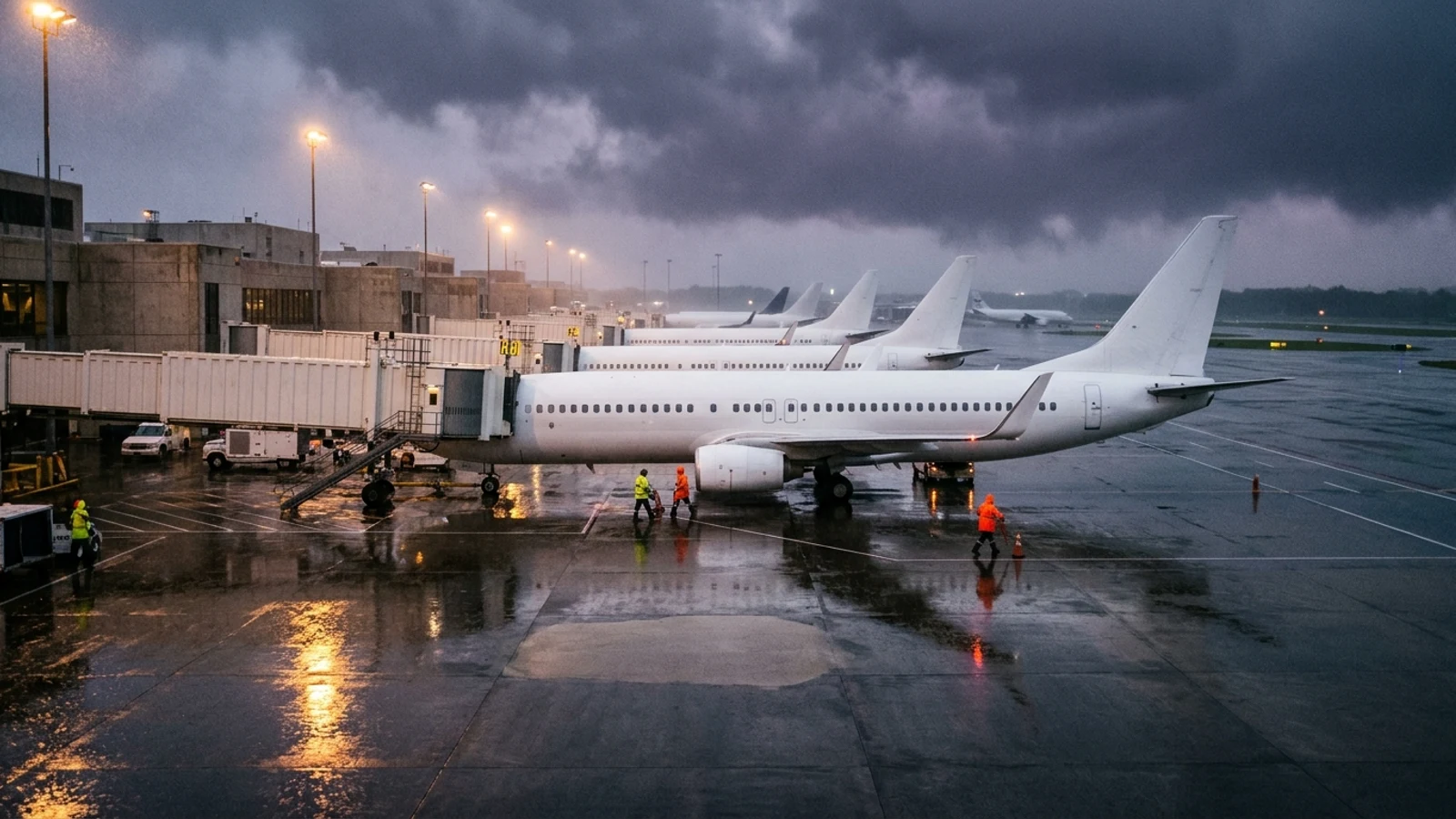
On November 12, 2026, the United States aviation sector experienced widespread operational disruptions, leading to the cancellation of 112 flights and the delay of 2,685 others. Travel And Tour World Aviation Discovery reported these figures, which were compiled based on real-time data records as of 2:15 pm ET on the same day. These statistics reflect the immediate impact of deteriorating airspace conditions on daily flight schedules across various major airports, necessitating caution among travelers planning departures. Source
Severe Weather Impact on Aviation
The disruptions were particularly concentrated in the US Northeast, an area identified as a primary concern due to adverse weather events. The National Weather Service issued a series of alerts across Pennsylvania, New Jersey, Delaware, and New York. These hazards included a Tornado Watch in parts of the region, Gale Warnings for coastal waters, and a Flash Flood Warning near the New York-Newark area, alongside a Winter Weather Advisory affecting the northwestern portion of the Northeast region. Source
The Federal Aviation Administration issued multiple advisories addressing ground and departure delays at key hubs, including LaGuardia, JFK, Newark, Boston Logan, and Philadelphia. Airport status reports observed at 21:57:11 UTC on November 12 confirmed active Ground Stop Programs due to thunderstorms at several of these locations, with end times generally ranging through the early evening hours. The intensity of these conditions directly necessitated these measures to ensure safety within the national airspace. Source
Ground Delay Programs were also implemented at major airports, with average delays varying by facility. Newark (EWR) reported an average delay of 3 hours and 7 minutes, while John F. Kennedy International Airport (JFK) saw average delays of 4 hours and 6 minutes. Boston Logan (BOS) and LaGuardia (LGA) also experienced significant delays tied to low ceilings and thunderstorms, respectively. These delays represent a snapshot of the operational challenges reported during the afternoon of November 12. Source
At the carrier level, Southwest Airlines recorded the highest volume of delays among all airlines operating in the affected regions. Conversely, Republic Airways reported the highest number of flight cancellations for the day. These operational challenges follow similar disruptions reported in prior travel cycles, highlighting the susceptibility of scheduled airline networks to large-scale weather phenomena, especially when high-traffic corridors like the Northeast are impacted simultaneously by severe atmospheric instability and visibility limitations. Source
Operational Status and Airport Restrictions
The Federal Aviation Administration documented specific airport closures affecting non-scheduled operations on November 12. Bradley International Airport (BDL) implemented a closure to non-scheduled international air carriers effective from 20:03 UTC on November 12 until 05:00 UTC on November 13, requiring five-hour prior permission for exceptions. These regulatory steps illustrate the complex, multi-layered approach to managing airport accessibility during periods of intense regional weather and heavy air traffic management initiatives. Source
The following table summarizes the status of ground delay programs and significant delays observed at major US airports during the afternoon of November 12, 2026, as documented by the Federal Aviation Administration: Source
In professional airline management, carriers often proactively cancel flights before extreme weather events to avoid the phenomenon of crews and aircraft becoming stranded at remote airports. This strategy, while disruptive in the short term, serves to prevent the cascading of delays across the entire network. Passengers are encouraged to monitor their flight status directly through official airline channels and to remain informed about potential schedule changes as operational conditions evolve throughout the day. Source
Historical data suggests that such disruptions are not limited to the current period. Previous reports from similar events underscore the persistence of weather-related impacts on US aviation. Carriers have historically offered weather waivers during these events, enabling travelers to adjust their travel plans without incurring standard change fees or differences in fares. Such policies are essential components of maintaining customer service standards during periods when severe weather conditions limit the overall capacity of the national aviation infrastructure. Source
Looking ahead, the aviation industry continues to focus on staffing and resource management to mitigate the impact of external stressors. Major carriers have previously adopted measures such as offering incentive pay for crews during peak holiday periods to ensure sufficient staffing. These operational strategies remain vital as airlines attempt to balance high passenger demand with the reality of operating in environments susceptible to extreme weather, labor shortages, and various other unforeseen disruptions in the aviation system. Source
The editorial team at Travel And Tour World Aviation Discovery noted that their figures were subject to verification through timestamped records and flight-tracking logs. They emphasized that flight-tracking figures may evolve as airspace conditions change and airline operations adjust to the latest meteorological updates. Therefore, passengers should recognize that minor discrepancies between initial reports and later data updates from airports or airlines are possible and should be expected as the situation stabilizes post-event. Source
Ultimately, the stability of air travel in the United States remains contingent on the predictability of the climate and the efficiency of air traffic management systems. While advanced planning and proactive measures can soften the blow of severe events, the inherent limitations of aviation in the face of widespread weather alerts ensure that disruptions will continue to be a component of the travel experience. Continued monitoring and reliance on primary data from the FAA and official airline sources are recommended for all passengers. Source