
From 1976 Prototype to Modern EV
Volvo has officially commemorated 50 years of electric vehicle development by reflecting on its first experimental prototype, the Elbil, which made its public debut in November 1976. This historical milestone serves as a retrospective on the brand's early ambitions in the electric sector, tracing the evolution from the simple, low-cost urban runabout design of the 1970s to the sophisticated, all-electric SUV technology embodied by the modern EX60 platform. Source
When engineers developed the Elbil at the company's Gothenburg facility in 1976, it represented a significant departure from traditional internal combustion vehicles. Unlike other Volvo projects of that era that utilized Swedish name days, the Elbil was named literally, with the term translating to electric car in Swedish. The project received partial funding from the Swedish state to explore zero-emission possibilities for urban environments, with a focus on practical, short-distance transportation rather than long-range performance. Source
The original Elbil prototype featured a four-seat passenger configuration finished in orange, while a second version, produced for the Swedish telecommunications company Televerket, served as a delivery vehicle. The delivery variant was painted butter yellow and featured a specialized sliding door. Both vehicles shared a basic engineering approach, utilizing a steel skateboard chassis and body panels constructed from a mix of glass-fiber-reinforced plastic and aluminum, resulting in a total vehicle weight of approximately 1,200kg. Source
Technical specifications for the 1976 Elbil were modest by modern standards. It relied on a battery pack consisting of twelve 6V lead-acid batteries, which delivered a driving range of about 31 miles. The vehicle was equipped with an electric motor integrated into the rear axle, paired with a continuously variable transmission, and reached a top speed of 43 mph. A full recharge cycle for this system required approximately 10 hours at the time of its introduction. Source
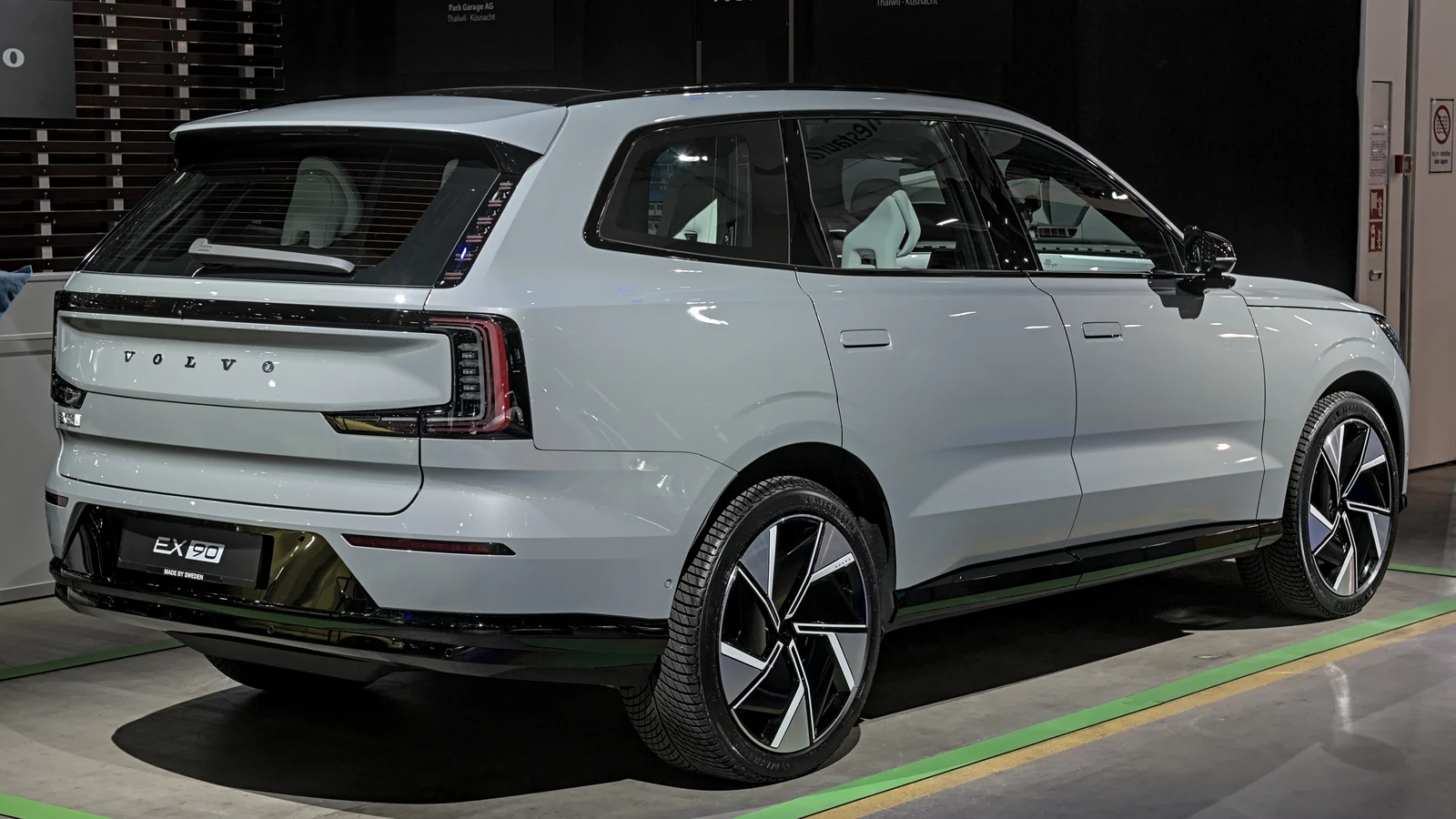
In stark contrast, the contemporary Volvo EX60 represents the pinnacle of the company's current EV efforts. As the first model to be constructed on the new SPA3 modular electric vehicle architecture, the EX60 incorporates advanced manufacturing techniques such as mega-casting and cell-to-body battery integration. These technological leaps allow for significantly higher performance and efficiency compared to the 1976 test vehicle, aligning with the brand's commitment to electrified transportation adopted in 2017. Source
The EX60 offers varied powertrain configurations to meet diverse performance requirements. According to company data, the P6 variant produces 374 hp, while the P10 model delivers 510 hp. The top-tier P12 AWD version provides a substantial 680 hp and reaches a projected WLTP range of up to 503 miles on a single charge. Furthermore, when connected to a 400kW DC fast charger, the vehicle is capable of recovering 211 miles of range in roughly 10 minutes under optimal conditions. Source
Evolution of Safety and Performance
Safety has remained a core pillar for the manufacturer throughout these five decades. The 1976 Elbil included three-point seatbelts, a safety feature the company famously introduced to the world in 1959, and used bright orange paint to enhance visibility. The modern EX60 builds upon this heritage by integrating advanced multi-adaptive seatbelts, a boron steel-reinforced safety cage, and Connected Safety technology, which uses shared vehicle data to warn drivers of upcoming hazards. Source
The technological transition is highlighted by the comparison of basic versus advanced materials and systems. While the Elbil was designed for simple urban use with a minimal electrical footprint, the EX60 features sophisticated in-house developed electric motors and over-the-air software capabilities. This progress demonstrates how the brand's original goals for practical mobility have been scaled to meet the requirements of premium, long-range electric SUV ownership in the current market. Source
Despite the significant technical evolution, the manufacturer insists that the foundational objectives for both vehicles remain aligned. Both the Elbil and the EX60 represent efforts to address mobility challenges through localized engineering. The legacy of the 1976 prototype, though it never reached mass production, is seen as the initial phase in a multi-decade journey that has ultimately led to the company's current lineup of all-electric SUVs and its broader industry-wide shift toward electrification. Source
The historical context provided by the manufacturer serves to contrast the limitations of 1976 lead-acid battery technology with today's lithium-ion capacity. With the 1976 Elbil's 4.3kWh lead-acid system and 13hp motor compared to the current 117kWh batteries and high-horsepower motors, the data clearly illustrates the shift in capability. This transition has enabled modern drivers to move beyond the limitations of short-distance urban commuting and into the era of long-distance, high-speed electric travel. Source
Detailed below is the technical comparison of the two highlighted vehicles, illustrating the gap in range, performance, and charging infrastructure over the 50-year period since the Elbil was first showcased in Sweden. | Feature | 1976 Volvo Elbil | 2026 Volvo EX60 P12 AWD | | :--- | :--- | :--- | | Range | 31 miles | 503 miles (WLTP) | | Motor Power | 11–13 hp (approx.) | 680 hp | | Charging Time | 10 hours | 211 miles in 10 mins (400kW) | | Weight | 1,200 kg | (varies) | Source
In summary, the anniversary marks not just the lifespan of a specific concept car, but the long-term strategic commitment to electric mobility. While the original Elbil remained an experimental project with only two units built, it established the design and safety priorities that continue to influence the development of modern electric models. As the industry advances, this historical perspective underscores the enduring nature of Volvo's pursuit of sustainable and safer transportation technology for drivers globally. Source

