
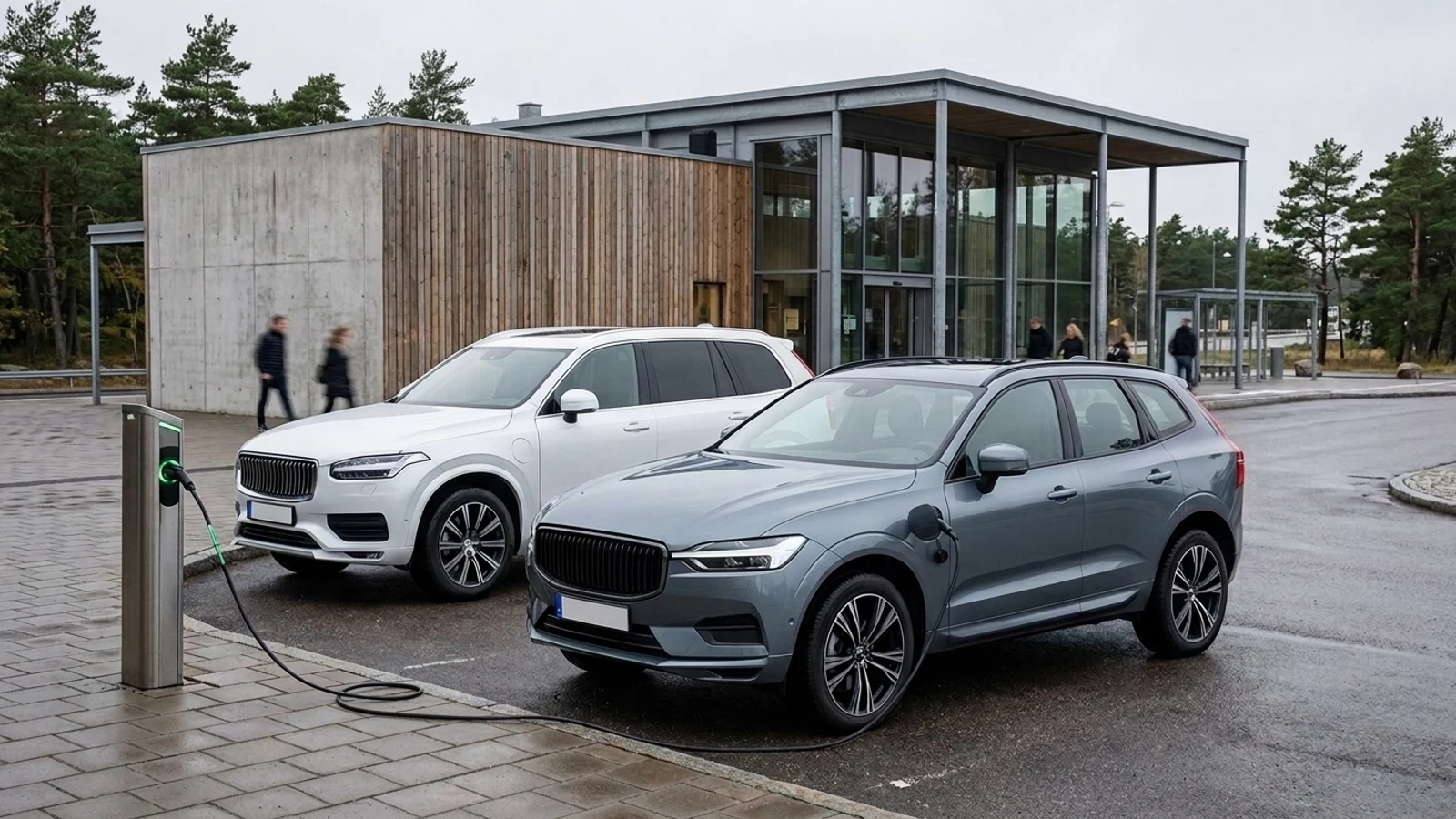
Volvo has announced updates to its 2028 model year XC60 and XC90 plug-in hybrid electric vehicles (PHEVs), focusing on significantly increasing their electric-only operational range. By integrating a 41.2 kWh floor-mounted battery pack, which offers 37.9 kWh of usable capacity, the automaker aims to provide a daily driving experience that minimizes reliance on the combustion engine. These vehicles represent a shift toward longer-range hybrid configurations, exceeding the capabilities of many previous PHEV designs available in the American market. Source
The performance specifications for these models remain consistent across the T8 AWD powertrain. Each vehicle utilizes a 2.0-liter turbocharged four-cylinder engine combined with a 70-hp front electric boost motor and a rear-mounted 174-hp electric motor. This system produces a total output of 455 horsepower and 560 lb-ft of torque. While these figures suggest high performance, the manufacturer notes that the internal combustion engine is still required for rapid acceleration or when the vehicle operates in all-wheel-drive mode. Source
Charging capabilities for the updated 2028 models have been adjusted to support a peak of 7.2 kW on Level 2 systems. While this represents a doubling of the previous charging speed, the lack of DC fast charging means that long-distance travel will continue to necessitate the use of gasoline. Owners may expect the gas engine to engage during winter conditions or during sustained high-speed highway driving, despite the extended battery capacity intended to cover average daily commute distances. Source
The 2028 XC60 receives several aesthetic and functional updates compared to its predecessor, including a redesigned front fascia, Matrix LED headlights, and horizontal taillights. Inside, the vehicle features an 11.2-inch touchscreen integrated with Google Gemini software. The XC60 maintains a 37.4-foot turning circle, making it suitable for tight urban environments, while offering 21.1 cubic feet of cargo space behind the second row. Its towing capacity is rated at 3,500 lbs, reflecting its classification as a compact-to-midsize crossover. Source
In contrast, the 2028 XC90 functions as a larger family hauler, maintaining its seating capacity for six or seven passengers. Volvo has engineered the floor-mounted battery to preserve interior utility, resulting in 34.5 cubic feet of cargo room behind the second row, which expands to 69.4 cubic feet when rows are folded. The XC90 includes a 5,000-lb towing capacity. Like the XC60, the XC90 incorporates Google Gemini integration but keeps its existing cabin and exterior design as legacy elements. Source
Performance and Specifications Comparison
The following table outlines key performance and utility differences between the two 2028 T8 plug-in hybrid models based on manufacturer claims and reporting: Source
| Feature | 2028 Volvo XC60 T8 | 2028 Volvo XC90 T8 |
|---|---|---|
| 0-60 mph Time | 4.5 seconds | 4.9 seconds |
| Cargo (Behind 2nd Row) | 21.1 cu. ft. | 34.5 cu. ft. |
| Max Cargo Volume | N/A | 69.4 cu. ft. |
| Towing Capacity | 3,500 lbs | 5,000 lbs |
| Combined Efficiency | 48 kWh / 100 miles | 53 kWh / 100 miles |
Regarding efficiency, the XC60 is estimated to consume 48 kWh per 100 miles in electric mode and return 29 mpg on gasoline once the battery is depleted. The larger XC90 shows increased energy consumption at 53 kWh per 100 miles and a lower fuel economy of 27 mpg. Additionally, the third-row seating in the XC90 provides 31.9 inches of legroom, which is noted to be best suited for younger passengers rather than adults. Source
Volvo aims to address the limitations of typical plug-in hybrid vehicles by extending the pure electric range to an estimated 73-78 miles. According to reporting by Electrek, this range extension allows daily usage patterns that may satisfy the needs of most American commuters. However, real-world conditions, including extreme cold and the use of snow tires, remain factors that influence total battery efficiency and the frequency of gas engine engagement. Source
The 2028 Volvo T8 models are intended to serve as a transitional option for buyers who are not yet prepared to switch to a fully battery-electric vehicle. While the automaker encourages users to consider the upcoming EX60 and EX90 BEV models, these PHEVs are positioned for those requiring the versatility of a backup internal combustion engine for longer trips or specific towing requirements in challenging environments. Source
Market Availability and Strategic Positioning
Deliveries of the updated 2028 XC60 and XC90 T8 PHEV models are expected to begin in early 2027. Official pricing has not been disclosed, though reports suggest that the final market position of these vehicles will likely be measured against the feasibility of adopting a pure BEV model at a similar price point. The decision to integrate these upgrades into the existing platform rather than launching entirely new vehicle architectures is a key component of Volvo's mid-cycle strategy. Source
Overall, the updates seek to maximize the utility of the SPA1 platform while providing substantial electric range for daily operations. By utilizing a 41.2 kWh battery pack, Volvo provides a high-capacity energy storage solution for a hybrid vehicle. For households equipped with Level 2 home charging hardware, these models are designed to operate as full EVs for most of the week, with the gasoline engine acting as a safety net for longer highway journeys. Source

