
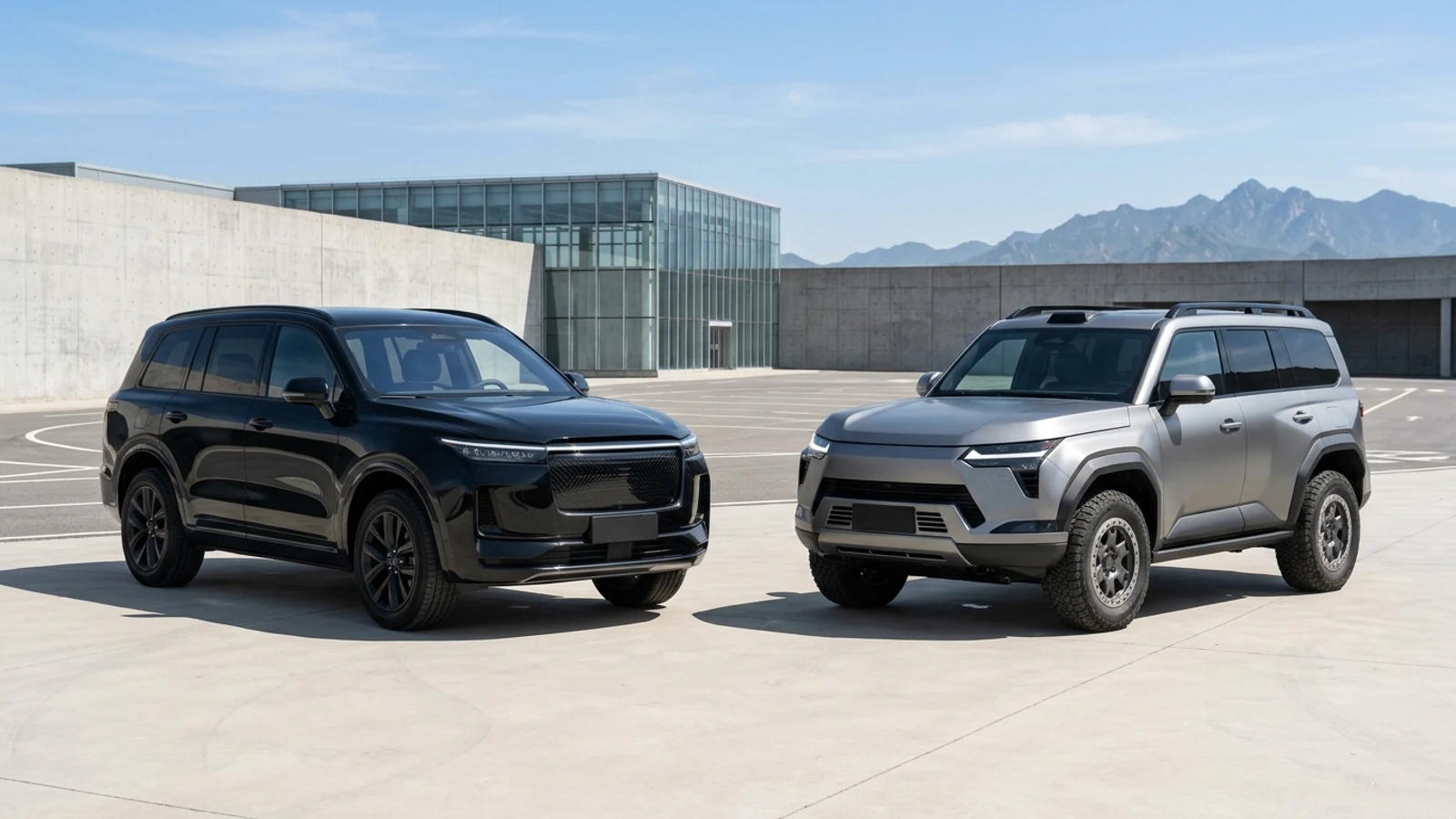
New Chinese Luxury Off-Road Entrants
The Chinese automotive market witnessed a significant development in the luxury off-road segment during the fall of 2026. Two major manufacturers, FAW and Dongfeng, introduced new large luxury off-road vehicles designed to compete with established global models like the Mercedes-Benz G-Class. These newcomers focus on integrating advanced electrification, significant power outputs, and modern interior comforts, while maintaining an aesthetic profile reminiscent of traditional, boxy off-road icons such as the Land Rover Defender and Toyota Land Cruiser. Source
FAW officially launched the Hongqi G919 on October 25, 2026. This vehicle utilizes a traditional body-on-frame architecture, prioritizing structural strength for demanding environments. The G919 is equipped with a four-motor electric drivetrain augmented by a 2.0-liter turbo gas range extender. According to manufacturer claims, this setup produces approximately 831 hp and 974 lb-ft of torque. The vehicle displays remarkable performance metrics, capable of reaching 62 mph in 4.5 seconds despite its substantial size and off-road orientation. Source
Technical specifications for the Hongqi G919 highlight its serious off-road ambitions. It features a ladder frame chassis with a claimed torsional rigidity of 9,500 Nm/°. To manage diverse terrain, the drivetrain includes independently controlled electric motors paired with mechanical differential locks at both the front and rear axles. This configuration allows for precise control of torque and rotational speed at each individual wheel, facilitating improved traction when tires encounter differing surface conditions. The vehicle also demonstrated utility capabilities by pulling a convoy of nine heavy trucks weighing 312 tonnes. Source
Regarding range and efficiency, the Hongqi G919 relies on its range-extender system to mitigate concerns associated with pure battery-electric vehicles in remote areas. The manufacturer claims an electric-only range of 174 miles, with a total combined range reaching 839 miles, based on the CLTC testing cycle. These capabilities are intended to provide peace of mind to drivers venturing into rugged environments. The G919 is offered in three distinct versions, with base pricing beginning at 349,800 yuan, approximately equivalent to $50,000. Source
Technological Focus and Market Positioning
Contrasting the traditional approach of the G919, the Dongfeng M Hero X-700 adopts a unibody construction. Introduced alongside the Hongqi model, the X-700 emphasizes everyday versatility, advanced electronics, and passenger comfort over traditional frame rigidity. The vehicle is slightly smaller than its Hongqi counterpart but features a marginally longer wheelbase of 115 inches. Dongfeng targets a different market segment with this model, offering four versions priced between 219,800 and 279,800 yuan, or roughly $41,000 at the high end. Source
The powertrain options for the M Hero X-700 vary by trim level. The entry-level X700 Pro uses a rear-wheel-drive range-extender system, while the three more expensive variants are equipped with all-wheel-drive plug-in hybrid powertrains. In its AWD configuration, the X700 produces 695 hp and 693 lb-ft of torque, enabling an acceleration to 62 mph in 4.93 seconds. While designed for suburban use, the vehicle retains off-road specifications, including 12.9 inches of ground clearance and a maximum wading depth of 31.5 inches. Source
Internal and driver assistance features distinguish the M Hero X-700. It is the first major collaboration between M Hero and Huawei, incorporating the Qiankun ADS5 driver assistance system, which utilizes a sensor suite of LiDAR and cameras to monitor surroundings. Inside, the vehicle features HarmonySpace 6 technology, highlighted by dual 15.6-inch screens and an augmented reality head-up display. Comfort amenities include zero-gravity front seats and a built-in refrigerator, alongside rear seats that fold flat to maximize cargo or sleeping capacity. Source
Suspension design in the X700 reflects its dual-purpose philosophy. Some versions utilize magnetorheological dampers, while the flagship Ultra variant adds dual-chamber air suspension capable of 150 mm of ride height adjustment. These features serve to balance road comfort with the requirements of wilderness travel. Compared to the G919, the X700 offers more aggressive approach and departure angles, rated at 37.5° and 38.3° respectively, compared to the 30° and 32° angles found on the Hongqi model. Source
The following table provides a comparison of key specifications and pricing for the two newly announced Chinese luxury SUVs. Source
| Feature | Hongqi G919 | Dongfeng M Hero X-700 |
|---|---|---|
| Chassis | Body-on-frame | Unibody |
| Wheelbase | 114.2 inches | 115 inches |
| Drivetrain | 4-Motor EV + Range Extender | RWD Extender / AWD PHEV |
| Power | ~831 hp | ~695 hp (AWD) |
| 0-62 mph | 4.5 seconds | 4.93 seconds |
| Approach Angle | 30° | 37.5° |
| Departure Angle | 32° | 38.3° |
| Starting Price | 349,800 Yuan | 219,800 Yuan |
The entry of these vehicles into the Chinese market presents a significant contrast to Western off-road models. While manufacturers like Mercedes-Benz, Toyota, and Land Rover rely on long-standing engineering legacies and established brand identities, these Chinese models are relatively new. This lack of a long-term ownership history makes it difficult to assess durability at this time. However, the ability of these OEMs to bring high-performance, technologically dense luxury SUVs to market at prices far lower than Western equivalents remains a notable development. Source
These Chinese vehicles are not intended for the North American market at this time, according to reports from CarBuzz. Comparison with established vehicles like the 2026 Mercedes-Benz G550, which has a starting price of $153,900 in the US, is therefore complex due to differing regulatory environments and market pricing structures. While they share the squared-off visual language of traditional off-roaders, their internal philosophies—ranging from frame-based ruggedness to unibody comfort—demonstrate the evolving and diverse strategies within the luxury SUV sector in China. Source

