
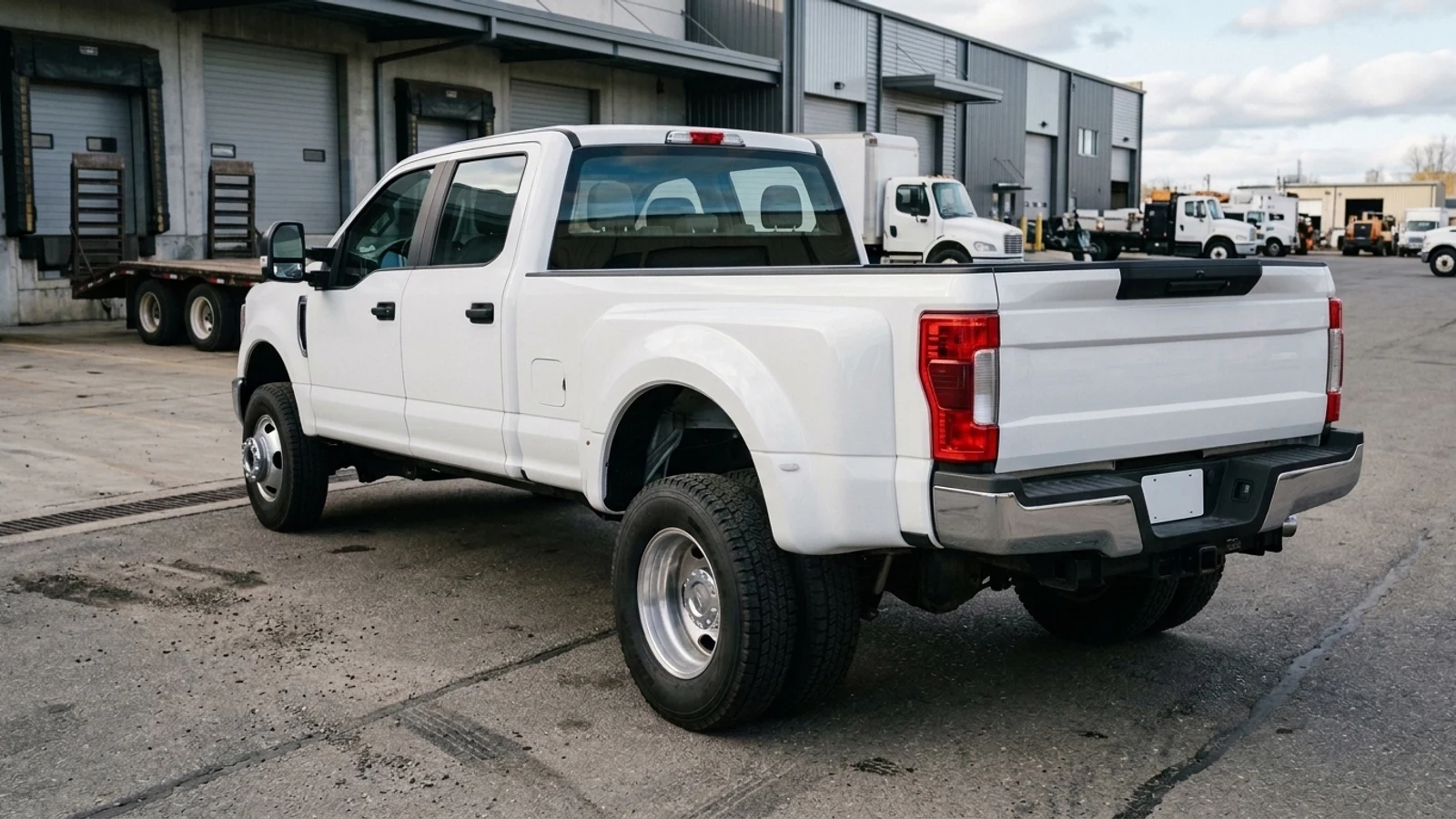
Understanding Dually Configurations
Dual rear wheels, often abbreviated as DRW in official vehicle specifications and build sheets, represent a specialized configuration for heavy-duty pickups and commercial vans. The setup places two wheels and tires on each side of the rear axle, distinguishing them from standard single-rear-wheel (SRW) vehicles. According to Car and Driver, automakers implement this design on heavy-duty platforms specifically to improve stability and distribute weight over a larger contact patch when hauling or towing heavy loads. Source
The operational principle behind DRW mirrors that of semi-trucks, where multiple tires support significant tonnage. In pickup trucks, the wider rear stance acts as an outrigger system, improving stability during turns and in high-crosswind conditions while towing fifth-wheel or gooseneck trailers. Conversely, full-size vans handle this differently by placing the extra tires inboard. While this avoids the need for flared rear fenders found on dually trucks, it results in the wheel wells encroaching further into the interior cabin space. Source
Selecting a DRW vehicle involves weighing increased capability against operational drawbacks. Owners must maintain six tires instead of four, increasing tire replacement costs. Furthermore, the increased vehicle width can complicate maneuvering in tight spaces, frequently leading to contact with stationary objects. Modern heavy-duty pickups utilize fiberglass for flared fenders, which are prone to cracking upon impact. However, for tasks like pulling heavy horse trailers or farm equipment, the stability provided by the extra rubber remains essential. Source
Regarding towing capacity, the advantage of a DRW configuration varies by vehicle type. Car and Driver reports that while SRW heavy-duty trucks may be rated for slightly over 20,000 pounds on a bumper hitch, the DRW version of the same truck can pull almost double that weight when using a gooseneck hitch. For vans, the benefit is primarily stability when near maximum payload, as adding rear wheels can sometimes decrease total towing capacity compared to comparable SRW models. Source
Market availability for DRW configurations is limited to specific segments. For pickup trucks with a bed, the option is available on the Ford F-Series Super Duty, Ram HD, Chevrolet Silverado HD, and GMC Sierra HD. In the cargo and passenger van segment, the options are restricted to the Ford Transit and Mercedes-Benz Sprinter. These setups are also frequently utilized on cutaway or chassis-cab versions to support aftermarket builds including box trucks, ambulances, and recreational vehicles. Source
Comparing Fleet Economics
Fleet managers often weigh vans against pickups based on the specific vocation of the fleet. Analysis of operating costs between 2016 and 2017 showed performance variances based on annual mileage. For applications under 24,000 annual miles, light-duty pickups were more economical, costing approximately 18 cents per mile compared to 20 cents for vans. In high-mileage bands of 80,001 to 100,000 miles, however, full-size vans demonstrated lower total costs across fuel, oil, tires, and repair categories. Source
Efficiency data highlights distinct advantages for different applications. Ford Motor Co. notes that while 20 percent of Transit van buyers replace trucks, 20 percent of van owners transition to pickups. Vans often provide a lower acquisition cost for equivalent capacity and improved fuel economy, with compact models like the ProMaster City achieving up to 28 miles per gallon highway. Conversely, Ford F-150 pickups remain the choice for fleets requiring consistent off-road travel or specialized heavy-duty trailering requirements. Source
Total cost of ownership is influenced by factors beyond purchase price. Upfitting costs, for instance, are generally lower for vans because they arrive with pre-selected shelving configurations. Additionally, cargo security and equipment longevity are cited as operational benefits of enclosed vans. For instance, Shackleford Enterprises reported that shifting from pickup trucks to vans prevented expensive equipment like air compressors and power tools from being exposed to elements, ultimately reducing repair and replacement frequency over time. Source
General Motors has provided historical context regarding alternative fuel options for fleet vehicles. In 2015, GM announced pricing for bi-fuel CNG versions of the Silverado and Sierra 2500HD and 3500HD, with a starting price of $9,500. Dedicated CNG full-size vans including the Chevrolet Express and GMC Savana were offered starting at $10,825 for a three-tank configuration. These vehicles were supported by a five-year, 100,000-mile warranty, reflecting a strategy to address fuel price disparities between gasoline and compressed natural gas. Source
Innovation in vehicle platforms continues to evolve through secondary market conversions. A demonstration vehicle dubbed the Badger, showcased at SEMA 2026, utilizes a purpose-built chassis housing electric running gear sourced from a Tesla Model 3. Designed to take various forms including a camper, van, and utility vehicle, the project highlights interest in repurposing modern EV components for bespoke commercial applications, as the CEO of Hoffman noted the impracticality of converting older vehicles with antiquated technology. Source
The conversion landscape for electric work vehicles includes diverse cost structures. Some builders achieve results for as little as $7,785 by utilizing secondhand parts, while others aim for market-ready products. The shift toward electrification is also visible in large-scale operations; Rivian reported success in the van segment, contributing significantly to its EV sales growth, while Republic Services integrated 250 electric refuse trucks into its fleet, emphasizing that scalability depends on operational integration. Source
Fleet operators are encouraged to utilize data-driven approaches to determine the appropriate energy source for specific jobs. Using platforms like Vincentric’s 'Dynamic Cost to Own' calculator allows managers to quantify variables such as insurance, depreciation, and resale value against fuel consumption. As industry groups like Catalyst Mobility—formerly CALSTART—and Forth combine to advance clean transportation, the integration of data from charging sessions and real-world duty cycles remains vital for mixed-energy fleet management. Source

