
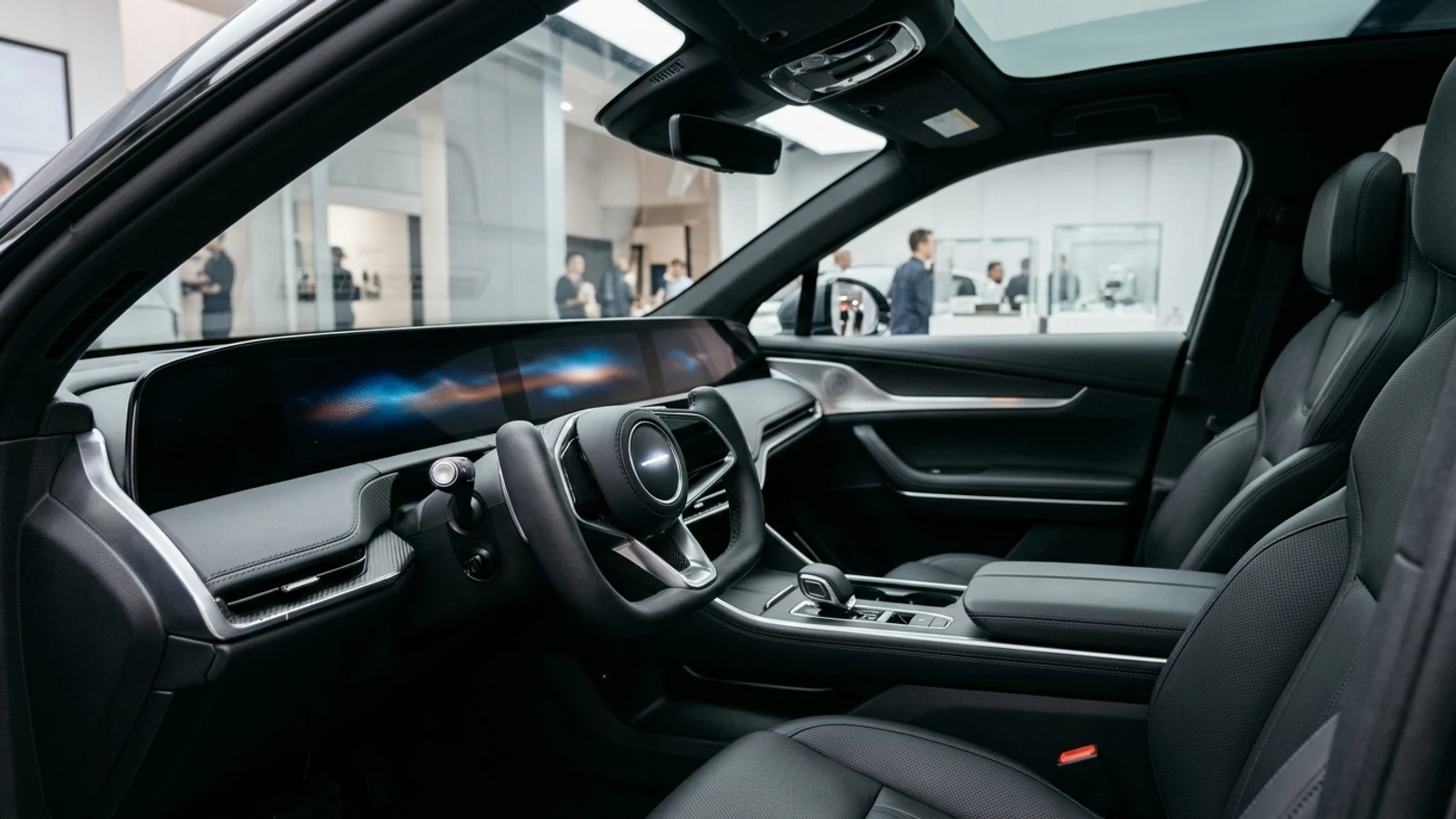
Production Launch and Technical Design
On November 19, 2026, BYD introduced a production vehicle equipped with a steering wheel designed to fold entirely into the dashboard. This feature is integrated into the Fang Cheng Bao Tai 9, an SUV available for purchase in China. According to information provided by Electrek, this development marks the first time a folding steering wheel has reached a mass production model, a concept that has been displayed by automotive manufacturers and suppliers for approximately a decade. Source
The operational core of this feature relies on a steer-by-wire system. Because there is no physical steering column linking the wheel to the front wheels, the steering component acts solely as an input device, allowing for flexible positioning. When the vehicle is parked, the steering wheel can rotate 180 degrees on a concealed hinge and retract into a storage compartment within the dashboard. This process takes roughly 10 seconds to complete, after which a panel seals the opening and a tray table extends. Source
Safety remains a priority during the stowage process. The airbag mechanism stays outside the compartment, ensuring it remains operational whether the steering wheel is in the deployed or stowed position. The manufacturer has rated the folding mechanism for 80,000 cycles, and the system is designed to activate exclusively while the vehicle is stationary. To complement the space, the driver's seat can recline to 165 degrees, effectively allowing the occupant to utilize the interior while charging or waiting. Source
When the steering wheel is in its active position, it functions as a standard D-shaped wheel featuring a full rim and physical buttons. This design choice stands in contrast to other manufacturers that have paired steer-by-wire implementations with yoke-style steering devices. General manager of Fang Cheng Bao, Xiong Tianbo, highlighted during the launch that while the industry has discussed folding steering technology since 2016, this implementation is the first to reach the consumer market. Source
To achieve this movement, BYD utilized motor technology similar to that developed for humanoid robotics. This application represents a first for the company within its vehicle lineup. The feasibility of this system is supported by Chinese regulations; as of July 1, 2026, the national standard for steering systems was updated. The revised rule removes the necessity for a physical mechanical link between the steering wheel and road wheels, provided that the system adheres to established redundancy and safety requirements. Source
Performance and Trim Specifications
The Tai 9 is positioned as the largest SUV within the Fang Cheng Bao portfolio. Measuring 5,270 mm in length with a 3,130 mm wheelbase, the vehicle accommodates six passengers in a 2+2+2 seating configuration. The SUV serves as the inaugural model for BYD’s new DMS hybrid platform. Performance is derived from a 1.5-liter turbo engine paired with front and rear electric motors, generating a combined 400 kW of power. The vehicle achieves a 0 to 100 km/h acceleration time of 4.8 seconds. Source
Energy storage is handled by a 66.48 kWh second-generation Blade battery, which is compatible with BYD’s flash charging technology. The manufacturer claims this battery enables an electric range of 310 km based on the WLTC cycle. Standard equipment on the model includes rear-wheel steering, a LiDAR system, and the proprietary God’s Eye B driver assistance suite. The vehicle is offered in three distinct trim levels for the Chinese market, with the folding steering wheel feature restricted to the top-tier trim. Source
The pricing structure for the Tai 9 ranges from 279,900 yuan to 329,900 yuan. Only the most expensive version includes the folding steering mechanism. This launch coincides with a period of growth for the Fang Cheng Bao brand, which recorded 43,872 vehicle sales in October 2026. While the smaller Tai 7 model has been exported, including to the United Kingdom, BYD has not provided information regarding potential international availability for the Tai 9 at this time. Source
The following table summarizes key performance and configuration metrics provided for the Tai 9. Source
| Feature | Specification |
|---|---|
| Length | 5,270 mm |
| Wheelbase | 3,130 mm |
| Power Output | 400 kW |
| Battery | 66.48 kWh Blade |
| 0-100 km/h | 4.8 seconds |
| Range (WLTC) | 310 km |
Market comparisons reflect the competitive nature of the Chinese automotive industry. Other entities, such as Nio, previously integrated steer-by-wire technology into the ET9 in December 2024. Meanwhile, brands like Tesla and Mercedes-Benz have explored steer-by-wire implementations in various international markets. However, the integration of a fully retractable steering wheel in a production vehicle has remained an elusive goal until the release of the Tai 9 by BYD’s sub-brand. Source
The deployment of this technology appears to align with the specific habits of EV buyers in China, where occupants often spend significant time inside parked vehicles. The interior design of the Tai 9 aims to provide a functional space that can transition between driving and lounging configurations. While the folding mechanism offers a distinct aesthetic and ergonomic change for the driver, the broader implications of this system suggest a wider trend toward steer-by-wire adoption in future vehicle architectures. Source

