
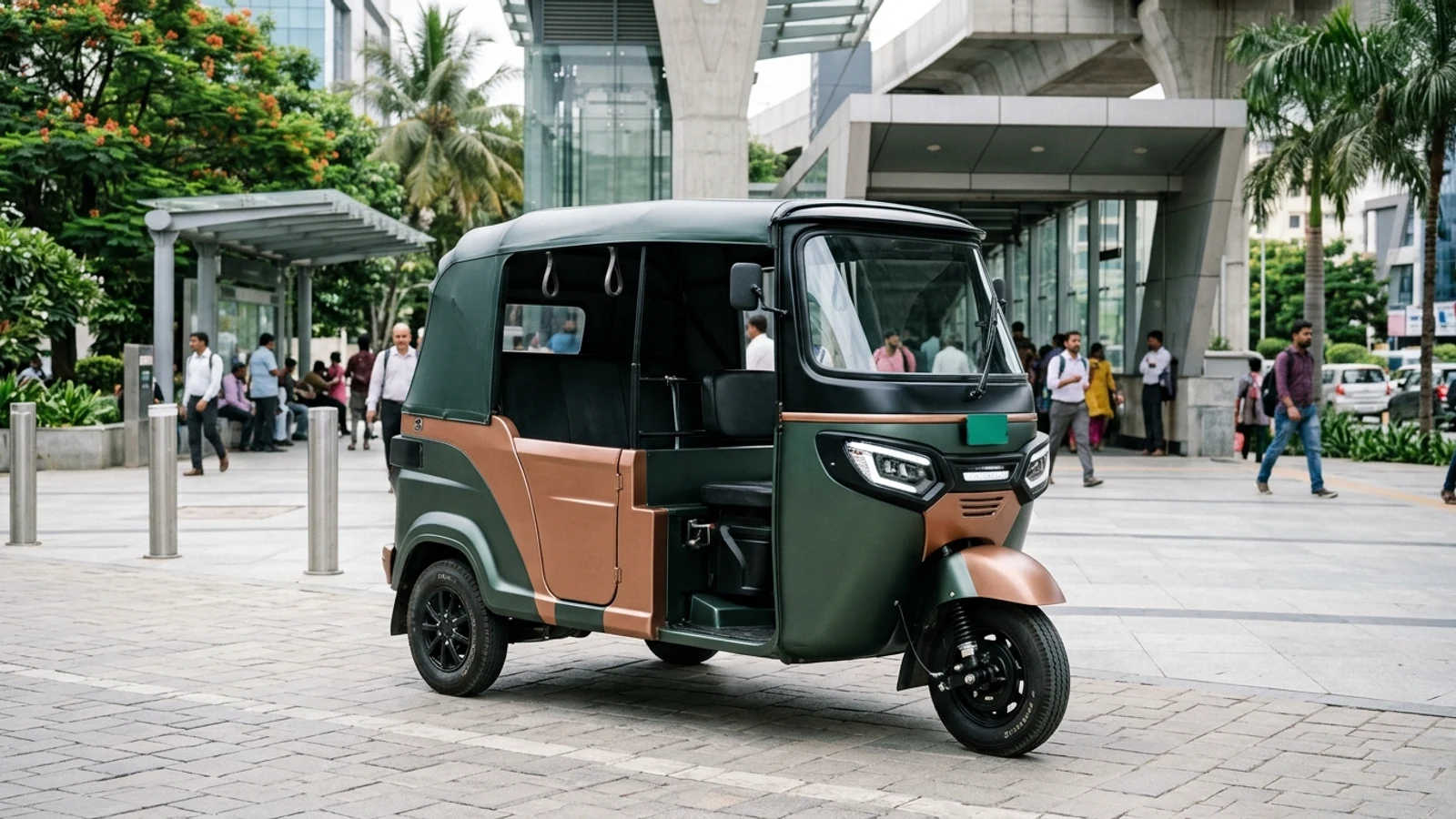
New Montra Electric Super Auto Launch Details
Montra Electric, a brand under the Murugappa Group, officially introduced a new variant of its Super Auto electric passenger three-wheeler on November 17, 2026. This launch, occurring in the Indian market, aims to establish a new category standard by focusing on passenger comfort, cabin space, and driver convenience. The company developed this vehicle after gathering feedback directly from drivers regarding their daily operational requirements, emphasizing a design philosophy that prioritizes the user experience and the specific challenges faced by drivers in Indian urban environments. Source
The Super Auto variant is built upon the company's existing platform and is priced at Rs 3.97 lakh (ex-showroom). The vehicle is powered by a 10kW permanent magnet motor capable of producing 60 Nm of peak torque. This configuration allows the vehicle to achieve a 32% gradeability, which is designed to enable navigation on steep inclines with increased confidence for the operator. The combination of motor performance and structural design aims to make the vehicle suitable for rigorous daily use in varied traffic conditions. Source
Equipped with a 10.6 kWh battery pack, the Super Auto offers a manufacturer-claimed typical driving range exceeding 180 km on a single charge. To maintain uptime, the vehicle utilizes an off-board 40A charger, which is reported to fully charge the battery from an empty state in 5 hours and 30 minutes. This charging capacity is a core component of the brand's effort to enhance the dependability of electric last-mile transportation for professional fleet operators and individual drivers alike. Source
The new variant includes several features aimed at improving daily operation, such as regenerative braking and three selectable drive modes: Eco, Drive, and Power. Additionally, it features reverse and park assist functions to assist in tight spaces. For safety and convenience on slopes, the vehicle includes a hill-hold assist system, a feature often noted as car-like in this vehicle segment, designed to prevent the vehicle from rolling backward when stationary on an incline. Source
Regarding comfort and utility, the vehicle is equipped with a double-fork coil-spring front suspension utilizing hydraulic shock absorbers. It rides on 120/80 R12 radial tubeless tyres. The interior and exterior design include integrated large LED lighting for visibility, a cabin light for passenger comfort, and a rear luggage compartment featuring an openable tailgate. These features are intended to accommodate both passengers and luggage requirements for varied last-mile transport tasks across India. Source
Connectivity and support play a major role in the new offering, with Montra Electric providing access to the One Montra application. While the application is available to owners, the company has not yet detailed specific connected functionalities or data integration features within its public announcement. The company supports its growing fleet through a 3S (Sales, Service, and Spares) network that now encompasses over 100 outlets across the country, aiming to provide accessible support for the vehicles on the road. Source
The new Super Auto is available in five different color options. According to Deependra Sharma, CEO of e3Wheeler at Montra Electric (TI Clean Mobility Pvt. Ltd.), the design and feature set were specifically chosen to ensure electric mobility remains profitable and dependable for the driver community. The company emphasizes a culture of respect, or 'Izzat,' for the driver community, framing this product launch as a commitment to the aspirations and hard work of the individuals who operate these vehicles daily. Source
Market Expansion and Industry Developments
Separately in the EV sector, Tesla has expanded its Cybercab robotaxi service to Dallas, marking the second city to receive the two-seat vehicle after Austin. Official activity suggests the company began public rides in Dallas as of November 19, 2026, following several weeks of anticipation. The Cybercab, a vehicle characterized by the absence of pedals or a steering wheel, relies exclusively on Tesla's unsupervised full self-driving software and represents a shift toward dedicated autonomous robotaxi fleets. Source
Tesla's expansion in the autonomous space continues with a significant increase in vehicle registrations. On November 17, 2026, the company added a record 200 Cybercabs to its Texas fleet in a single day, as recorded by the Texas Department of Motor Vehicles. This influx brought the total number of registered Cybercabs in Texas to 773 units. By surpassing Waymo's fleet size in the state, Tesla now holds 1,507 registered vehicles for driverless operations, with the Cybercab fleet comprising over 51% of that total. Source
Research into EV efficiency is also evolving, with technology like 'GenShock' exploring active damping to improve energy recovery. By mounting an electro-hydraulic device to the outside of each shock absorber, the system regulates oil flow and converts kinetic energy from vehicle movement—such as cornering, acceleration, or braking—into electricity. This electricity is then returned to the vehicle's power supply, demonstrating a potential method for extending vehicle efficiency through energy harvesting from road vibrations. Source
Finally, Tesla's production environment continues to be a central focus of industry output. Gigafactory Shanghai, noted as the most productive facility for the company, shipped 810,889 Model 3 and Model Y vehicles during the first ten months of 2026, a 21.4% increase from the previous year. Most of this volume is intended for international export rather than domestic Chinese consumption. This high output and the ongoing expansion of autonomous services underscore the dual focus on manufacturing scale and software-led fleet deployment. Source
In summary, the automotive sector is seeing concurrent advancements in both high-tech autonomous fleet management in the United States and pragmatic, driver-focused electric three-wheeler development in India. While Montra Electric focuses on improving the daily livelihood and utility for the commercial segment through accessible pricing and functional upgrades, companies like Tesla are scaling autonomous software deployments. Both tracks highlight how EV technology is being adapted to solve distinct market-specific operational needs. Source

