
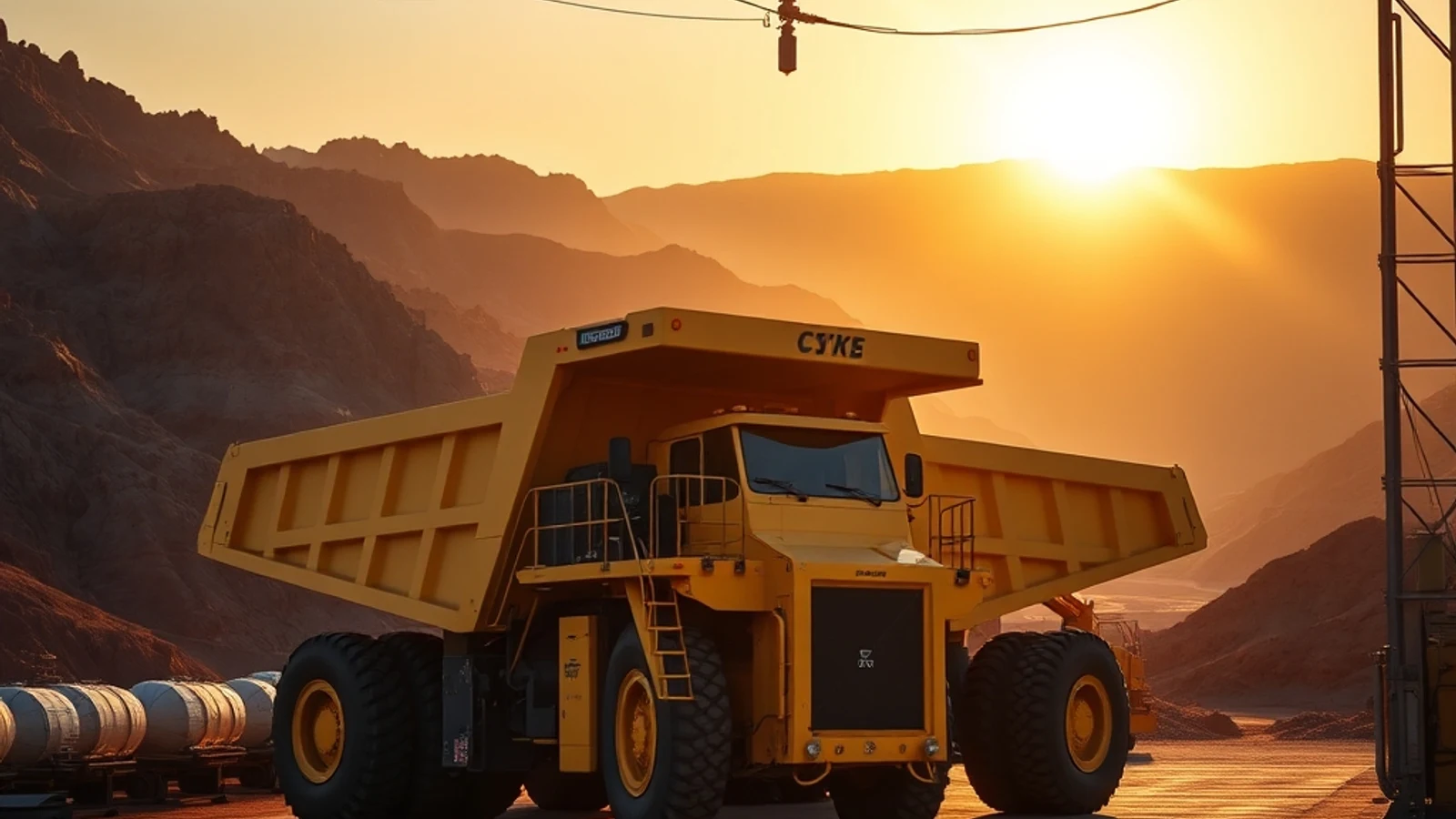
The mining industry is seeing a transition toward heavy-duty battery-electric vehicles as manufacturers aim to resolve the issue of downtime. Inner Mongolia North Hauler Joint Stock Co., Ltd., also known as NHL, recently announced its NTE240E ultra-class haul truck. This vehicle features a 240-ton payload capacity and an onboard battery system reaching up to 4,100 kWh. The company has integrated a world-first double-gun Megawatt Charging System, allowing the battery to charge from 20% to 90% in under one hour. Source
The NTE240E utilizes a dynamic power reception system that incorporates overhead current collectors. This technology provides electricity directly to the truck while navigating loaded mine roads, which then enables the vehicle to capture energy through regenerative braking during downhill travel. According to NHL, these combined systems result in a 15% increase in energy efficiency compared to the industry average for ultra-class trucks, potentially cutting operating costs by over 60% compared to traditional diesel-electric models. Source
In a separate development, LGMG demonstrated its RTE156 electric mining truck at an event in Ordos, Inner Mongolia. This model uses a 3C fast-charging architecture designed to operate in extreme temperatures ranging from -30°C to 50°C. LGMG reported that its charging system can deliver nearly 800kWh in 18 minutes under extreme conditions, achieving a peak power of approximately 3.6MW. This demonstration was part of the company's first Global Mining Customer Service Festival held from 9-11 October. Source
LGMG is moving beyond individual vehicle performance by developing an integrated system that combines solar power generation, stationary battery storage, and charging infrastructure. The system is managed by a central platform that coordinates fleet dispatch and power distribution, which the manufacturer states can reduce reliance on diesel-generated electricity in remote mines where grid capacity is restricted. This approach is intended to synchronize charging demand with available renewable energy supply for high-utilization mining sites. Source
The Megawatt Charging System serves as a common standard across these innovations, designed to handle power levels exceeding 1,000 amps. Scania notes that this standard, supported by liquid-cooled cables and connectors, is essential for enabling heavy-duty BEVs to operate on long-distance routes. Unlike the current CCS2 standard, which is typically used for depot-based charging, the MCS is specifically engineered to provide rapid en-route power replenishment that fits into mandatory driver rest periods. Source
For long-haul logistics, MCS technology allows a truck to charge from 20% to 80% in less than 30 minutes. This aligns with standard EU driving regulations, where a operator takes a 45-minute rest after 4.5 hours of driving. Scania states that this integration enables electric trucks to maintain a work rhythm comparable to diesel vehicles. Furthermore, the efficiency gains from rapid charging allow for smaller battery pack requirements, which reduces vehicle weight and increases total payload capacity. Source
Infrastructure rollout remains a critical factor for the adoption of megawatt-class charging. Scania expects its own battery-electric trucks to be available with MCS starting in mid-2026. Simultaneously, public MCS corridors are planned along major European routes for 2025. Through initiatives such as Milence, the company and its partners are targeting the establishment of 1,700 high-performance charging points across Europe by 2027 to ensure that charging capacity keeps pace with fleet requirements. Source
The technical specifications and performance targets for these electric mining and transport solutions vary by application and manufacturer architecture. Below is a summary of the reported charging capabilities and performance benchmarks for the vehicles and systems mentioned in the primary and supporting reports. Source
| Manufacturer/System | Charging Benchmark | Performance Detail |
|---|---|---|
| NHL NTE240E | 20-90% in < 60 min | 4,100 kWh battery capacity |
| LGMG RTE156 | 20-90% in 23 min | 3.6MW peak power |
| MCS Standard | 20-80% in < 30 min | Up to 3.75MW potential |
Operational strategy for these vehicles prioritizes the reduction of hardware maintenance costs by removing traditional engine-related components like generators. In mining environments, the combination of intelligent fleet dispatch and optimized charging schedules is becoming a standard feature to improve equipment utilization. Both NHL and LGMG emphasize the integration of these trucks into broader energy ecosystems that include site-specific renewable generation, which helps stabilize grid demand during high-power charging events. Source
The transition to these technologies represents a shift toward more consistent uptime for industrial operations. While MCS is intended for rapid en-route charging, CCS2 remains a core component for depot-based charging scenarios where longer turnaround times are acceptable. Manufacturers are increasingly offering vehicles capable of utilizing both systems, ensuring flexibility for operators who must navigate varying infrastructure availability between deep-mine sites and public motorway networks. Source
Ultimately, the adoption of these electrified haulage solutions depends on the synchronization of vehicle design, charging infrastructure, and site energy management. As Scania and other heavy-equipment manufacturers continue to deploy MCS-ready hardware, the ability to match charging power with duty cycles will remain the primary focus. Mining companies are currently evaluating these technologies to determine their long-term economic impact, particularly regarding the reduction of annual carbon emissions and maintenance requirements. Source

