
Network Expansion and Infrastructure Targets
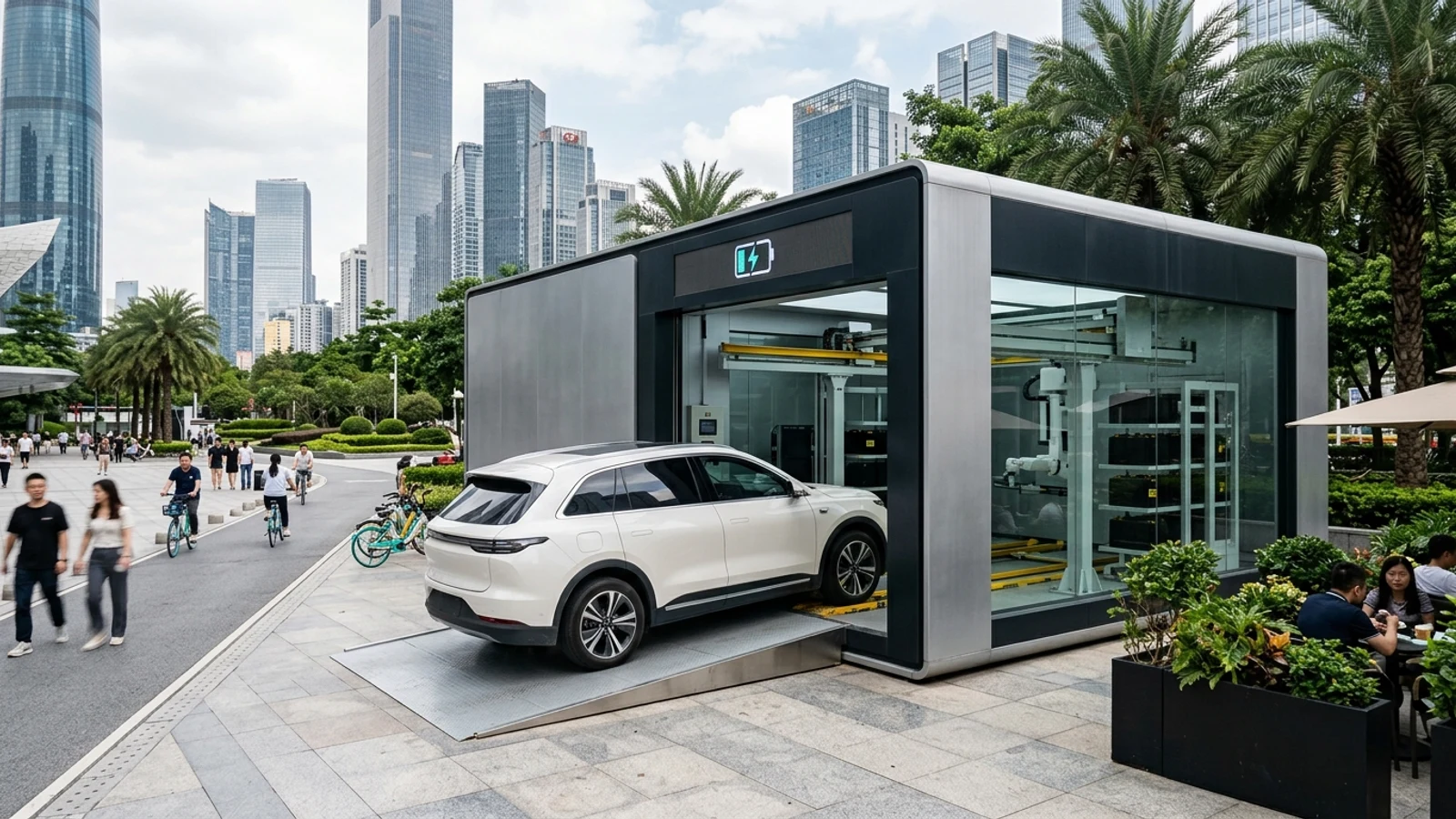
NIO officially unveiled a major expansion strategy for its energy division, NIO Power, during the company's annual technology conference, NIO IN 2026. Held in Guangzhou to coincide with the automaker's 12th anniversary, the event detailed plans to operate more than 10,000 battery swap stations by 2030. This initiative aims to more than double the company's current swap network within China. Additionally, the firm aims to manage a portfolio of battery packs valued at over RMB 350 billion, equivalent to approximately $52 billion, within the next four years. Source
The company reported that as of November 11, it maintained a network of 4,252 battery swap stations in China, supplemented by 5,584 charging stations. Reaching the 10,000-station milestone by 2030 will require the installation of roughly 1,400 new units annually over the next four years. This pace represents a significant acceleration compared to the 679 stations deployed in 2024 and the 681 added in 2025. Given that only about 500 stations have been added since February 2026, reaching the current annual goal of 1,000 remains a challenging prospect. Source
Past performance metrics provide necessary context for these projections. In 2021, NIO committed to a goal of 4,000 global swap stations by the end of 2025, with 1,000 of those located outside China. However, by February 2026, the company had established approximately 3,700 stations, with the vast majority remaining within the domestic Chinese market. This previous shortfall suggests that the newly announced 2030 targets serve as institutional ambitions rather than guaranteed deployment schedules, reflecting the complexity of scaling capital-intensive infrastructure. Source
Energy delivery remains a primary focus for the network, with NIO Power aiming to deliver over 10 billion kWh of energy annually through its combined charging and swapping ecosystem by 2030. As of February 2026, the total energy delivered by the network since its inception eight years prior stood at 5.28 billion kWh. To meet the 2030 goal, the annual output will need to nearly double current performance levels, although this figure aggregates output from both dedicated swap stations and proprietary charging hardware. Source
Operational Strategy and Hardware Advancements
The Battery-as-a-Service (BaaS) model remains integral to the company's operational strategy, as it necessitates the management of a massive fleet of battery packs. To mitigate the financial burden, NIO has increasingly moved capital costs off its own balance sheets. Through strategic partnerships, such as a recent agreement with Zhongan Energy to deploy 500 stations, third-party partners now own the hardware while NIO maintains operational and technical control. To date, the company has co-built more than 900 swap stations via these collaborative agreements. Source
Hardware iterations are supporting this expansion, particularly with the introduction of the fifth-generation swap station in August 2026. These stations are the first to accommodate all three of the company’s automotive brands. This compatibility is particularly important for the compact 'firefly' model, which was previously unable to utilize legacy swap infrastructure due to its smaller wheelbase. CFO Stanley Qu, who oversees NIO Power, highlighted the division's use of AI agents to optimize battery value, site operations, and overall energy efficiency. Source
Beyond infrastructure, the company is prioritizing software development through its 'AI-fication' initiative. The new NIO WorldModel (NWM) 3.0 driver-assist platform is scheduled to begin rolling out in December 2026 to vehicles equipped with Banyan, Cedar, Cedar S, and Coconut+ systems, subject to regulatory approvals. NIO claims that this iteration requires 40% fewer driver interventions than its predecessor. Additionally, the manufacturer reported a 54% reduction in vehicle control latency and a 78% decrease in chassis control latency. Source
In-car functionality is also undergoing a significant update with the unveiling of NOMI Intelligence 4.0. This revision reconfigures the digital assistant to operate using an AI agent framework capable of autonomous task planning rather than relying on predefined commands. The initial release, designated as Cedar 2.0.0, is slated for filing in early December 2026. Deployment for vehicles utilizing Cedar S and Banyan systems is expected in the second quarter of 2027, with subsequent availability planned for ONVO branded models. Source

